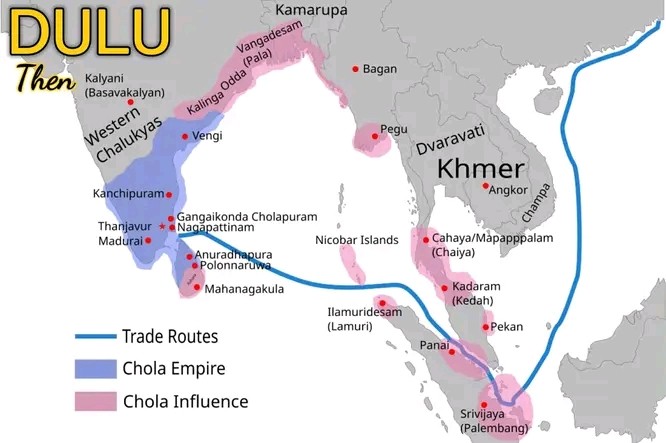
THE PEOPLE OF THE WEST COAST OF THE PENINSULA, SUCH AS KEDAH, PERAK, AND SELANGOR, ARE OF TAMIL DESCENT
By: Hamly Hadi
(History Observer)
Therefore, it is not surprising that the physical appearance of people on the west coast of the peninsula, such as Kedah, Perak, Negeri Sembilan, and Selangor, tends to resemble Tamils, as they indeed inherit Tamil ancestry.
Tamils arrived in the Peninsula (Malaysia/Indonesia) in two main waves: first, as traders and migrants starting in the 11th century (the Chola Empire), establishing early settlements in coastal areas; and second, during the British colonial era (19th century), they were brought in en masse as contract laborers on tobacco, rubber, and tea plantations, forming large plantation communities that became the forerunners of modern Tamil communities in Malaysia and North Sumatra, Indonesia.
1. Early Waves of Arrival (Before the Colonial Era)
Maritime Traders: Tamils have been prominent maritime traders in Asia since the heyday of the Chola Empire in South India (11th century).
Relationship with Srivijaya: Historical evidence from Chinese records indicates that the Chola Empire controlled the Malay (Srivijaya) region around 1025-1079 CE, indicating strong political and economic interactions between the Tamils and the Indonesian archipelago.
Early Settlement: Some of these traders remained, such as the Muslim Tamil and Chetty communities of Malacca, which are remnants of this early migration.
2. Colonial Waves of Arrival (19th and 20th Centuries)
Labor Needs: The Dutch (in Sumatra) and the British (in the Malay Peninsula) required large numbers of laborers for their large plantations (tobacco, coffee, tea, and rubber) because the local population was reluctant to perform heavy manual labor.
Indentured Coolie System: Tamils from South India were imported in large numbers via Penang and Singapore as indentured coolies.
Distribution: They spread throughout the plantation areas, forming communities in plantations and towns, and bringing with them their culture and religion (Hinduism, Christianity, Islam).
Impact and Sustainability
This arrival established significant Tamil populations in Malaysia and Singapore, as well as a Tamil community in North Sumatra (Kampung Madras/Little India).
They managed to maintain the Tamil language and culture despite close interaction with other Malay and Indian ethnicities. ***
Banjarmasin, South Kalimantan, December 27, 2025
——-