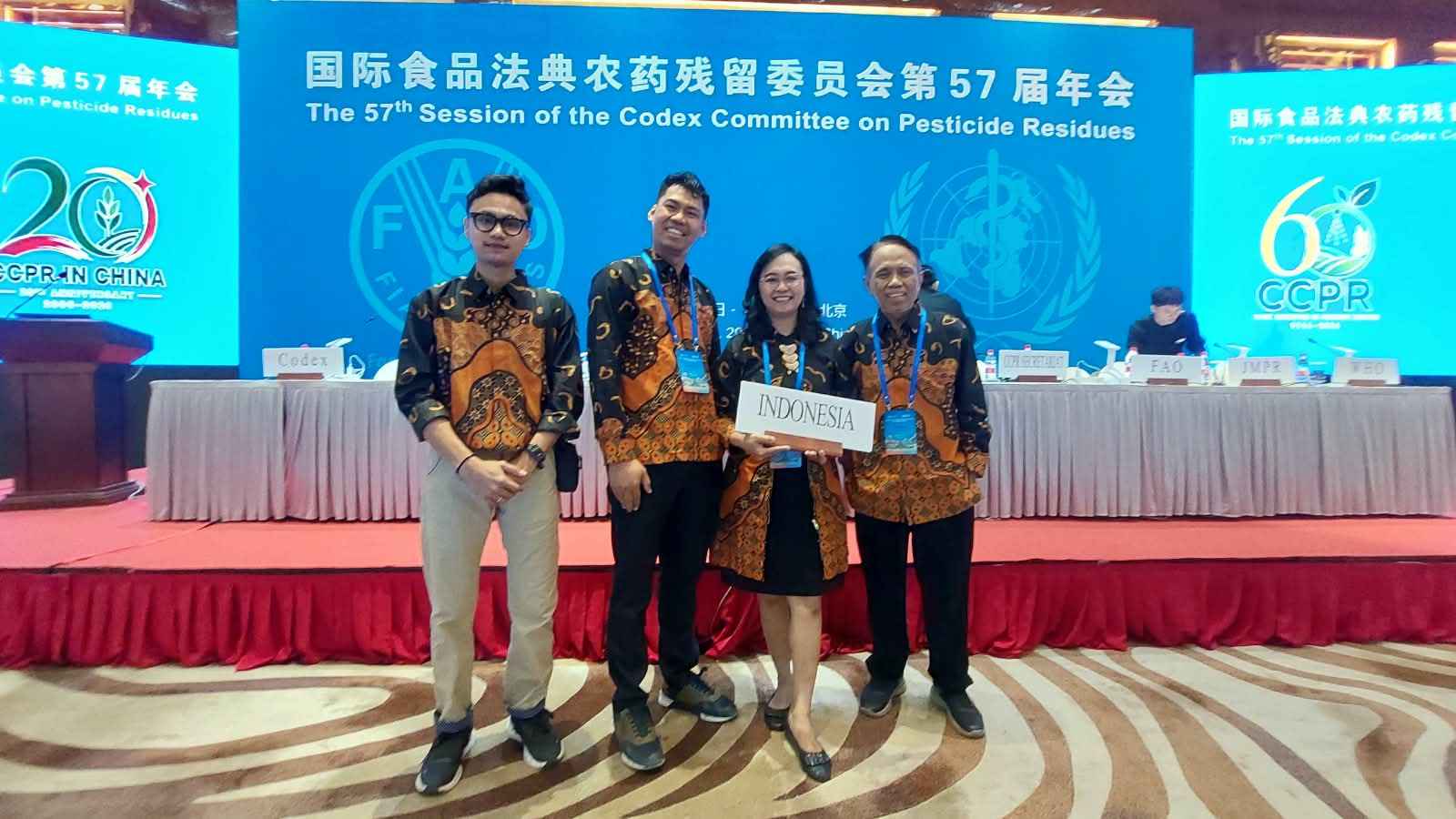
UNNES’s CoSpice Center (PUI-PT) Supports Indonesia’s Food Safety Diplomacy at the Global CCPR57 Forum in Beijing
BEIJING – JayaNews.com – Indonesia is strengthening its diplomacy regarding global food safety standards through its participation in the 57th Session of the Codex Committee on Pesticide Residues (CCPR57) in Beijing, China, held from September 7–12, 2026.
This forum, operating under the Joint FAO/WHO Food Standards Programme, serves as a strategic venue for discussing pesticide residue standards in food and feed—specifically Maximum Residue Limits (MRLs)—which directly impact food safety, consumer protection, and the marketability of agricultural products internationally.
The Indonesian delegation was led by Prof. Dr. Joni Munarso from BRIN, serving as the Head of Delegation. Also participating were Dr. Eka Yuli Astuti, Head of the Center of Excellence for Post-harvest Coffee and Spices (CoSpice) at Universitas Negeri Semarang (UNNES), and Sigit Ismaryanto, S.E., representing the business sector and the Indonesian Spice Council.
This collaboration—involving research institutions, universities, business players, and commodity organizations—demonstrates Indonesia’s increasingly integrated approach to standards diplomacy.
CCPR Marks 60 Years; Pesticide Standards a Strategic Issue
CCPR57 coincides with the 60th anniversary of the CCPR, marking six decades since its inaugural session in the Netherlands in 1966. The session was chaired by Duan Lifang of China. China’s Vice Minister of Agriculture, Zhang Xingwang, and the Chairperson of the Codex Alimentarius Commission, Allan Azegele, emphasized the importance of harmonizing science-based standards.
A key agenda item was the compilation of a priority list of pesticide compounds to be evaluated by the JMPR. Codex Secretary Sarah Cahill emphasized that MRLs provide certainty for producers and regulators while simultaneously facilitating trade. Indonesia’s Position on MRLs
In its official comments, Indonesia supports the advancement of Maximum Residue Limits (MRLs) for Bifenthrin (178), Pyriproxyfen (200), Boscalid (221), Flubendiamide (242), Broflanilide (326), and Trifloxystrobin (213). This stance considers the trade of import-export commodities that currently lack established MRL values in either the Indonesian National Standard (SNI) or National Food Agency regulations.
Focus on Malathion and Methyl Bromide
Malathion (049) emerged as a critical issue. The forum ultimately agreed to retain Codex MRLs (CXLs) for blueberries, the cherry group, cottonseed, maize, sorghum grain, and wheat based on the “four-year rule,” while revoking other CXLs.
Regarding Methyl Bromide (052), Indonesia expressed its disagreement with the revocation of all CXLs, noting that the substance remains registered and in use within the country. This position aligns with the CCPR57 decision to maintain the MRL at Step 4 pending a periodic review by the Joint FAO/WHO Meeting on Pesticide Residues (JMPR), given the substance’s importance for quarantine and pre-shipment (QPS) purposes.
CoSpice UNNES Champions Coffee and Spices
CoSpice UNNES serves as a bridge connecting post-harvest research, standardization, and the interests of the national coffee and spice sectors. A significant development involves exploring the inclusion of Isoprocarb and 2,4-Dichlorophenoxyacetic acid for coffee in the 2028 priority list.
“For the coffee industry, residue standards are not merely a matter of safety; they also determine market acceptance for exports. Indonesia requires a robust, commodity- and region-specific residue database,” the delegation noted.
The involvement of business stakeholders through the Indonesian Spice Council complements the academic perspective, as changes to MRLs directly impact market access and supply chains.
From Standard Taker to Standard Influencer
CCPR57 emphasized that the future of food standardization hinges on the quality of scientific data, database modernization, and the strengthening of scientific advice provided by the FAO and WHO. This participation sends a message that the competitiveness of Indonesian coffee and spices relies on more than just superior flavor and aroma; they must also meet global food safety requirements. The post-Beijing agenda focuses on strengthening residue research and laboratory capabilities, harmonizing the Indonesian National Standard (SNI) with Codex standards, and building the capacity of farmers and exporters.
Indonesia’s strategic goal is no longer merely to be a “standard taker,” but to evolve into a “standard influencer” within the global food safety governance framework.**
Nur Fateah
——-