When Qurbani Meat Is No Longer Wrapped in Plastic: A Lesson in Ecological Awareness from Al Zaytun
By Ali Aminulloh
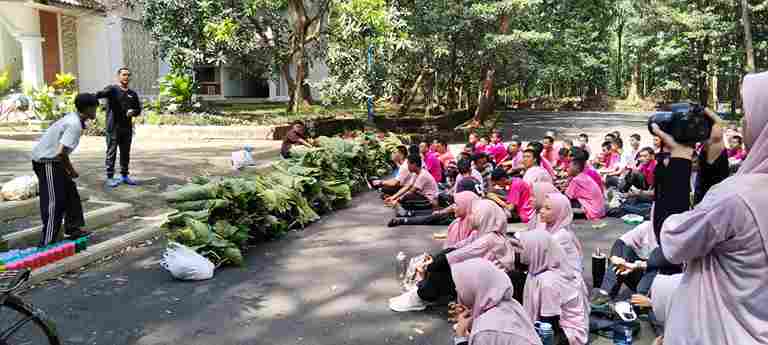
The aroma of wet earth mixed with the breeze of teak leaves enveloped the morning of Eid al-Adha at Ma’had Al Zaytun. Amidst the echoes of the takbir (Islamic call to prayer) that shook the Islamic boarding school sky, hundreds of students were busy collecting and arranging large teak leaves. Not for animal feed, nor for handicrafts. These leaves would become wrappings for the qurbani meat.
While many places still rely on single-use plastic bags, Al Zaytun chose to return to nature.
Simple indeed. But from those teak leaves, a powerful message about civilization, faith, and human ecological awareness is born.
Every day from the 10th of Dhul Hijjah until the days of tashrik (the 11th-13th of Dhul Hijjah), Muslims around the world celebrate the ritual of qurban (sacrifice). For a mudhahhi, or someone who makes a qurban, this ritual is not simply the slaughter of an animal, but rather a demonstration of devotion to Allah SWT. As He says in the Qur’an:
“The flesh of camels and their blood will never reach Allah, but what reaches Him is your piety.”
(QS. Al-Hajj: 37)
The spirit of sacrifice is also emphasized in the words of Allah SWT:
“Indeed, We have given you many blessings. So establish prayer for your Lord and offer sacrifice.”
(Surah Al-Kautsar: 1–2)
The Prophet (peace and blessings of Allaah be upon him) said, “The sacrifice of the sacrifice is a time of social joy. For those who receive the sacrificial meat, this holiday is a moment of social joy. Many families can enjoy special dishes they might rarely experience on ordinary days. Therefore, Eid al-Adha is a day of gratitude and joy throughout the Islamic world.
In Saudi Arabia, as millions of pilgrims perform the culmination of the Hajj pilgrimage at Arafah, the spiritual echo of sacrifice also reverberates throughout the world. And in an educational complex in Indramayu, these values are translated not only into worship rituals, but also into ecological awareness.
The qurban tradition at Ma’had Al Zaytun has been practiced since its inception in 1999. However, one unique aspect always attracts attention: the wrapping of sacrificial meat using teak leaves.
Amidst a culture of increasingly massive plastic consumption, this step seems simple, but is actually deeply philosophical.
Millions of teak trees grow around the Al Zaytun campus. As Eid al-Adha approaches, students work together to collect large, strong teak leaves to use as natural wrapping for sacrificial meat. This tradition is not simply a preservation of an ancient practice, but a form of civilizational education.
The use of teak leaves has many benefits. Teak leaves are natural, biodegradable, and do not pollute the environment like plastic. They are also strong enough to hold meat and contain natural compounds that help maintain the freshness of food for a certain period. Furthermore, the distinctive aroma of teak leaves creates a traditional atmosphere that fosters a closeness to nature.
Furthermore, the use of teak leaves reduces plastic waste, which typically increases drastically during Eid al-Adha. Imagine if thousands of single-use plastic bags were simply thrown away after the distribution of the sacrificial animal. This waste would end up in rivers, soil, or oceans, becoming pollution that damages the human ecosystem.
This demonstrates that sacrifice is not only a vertical act of worship between humans and God, but also has a horizontal dimension to nature and life.
This simple practice at Al Zaytun is in fact aligned with the trilogy of awareness initiated by Shaykh Abdussalam Rasyidi Panji Gumilang: philosophical awareness, ecological awareness, and child awareness.
Philosophical awareness teaches that every act of worship must be understood in its deeper meaning, not merely a symbolic routine. Sacrifice is not just about slaughtering an animal, but also about slaughtering human egoism and greed.
Ecological awareness reminds us that humans are caliphs on earth, tasked with maintaining the balance of nature. Therefore, worship should not result in environmental damage. The spirit of “rahmatan lil ‘alamin” (blessing for the universe) must be reflected in concrete actions, including simple things like choosing environmentally friendly packaging for sacrificial meat.
Meanwhile, the children’s awareness is evident in the students’ involvement in the entire qurban process. They learn to work together, love the environment, respect traditions, and understand that religion is not only taught through lectures, but through everyday practice.
Amidst the global environmental crisis, big changes often begin with small steps. From a single teak leaf, Al Zaytun is teaching that worship can go hand in hand with environmental conservation.
And perhaps, in the future, the world will need not only religious people, but also people who understand that protecting the earth is part of their responsibility there is the truth itself.**
Indramayu, May 26, 2026
——