NDERES POETRY, THE INNER ACT OF BURYING UP THE WOUNDS OF CIVILIZATION: A POETRY PRESENTATION, JAVANESE POETRY DERMAYU BY SUPALI KASIM
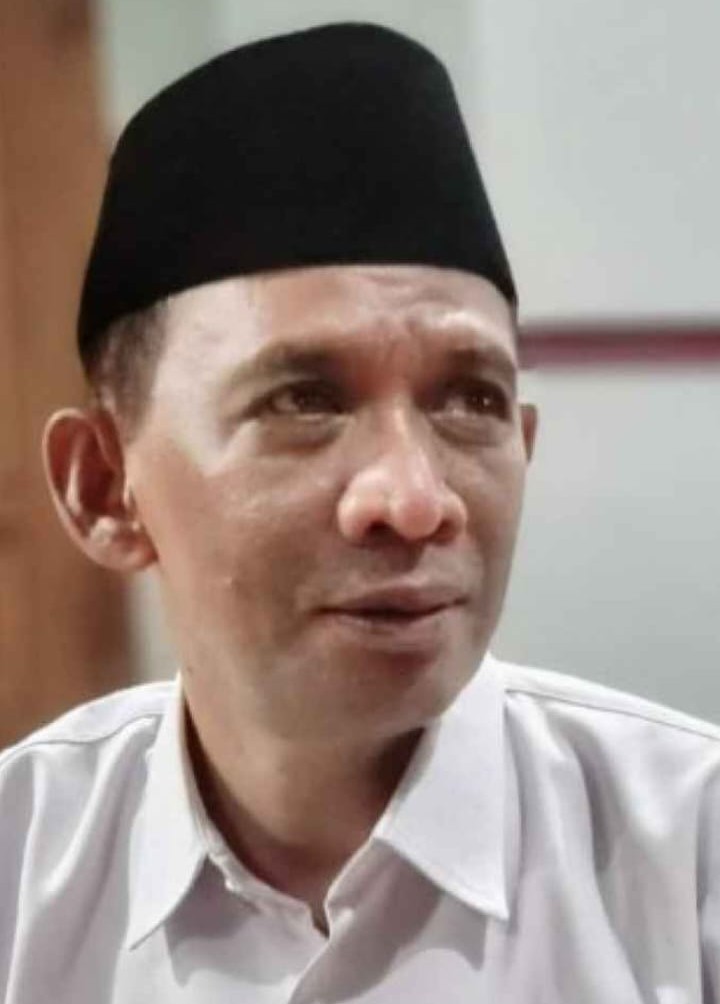
By: H. Adlan Daie
General Secretary of the Indonesian Ulema Council (MUI) of Indramayu Regency/Chairman of the Indramayu Literature Forum (FSI-1994).
Poetry is an “inner act,” impossible to summarize in a single definition. Understanding poetry solely from a scientific perspective and literary standards is a form of “simplification” and oversimplification—it only touches the “outer shell” of poetry.
Poetry is difficult to theorize about its birth process except by approaching the choice of diction, expression patterns, and categorization of form, for example, lyric poetry (Goenawan Muhammad), pamphlet poetry (Rendra), “mbling” poetry (Emha Ainun Nadjib), etc.
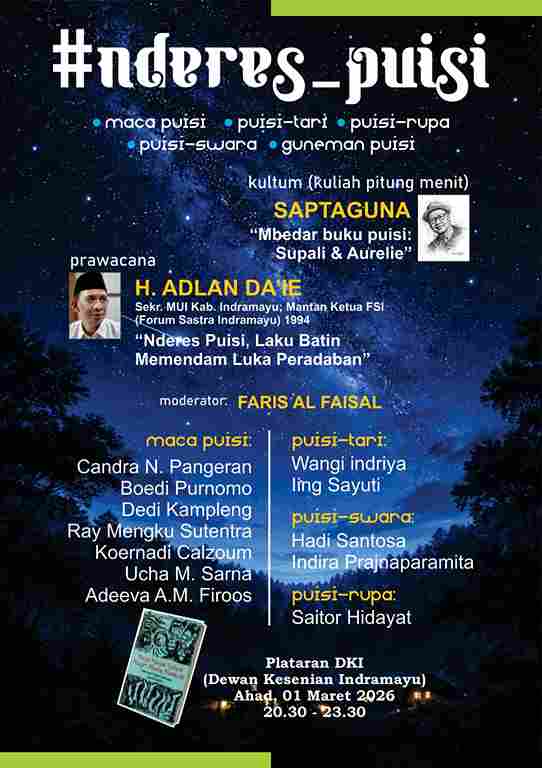
That’s why, frankly, the author finds it difficult to reconstruct the “inner practice” of the birth of Dermayu Supali Kasim’s book of Javanese poems, “Desa Mawa Lelara, Nagri Mawa Memedi” (2026), launched tonight at a cultural reception in the courtyard of the DKI Indramayu Arts Council (March 1, 2026).
Let us use the spirit of “Iqro,” the first verse revealed in the month of Ramadan, as a momentum to revive the spirit of “nderes,” the depth of “insight” in Supali Kasim’s poems, despite the author’s limitations in mastering the depth of meaning of Dermayu’s cultural diction in his poems.
Tonight, we gather not to dismantle the “inner practice” of Supali Kasim’s Javanese Dermayu poetry, except for “Nderes” with all its various forms of interpretive articulation: “maca” poetry, “dance poetry,” “visual poetry,” “sound poetry,” “guneman” poetry—to refuse to give up on the idea that moral awareness in poetry must be inherited.
The author has known Supali Kasim for decades, and he is remarkably “stubborn,” consistently nurturing the foundations of local cultural horizons, reviving poetry literacy (literature) in his “mother tongue” (Javanese Dermayu) amidst “unfriendly” cultural trends, harboring the wounds of civilization.
His consistency in the “cultural practice” of Javanese Dermayu has resulted in seven books of Javanese Dermayu literature: poetry, short stories, drama scripts, and more from 2012 to 2026.
This is not only worthy of appreciation, but also through his book of Javanese Dermayu poetry, “Sawiji Dina Sawiji Mangsa,” which was named the best poetry book in the Javanese literature category in 2019. 2021.
The award was presented by the “Rancage” foundation, a non-profit organization led by authoritative figures with high moral integrity, such as Ajib Rosidi (cultural figure), Hatjapamekas (anti-corruption activist), and others.
This is more subliminal about the boundless loyalty that the Javanese language is not a matter of primordial pride but of cultural identity that must be nurtured and given a cultural “soul,” and that Javanese literature has equal existential rights in social dialectics.
As “inner practice,” poetry and literature born from Supali Kasim’s “inner power,” according to Arif Budiman, “appears ordinary but harbors a story of inner wounds that are unbearable to voice.” Arif Budiman is a sociologist and author of the book “sociological interpretations” of Chairil Anwar’s poems, “The Wild Beast.”
From the perspective of George Orwell, the British writer and author of the iconic book “Political Animalism,” poetry is a living memory that rejects cruelty as a habit. Rejecting “normalized” injustice.
Supali Kasim certainly wasn’t as explosive as Arif Budiman and George Orwell above in “re-translating” the Javanese Dermayu poems he created, but his emphasis is that the era of “artificial intelligence” (AI) embraced by the modern digital market is only a tool, not a substitute for poetic conscience, and cannot marginalize the power of the “mother tongue.”
AI only assists in research, visualization, and transformation, but the voice of poetry’s conscience remains a compass for safe living, grounded in local wisdom and the power of diction that is rooted in the earth.
That is the “power off” of poetry. That is the “nature” of poetry. Only poetry rejects the sophistication of repeated lies, even with “soft” and “complete” lyrics, like Supali Kasim’s Javanese Dermayu poem below:
ANYAR YEAR, OLD POLITICS
the calendar is gentle
January sheets
This is the day of the head of the six
Anyar AD year
the calendar is genti
everyone wants to be angry
bleddogan wis mari
also fireworks
yén watch the news on TV
heartache and heartache
banyumata sumatra brebes mili
but foreign aid was blocked
yén watch the news on TV
Akéh talks and criticizes who cares
Why not seek foreign aid?
Why are you looking for foreign debt?
Watching TV news in Wédangan
Umahé, the critic, was sent a chicken drumstick
and a threatening letter
drinking a sip of blaratan wedang
Siji date is my brother’s date
like sedurungé years sangang tens of years
what should I say about New Year?
New year, old politics come to the fore
January 1, 2026
That’s poetry, it can’t help but sell “The inner” harbors the wounds of civilization, unable to bear to be written and spoken even though it is soft and broken in front of the concrete of political power. “New year, but old political behavior” our cultural heritage remains unchanged, and its instruments of hypocrisy have even become more sophisticated.
Hypocrisy in Emha Ainun Nadjib’s cultural construction finds a front stage in the theater of political image-making. Image-making is falsification, and falsification is inner criminality. People are forced to love falsehood and lies.
So, is poetry—as well as literature and cultural practices—important and useless amidst the massification of “artificial intelligence” (AI) and structured, systemic, and massive political hypocrisy?
Poetry, however it may shout “quietly” and “thinly,” is an alternative path for “state-ordered memory.” Poetry provides a path for marginalized voices, for inner wounds not recorded in state archives.
Without poetry, without literature, social wounds are easily repeated. Poetry, novels, and literary testimonies build empathy across time and generations, allowing past inner suffering to be felt anew by those who did not experience it.
This is the spirit of poetry, the spirit of literature, the power of words, a guiding path toward a new awareness that soars to an enlightened sky but never forgets the depth of the “feeling” of the mother tongue.**
Indramayu, February 26, 2026.
——-