Indonesian Writer Denny JA Receives BRICS International Literary Award, Special Invitation from Russian Ambassador
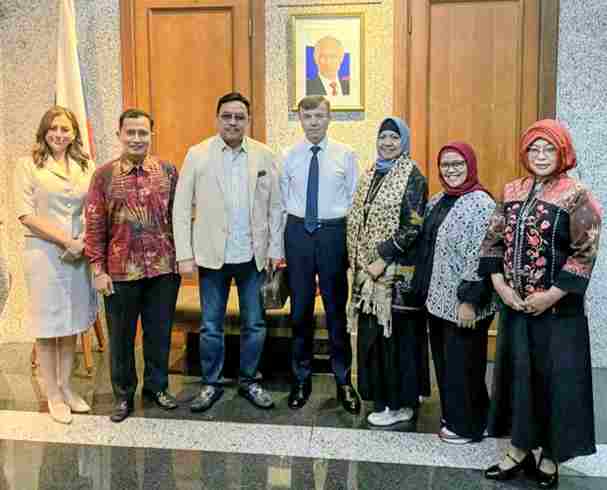
JAKARTA-JAYA NEWS.COM – Indonesian writer Denny JA, who recently received the BRICS Literary Award in Cairo, Egypt, was specially invited by the Russian Ambassador to Indonesia, Sergei Tolchenov.
He was joined by Sastri Bakry, Coordinator of the BRICS Indonesia Literary Network, at the Russian Embassy on Jl. Rasuna Said, Kuningan, Jakarta, on Friday, February 13, 2026.
Denny received the BRICS Literary Innovation Award for his contributions to introducing the essay poetry genre and promoting humanitarian and peace values.
In the warm meeting, the Russian Ambassador stated that literature can bridge differences and build understanding between nations.
“Literature is a universal language that can unite us all. Literature can bridge communication between nations through peaceful means and prevent global war. We must strengthen the Global South from global inequality through literature,” he said.
This award recognizes Denny’s works, which have been translated into several languages and attracted the attention of literary figures worldwide.
The Power of Indonesian Literature
Denny JA’s works, such as “Atas Nama Cinta,” have demonstrated the strength of Indonesian literature and its potential to enrich the world’s literary heritage.
Using poetic essays as a tool, Denny JA champions social justice and human rights.
The Russian Ambassador even expressed his high appreciation for Denny JA’s contribution to promoting Indonesian and Global South literature.
“Denny JA’s works have demonstrated his commitment to promoting humanitarian values and peace,” he said.
This BRICS Literary Award is proof that literature can be a powerful tool in building understanding and peace between nations.
Denny JA is one of the writers who has proven this through his continued work.
In his speech, Denny began with gratitude. Not ceremonial gratitude.
Not merely diplomatic courtesy.
But gratitude born from the heart of a writer.
He expressed his gratitude for the ambassador’s vision in initiating and supporting the BRICS Award for literature.
In a world that often measures power through weapons, markets, and technology, Russia chose to invest in something far more enduring: the human spirit.
And that choice was truly meaningful.
On that occasion, Denny explained one reason why this award is so important—not just for writers—but for civilization itself.
He believes that literature defends human dignity.
Amid geopolitical tensions, economic rivalries, and cultural divisions, literature reminds us that before we are citizens of a nation, we are storytellers.
Stories of love.
Stories of loss.
Stories of injustice and hope.
An award like this doesn’t just celebrate talent.
He defends the dignity of language. He said to writers—from Brazil to India, from China to South Africa, from Russia to Indonesia—that with literature, we remain human.
Denny also offered a suggestion that for this award to survive as an institution that can last for decades, even across generations, it must be built on a solid and sustainable financial foundation.
History shows that literary awards endure not only because of prestige, but also because of a stable endowment.
For example, the Nobel Prize, established in 1901. The Nobel Foundation manages Alfred Nobel’s bequest and invests it, so the prizes are awarded from the proceeds of those investments.
Or the Booker Prize, established in 1969. Originally sponsored by Booker McConnell, it is now supported by powerful foundations and corporate sponsors.
The question is: who could be a donor to the BRICS Award for Literature?
It could be energy companies, development banks, technology companies, sovereign wealth funds, or philanthropic foundations committed to education and cultural exchange.
“Because literature requires resilience, not just celebration,” he said.
“May the BRICS Award for Literature continue to grow.
May it ignite courage in writers. And may it remind us all that when economies rise and fall, the human story will continue,” he concluded.
The Russian Ambassador applauded Denny’s speech.
He also agreed that literacy in the Global South should be encouraged to develop further with the power of funding.
“Countries in the Global South have an extraordinary wealth of literature, but their publications are still dominated by Western literature,” he said.
Denny JA welcomed the Russian Ambassador’s statement and hoped that cooperation between Indonesia and Russia in the field of literature could continue to improve.
Meanwhile, Dikdik Sadikin, author and BRICS Indonesia judge, also expressed his excitement his.
“I’m glad the Ambassador responded to me. He agrees that Global South literacy should be encouraged. We have an extraordinary wealth of literature,” he said.
The meeting concluded with an exchange of souvenirs and a group photo.
Accompanying Denny JA were Sastri Bakry, Coordinator of the BRICS Indonesia Literature Network; Dikdik Sadikin, writer and BRICS Indonesia judge; Soni Drestiana, secretary of the BRICS Writers Association; Monica Anggi JR, writer; and Nita Lusaid, from the DJA Foundation. (***)
Contributor: Lasman Simanjuntak
——–