When Intelligence Becomes Easier, Why Is the Future Increasingly Fragile?
By: Dr. Ali Aminuloh, M.Pd.I. ME
We live in an age where answers are available faster than questions. Machines know everything, yet humans increasingly lose their way. This paradox seems odd: education is advancing rapidly, technology is advancing, but human anxiety remains unabated, even deepening. The question, then, is no longer what to learn, but how humans learn to remain human.
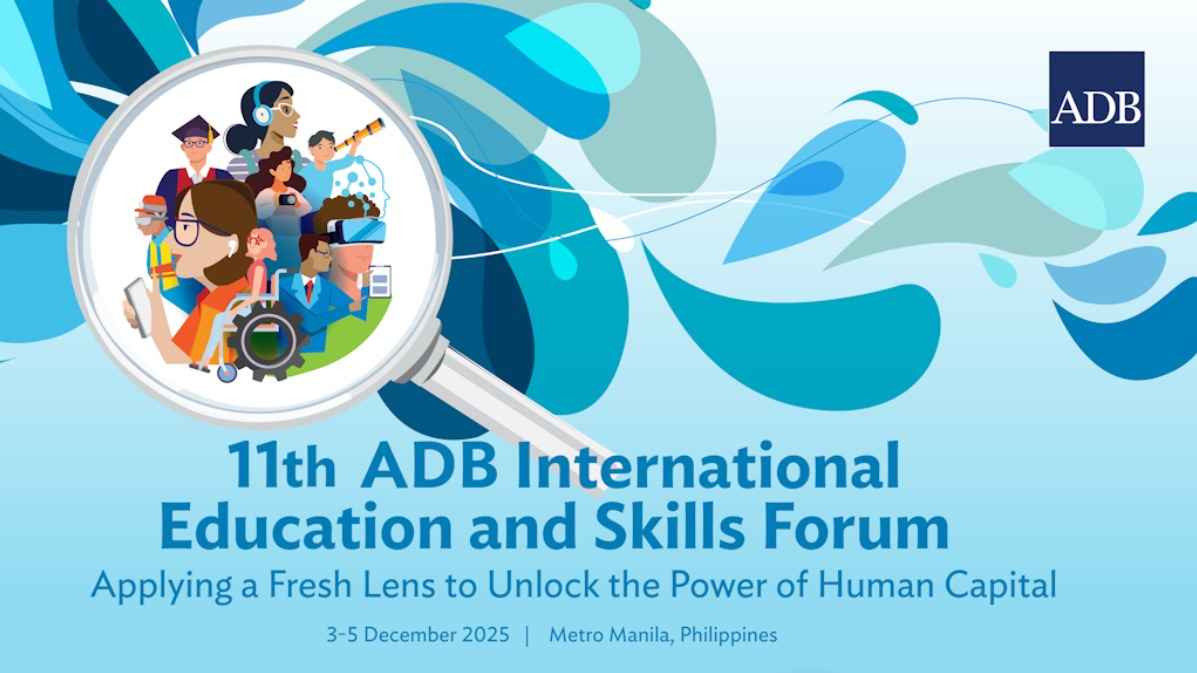
This paradox is the crucial backdrop for the 11th International Education and Skills Forum, regularly held by the Asian Development Bank. On December 3–5, 2025, the 11th forum will be held in Manila, Philippines, with the overarching theme “Applying New Lenses to Unlock the Power of Human Capital.”
This forum is more than just an academic gathering. It serves as a strategic space for policymakers, academics, and education practitioners across countries to formulate a direction for future education that is inclusive, adaptive, and sustainable. This is where education is positioned not just as a school affair, but as the foundation of civilization.
In the closing session, which is usually the most prone to “losing attention,” a young woman stole the entire room’s focus. Her name was Lyqa Maravilla, an education influencer who presented with a simple style, minimalist slides, but with ideas that struck a chord.
The title of her presentation, “The Future of Education: Learning Beyond the Classroom,” was not just jargon. It was an invitation to reexamine the history of how humans learn and recognize that every technological leap changes the definition of “smart.”
Lyqa began with the Print Era, when knowledge was physical and scarce. Books, newspapers, and handouts were the centers of scientific authority. In this era, smart people were “memorizers.” Education demanded extreme diligence, reading from cover to cover, and practicing long-term focus. There was only one enemy: boredom. But that is precisely where mental discipline was forged. The human brain was shaped to be patient, sequential, and insightful.
Then the world shifted to the “Search Era.” Information was no longer stored on shelves, but retrieved through keywords. Google has replaced the role of the teacher as the sole source of knowledge. Smart people have evolved into seekers. Excellence is no longer in memorization, but in the ability to find and compare information. In this era, skepticism has become a key skill. Those who are not critical will drown in a sea of meaningless data.
But the quietest and most spectacular change has occurred in the “Algorithm Era.” Humans no longer seek information; information seeks humans. Social media algorithms feed content according to personal tastes, emotions, and biases. This is where intelligence is often mistaken for “virality.” The true challenge is no longer seeking truth, but maintaining sanity. Echo chambers make humans feel they are always right, without ever being truly tested.
Lyqa then offers the concept of “reach to teach”: deliberately stepping out of your comfort zone, seeking out unpopular views, and then teaching them back. Because in the algorithm era, true understanding is born not from consumption, but from sharing and dialogue.
But the world doesn’t stop there. We are now in the Era of Generative AI. Machines no longer provide links, but answers. It summarizes, synthesizes, and even mimics human thinking styles. The smartest people in this era aren’t those who know best, but those who ask the most questions. Prompts are key. Dialogue becomes a new learning method. AI transforms from a tool into an intellectual sparring partner.
Lyqa then calls the approaching phase “Post-Generative AI or Agentic AI.” Here, technology becomes an invisible interface. Humans no longer operate, but direct. We become the direction-setters, not the technical implementers. And at this point, the human cognitive burden shifts drastically, from brain function to moral considerations.
This is where Lyqa’s reflections become increasingly relevant and profound. As machines take over nearly all intellectual functions, humans face new threats: popcorn brain, brain rot, loss of focus, shallow thinking, and quick gratification by fleeting sensations. Ironically, in the future, the most “ancient” skill will become the most valuable: “deep reading.”
Deep reading is not a matter of nostalgia, but an existential necessity. Without it, humans lose their thought structure, their accumulated knowledge, and ultimately their wisdom. AI can provide facts, but it cannot cultivate meaning. He can strategize, but he can’t feel suffering.
The harsh reality is that many education systems are still stuck in the past: assessing memorization, testing answers that machines can solve in seconds. The cognitive gap is widening: the few who have deep thinking will control AI, while the majority becomes mere objects of algorithms.
Therefore, future education is truly returning to nature. It’s not about what technology is used, but what awareness is instilled. Intelligence will become increasingly cheap. What’s rare is wisdom. What determines is not how fast a machine works, but how clearly the human heart guides it.
Lyqa concludes with a simple yet haunting sentence: “We lose what we don’t use, but the world will forget what we don’t share.”
Trilogy of Awareness: The Key that Binds All Eras
It is at this point that the ideas of Sheikh AS Panji Gumilang find their full relevance. What Lyqa presents actually illustrates the evolution of learning tools and methods, while Sheikh Panji Gumilang offers a value compass to ensure that evolution doesn’t lose its direction. Contemporary education, he believes, must be grounded in the trilogy of awareness: philosophical, ecological, and social.
Philosophical awareness addresses the deepest anxieties in the AI era. As humans transform from memorizers, to seekers, to machine controllers, the primary question is no longer how to learn, but why to learn. This is the realm of philosophy: the meaning, purpose, and orientation of life. AI can answer the “what” and “how,” but only humans can ponder the “why.” Without philosophical awareness, humans would be very intelligent, but devoid of wisdom.
Ecological awareness serves as a correction to the illusion of progress. Technological evolution is often perceived as a straight path to the future, yet it often leaves a trail of destruction. This trilogy emphasizes that science must reconcile with nature, not conquer it. When education only pursues efficiency and speed, nature becomes a silent victim. Conversely, when science is accompanied by ecological awareness, progress becomes a means of caring for the universe.
Social awareness is the ultimate test of all this sophistication. In the era of Agentic AI, when machines are capable of designing policies and distributing aid, humans remain irreplaceable: empathy. Education is not enough to produce competent humans, but must also produce caring humans. Humanity is not a slogan; it is present in concrete actions: reaching out to the weak, protecting the disadvantaged, and ensuring that progress is not enjoyed only by a few.
Thus, Lyqa’s presentation and Shaykh Panji Gumilang’s awareness trilogy are not two independent ideas. The two complement each other. Lyqa explains where education is headed, while Sheikh Panji Gumilang emphasizes how education should guide humanity along that journey.
His reflection is illuminating:
The more advanced the technology, the deeper the awareness that must be instilled.
The smarter the machines, the more humane humans must be maintained.
Otherwise, we may succeed in building an efficient world, but lose a humane one.
Indonesia, January 17, 2026
——-