KH ZULFA MUSTOFA’S PENETRATION INTO THE PWNU OF WEST JAVA, THE POLITICS OF KEMAJON, AND NU’S TURBULENCE IN THE REGION
By: H. Adlan Daie
Political and Socio-Religious Analyst
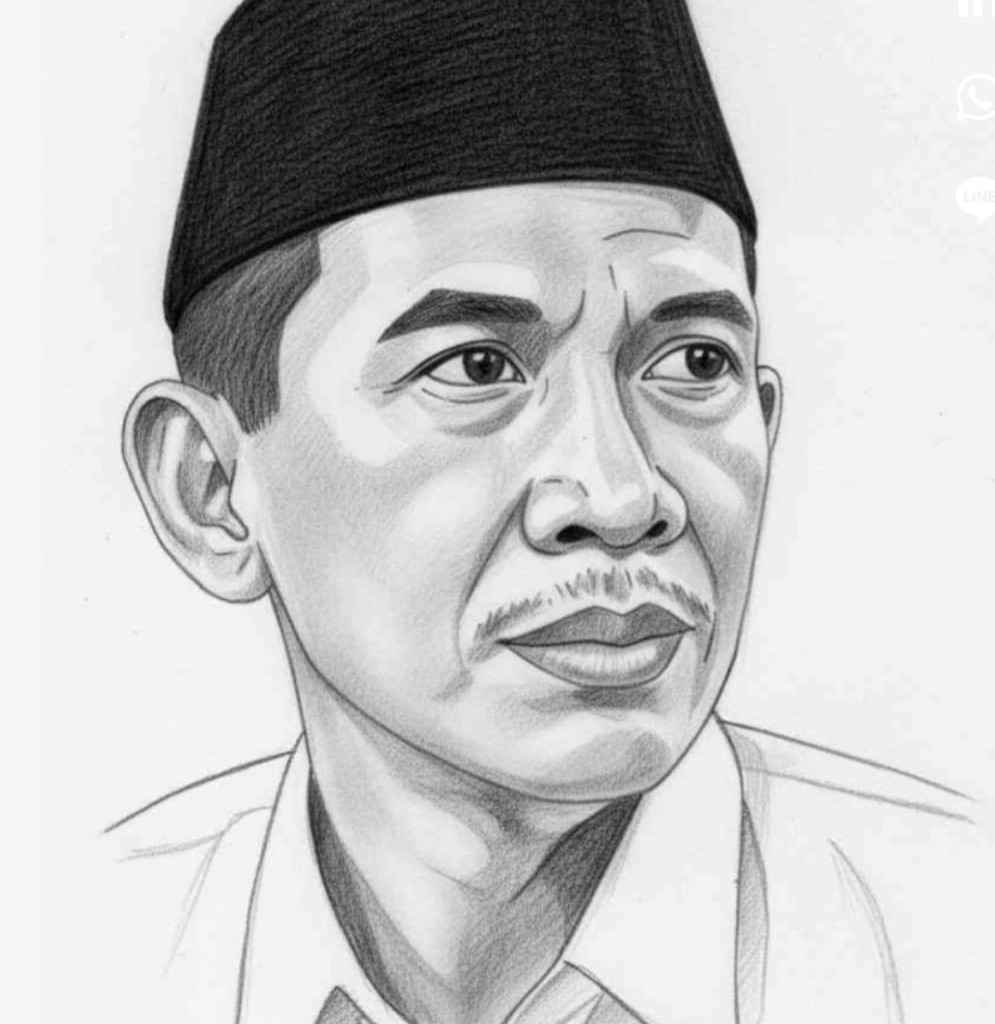
In Javanese political philosophy, referring to the terminology of sociologist Prof. Umar Kayam, KH Zulfa Mustofa’s choice to penetrate the PWNU of West Java (December 14, 2025) is a political act of “kemajon.” Umar Kayam interprets this as an “excessive” act, inappropriately drawn into the NU social ecosystem, and, like it or not, a dominant acculturation of Javanese political culture.
The term “kemajon” is not simply KH Zulfa Mustofa’s role as Acting Chairman. The PBNU General Chairperson faces significant challenges in terms of organic structural legitimacy and cultural resistance within the Islamic boarding school ecosystem, as voiced by senior kiai (Islamic scholars) and PBNU Mustasyar (leaders of the PBNU), such as those in the Ploso and Tebuireng forums, who call for “reconciliation.”
Furthermore, the presence of KH. Zulfa Mustofa at the West Java PWNU (National Nahdlatul Ulama Executive Board) has become a kind of “breakwater,” a point of open division between the West Java PWNU leadership duo, KH. Abun Bunyamin, the Chairman of the Syuriyah Council, and H. Juhadi, the Chairman of the Tanriziyah Council. This represents turbulence and turmoil within NU in West Java, becoming an area for expanding conflict within the PBNU.
This isn’t about “defending” any conflicting faction within the PBNU, but about how to “quarantine” the conflict at the PBNU’s “seismic point,” preventing it from escalating into turbulent conflict in the regions, and ensuring NU remains the “guide” for the people, preventing it from becoming a “spectacle” of conflict in the public sphere.
This is the “majesty” of KH. Zulfa Mustofa. He is so fluent in mastering the principles of “Usul al-Fiqh” (Islamic principles) and their actualization, even being one of NU’s “rising stars” as a preacher. However, when it comes to navigating the national political stage, NU is frankly a complex political choice that requires extensive experience.
What were the intentions and motivations behind KH. Zulfa Mustofa’s willingness to be appointed Acting Chairman of the PBNU, and his courage in penetrating and consolidating the West Java PWNU, despite the risk of turbulent conflict spreading to the regions?
Was he trapped, framed, or even enjoying the trap by assuming that the Rois Am faction of the Nahdlatul Ulama Executive Board (PBNU), with which KH Zulfa Mustofa was allied, would win the “conflict” due to its power relations with the government?
Frankly, it would be too “kemajon,” in the Javanese political terminology of sociologist Prof. Umar Kayam, in this context, too “confident” for a conflicting party within the PBNU to pretend to have received the “blessing” of the government simply by referring to the presence of a “bureaucratic figure” at the plenary session appointing KH Zulfa Mustofa as Acting Chairman of the PBNU.
NU, as a “Jam’iyyah,” is clearly distinct from political parties, and even genealogically, from “modernist” Islamic organizations. NU is more than “just an ordinary organization.” It was founded by kiai (Islamic scholars) and does not follow the theory of “global modernism,” citing Martin Van Bruinessen.
The reason is that NU’s social ecosystem was established first through the network of religious cultural traditions of Islamic boarding schools (pesantren), then structured within organizational formalism due to legal and administrative interests in relations with other institutions.
This means that NU’s cultural strength precedes its structural strength. Therefore, winning the “conflict” within the PBNU is more complex. It cannot simply be a matter of securing a decree on formal structural legality, but also of gaining recognition for the cultural morality of Islamic boarding schools (pesantren), an inseparable variable of NU.
That is why Gus Salam, the caretaker of the Denanyar Islamic boarding school in Jombang, one of NU’s “mother” Islamic boarding schools, warned the government not to interfere in the PBNU conflict and emphasized that PBNU’s legitimacy does not come from the government, i.e., the Ministry of Law and Human Rights, but rather from the recognition of Islamic boarding school scholars (Rmol, 11/12/2025).
“Although NU is bound by the Law on Mass Organizations (ormas), its legal status was established before the formation of the Unitary State of the Republic of Indonesia (NKRI). “The primary recognition of the PBNU leadership is the recognition of the cohesiveness of Islamic boarding school (pesantren) ulama within the NU structure, from regional to branch to sub-branch levels,” wrote Gus Salam.
President Prabowo, who has interacted intensively with Islamic boarding school (pesantren) kiai since his active military service, clearly understands that Islamic boarding schools are a supporting subculture for NU. Therefore, the voice of Islamic boarding schools, especially those that form the NU’s primary cultural base, will be a crucial factor in his policy decisions regarding the PBNU conflict.
Therefore, the author believes, the government will not take sides in the PBNU conflict. At the most, it should encourage a joint agreement to accelerate the MLB (Religious Lecture) and involve Islamic boarding school figures to prevent the PBNU from becoming a “spectacle” of conflict for a prolonged period, and to re-establish itself as a “guide” for exemplary morality and community behavior.
This is where the West Java PWNU should position its role amidst the PBNU conflict, becoming a focal point for consolidation and strengthening the acceleration of the Congress as a forum for “constitutional reconciliation,” not a stage for “political training” for anyone, unless the West Java PWNU deliberately chooses to complicate the issue. NU is already complicated. It’s a mess!!!. ***
Indramayu, December 17, 2025
Wassalam
——