
Political Analyst, General Secretary of the Indonesian Ulema Council (MUI) for Indramayu Regency.
What can be expected from the paradigms and schools of thought of HOS Tjokroaminoto and Ali Shariati—two influential Muslim intellectuals of their respective eras—regarding Islam and socialism? Do their writings still hold value as a framework for realizing “Islamic socialism” within the spirit of contemporary political struggle?
How might we articulate the relevance of these two intellectuals’ perspectives on Islam and socialism to develop an economic system rooted in the ethics of Islamic socialism—integrated within the framework of *Pancasila*, the philosophical foundation of our nation-state?
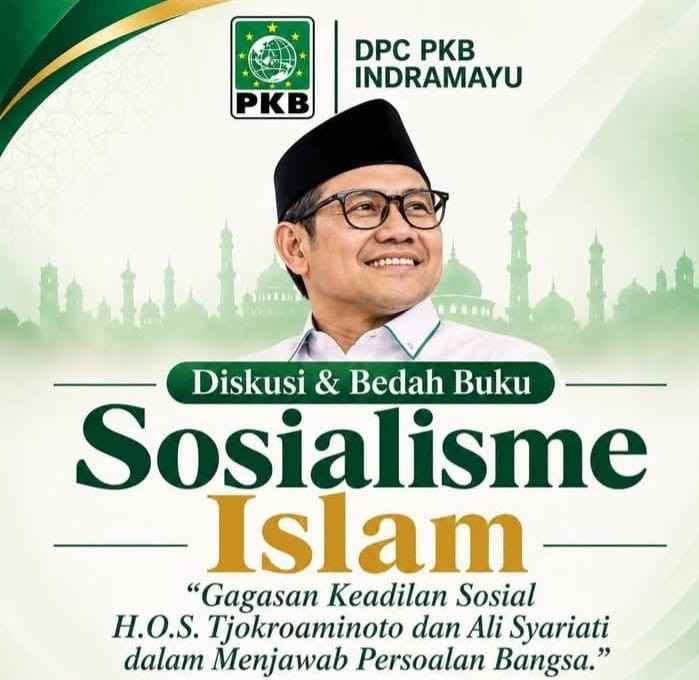
These are the “introductory” questions—a starting point to guide this book review forum, initiated by the Indramayu Regency branch of the National Awakening Party (PKB). As someone who was once deeply involved in political activism within this party, I believe that the mabda’ siyasyi (political principles) and the aggregation function of the PKB must not be buried under a heap of “political image-building” (mere posturing).
This book review forum is more than just a political discourse; it serves as a foundation for critical awareness regarding the direction of the PKB’s political struggle. By critically examining the ideas of Islamic socialism as articulated by HOS Tjokroaminoto and Ali Shariati, we aim to enrich our perspective on the paradigms of political struggle—specifically those directed toward the affirmation of public justice.
HOS Tjokroaminoto and Ali Shariati are “organic intellectuals,” to use the categorical definition coined by the Italian political theorist Antonio Gramsci. In other words, both intellectuals developed intellectually through a dialectical process—a “clash” between a wealth of global literature and the intensity of political activism within their respective social environments.
They emerged from distinct socio-cultural traditions. HOS Tjokroaminoto developed within the social dynamics of the movement leading up to Indonesia’s independence, whereas Ali Shariati was deeply rooted in the Islamic intellectual tradition that preceded the 1979 Iranian Revolution. HOS Tjokroaminoto belonged to an earlier generation than Ali Shariati, with a gap of approximately 50 years between them.
HOS Tjokroaminoto’s ideas on Islam and socialism can be examined, for instance, in his book *Islam dan Sosialisme* (1924). The work presents Islam as an alternative response to social and political inequality. The Dutch colonization of Indonesia at the time of the book’s writing served as the sociological backdrop that reinforced his view of Islam as an ideological solution.
Meanwhile, Ali Shariati employed more assertive political terminology—characterizing Islam as a “religion of protest,” a “religion of liberation,” and a “religion of resistance” against the dominance of socialism and other Western ideologies. This is explored in *Sosialisme Islam Pemikiran Ali Syariati* (2003), a compilation of Shariati’s socialist-leaning ideas authored by Eko Supriadi.
In the context of these works, a common thread emerges: both HOS Tjokroaminoto and Ali Shariati—from the author’s perspective—tended to position Islam as an ideology. The ideas of these two intellectuals represent a “paradigmatic protest” against the trajectory of socialism in the Eastern Bloc and capitalism in the Western Bloc—systems that, in their view, only served to generate social inequalities and an unjust global political configuration. Unfortunately, based on the author’s own research into the ideas of these two Islamic intellectuals—and indeed other Islamic ideologues—no one has yet succeeded in formulating an “Islamic socialism” that is coherent, systemic, and operational. Instead, such efforts have relied primarily on a doctrinal conviction derived from the Quran: that Islam is a perfect religion, governing the entire “system” of human life (Quran, Surah Al-Ma’idah: 3).
This verse is interpreted within an ideological framework that posits Islam as a comprehensive “system” regulating every facet of life—encompassing political, economic, social, and cultural spheres. Consequently, Islam is consistently positioned as an “alternative” ideology—a form of resistance against other global ideologies such as socialism, capitalism, and liberalism.
Regarding the paradigm of “Islamic socialism,” for instance, proponents have traditionally anchored their arguments in doctrinal references—such as the verses concerning *zakat* (obligatory alms) and its distribution among the “eight categories” (*asnaf*) of recipients, as well as the Quranic injunction that wealth should not merely circulate among the affluent (Quran, Surah Al-Hashr: 7). Yet, these concepts have never been successfully synthesized into a practical, operational “system” of Islamic socialism.
It is for this reason that Prof. Dr. Hasan Hanafi—an Egyptian Islamic intellectual and alumnus of the Sorbonne—leveled sharp criticism at this perspective. In his book, *Madza Ya’ni al-Yasar al-Islami* (“What is Meant by the ‘Islamic Left’?”—referring to “Islamic socialism”), he dismisses the notion, stating, “It is merely utopianism.”
*Islamic Socialism within the Paradigm of Gus Dur*
In the author’s view, Gus Dur—an “organic intellectual,” former General Chairman of PBNU, and the iconic founder of the National Awakening Party (PKB)—offered a more progressive perspective than many other Indonesian Muslim intellectuals across various generations.
Muslim intellectuals across the Islamic world regarding how Islam is situated amidst the struggles and intersections of global political ideologies and economic systems.
For Gus Dur—who possessed a mastery of global ideological literature as profound and fluent as his command of Islamic scholarship—Islam, within the realm of *mu’amalah* (matters outside of formal acts of worship and core articles of faith), is neither a rigid system nor an alternative ideology. This constitutes Gus Dur’s paradigm of Islam. It is a compelling, even “leaping” perspective—one that frequently sparked controversy.
In the context of *mu’amalah*, Gus Dur interpreted the “perfection of Islam” (as referenced in Surah Al-Ma’idah, verse 3) not as an “organically structured system,” but rather as a framework of values or fundamental Islamic principles—such as equal rights (*al-musawah*) and justice (*al-‘adalah*), along with an affirmative stance toward the weak and the marginalized—intended to be infused into various global political and economic systems.
Because the organic structures of political and economic ideologies are subject to the ever-changing and adaptive dynamics of the times (*al-umur al-mustajaddah*), Gus Dur was a staunch critic of Islamic thinkers—such as Al-Maududi and others—who sought to formalize Islam specifically as a political ideology or an economic system.
Conversely, he was also a sharp critic of the thesis presented by Francis Fukuyama in his book *The End of History*, which argued that the conclusion of the Cold War—marked by the defeat of the Soviet Union—signified the “end of history” for human civilization, with democracy emerging as the definitive political system and capitalism as the prevailing economic system. In short, Islam is eternal as a system of values; however, its organic structures, working cultures, and operational systems can evolve in response to the dynamics of social demands—provided they are built upon the principles of equal rights, justice, and a commitment to the vulnerable. This is what can be termed “Islamic socialism,” which requires no explicit *sharia* labeling, religious “garb,” or exoteric Islamic symbols.
In this context, Gus Dur positioned Islam in relation to global political ideologies and economic systems—including its relationship with *Pancasila* (the Indonesian foundational philosophy). Rather than viewing them as entities in direct, head-on conflict, he saw them as “complementary”—a relationship of mutual reinforcement aimed at fostering a just and civilized public life.
Gus Dur consistently stood firm in his defense of *Pancasila*—as the ideological foundation—and the 1945 Constitution—as the constitutional foundation—arguing that these were not mere acts of “political pragmatism,” but rather a steadfast commitment to fundamental Islamic values, which are embedded within the socialistic character of *Pancasila*. Islam is a “celestial” religion brought down to earth for the benefit of humanity; one should not be so preoccupied with trying to carry religion back to the heavens by cloaking it in “religious garb” that is disconnected from the realities of life on earth.
A contextual illustration can be found in Indramayu: the PKB (National Awakening Party) faction in the local regional parliament (DPRD) conducted a socio-economic study on the erosion of the local community’s economic resilience—driven by the proliferation of mini-markets, *warung Madura* (small, locally-owned kiosks), and village cooperatives—by simulating what might constitute an ideal, tolerable distance between such establishments.
This research led to the initiation of a draft regional regulation (*Raperda*). This serves as a regulatory instrument of Islamic socialism—one of many examples of how the spirit of Islamic socialism functions as the ethical core of the PKB’s political struggle, without the need for “performative” religiosity that misleads the public—or, in a sense, attempts to “deceive God.”
Wassalam.
—-


