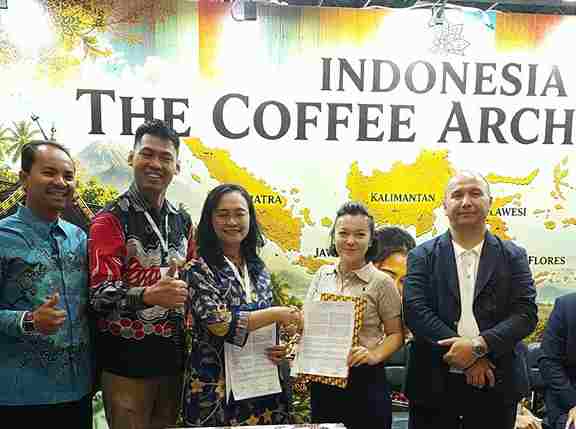
ASTANA, KAZAKHSTAN-JAYANEWS.COM– Indonesian coffee and spices have officially opened up new opportunities in the Eurasian market. The Center of Excellence for Post-Harvest Coffee and Spices (Co-Spice) at Universitas Negeri Semarang (UNNES), in collaboration with Nestra Kottama Indonesia, successfully participated in the Astana Coffee Expo 2026, held from September 3–5, 2026, at the EXPO International Exhibition Center in Astana, Kazakhstan.
This participation was facilitated by the Embassy of the Republic of Indonesia in Astana as part of economic diplomacy and the commercialization of university research outcomes, aiming to provide market access for innovative Indonesian products in Central Asia and Eurasia.
The Astana Coffee Expo brought together coffee industry players, roasters, importers, the HoReCa sector, raw material suppliers, and potential business partners from Kazakhstan and Central Asia. The event agenda included exhibitions, business programs, cupping sessions, workshops, and business networking opportunities.
From Research to the Global Market
UNNES’s Co-Spice adopted a “from academic research to global market” approach, linking university research findings with the needs of international consumers.
Indonesian coffee and spice products—including innovative wellness beverages—were showcased and subjected to market and organoleptic preference testing. The aspects evaluated included taste, aroma, color, bitterness levels, sweetness, and acceptance by Kazakhstani consumers.
The test results will serve as a foundation for refining formulas, packaging, product positioning, and marketing strategies before broader expansion into the Eurasian market. This approach aligns with SDG 9: Industry, Innovation, and Infrastructure.
Showcasing 100 Indonesian Spices Virtually
In addition to physical products, Indonesia launched the “Virtual Indonesian Spices” initiative. This digital gallery is the result of a collaboration between Co-Spice, Nestra Indonesia, the Polytechnic of Science, Art, and Recreation, and the Ministry of Industry.
The virtual gallery showcases approximately 100 varieties of Indonesian spices. Spices are positioned not merely as commodities but as integral elements of biodiversity, culture, and gastronomy, as well as sources of potential innovation—utilizing natural ingredients—across the food, beverage, wellness, and cosmetics sectors.
**Securing Two Export Letters of Intent**
A strategic outcome of this expo was the securing of two Letters of Intent (LoI) for export partnerships involving coffee and spices with Jibek Joly Co LPP and Navien-Turkestan.
These LoIs mark the initial step toward formal export contracts. Subsequent stages will involve discussions on product specifications, standardization, quality testing, volume, pricing, packaging, and certification.
The Indonesian Ambassador to Kazakhstan and Tajikistan, Dr. M. Fadjroel Rachman, commended this achievement. “Synergy among the ABCG elements—Academia, Business, Community, and Government—is key to realizing the journey from academic research to the global market,” he stated.
Dr. Eka Yuli Astuti, Head of the Co-Spice UNNES Center of Excellence (PUI-PT), added, “We aim to build an ecosystem that spans from research to product, product to market, and ultimately to global commercialization. Indonesian coffee and spices are not just commodities; they also embody knowledge, culture, innovation, and health benefits.”
Given Kazakhstan’s status as a member of the Eurasian Economic Union (EAEU), the gateway to the Eurasian market is now wide open. Moving forward, Co-Spice UNNES and Nestra Indonesia plan to develop the “Indonesia Coffee & Spices Wellness Innovation” initiative as a platform integrating research, innovation, sustainable agriculture, and gastronomic diplomacy.
From Astana, Indonesian coffee and spices are being introduced not merely as commodities, but as representations of Indonesia’s research, innovation, culture, and value-added offerings for the global market.**
Nur Fateah
——