By: Ali Aminulloh
Education should not cease the moment one receives a diploma. It must continue to flow—from the classroom into real life, from student to alumnus, from knowledge into tangible works, and from the institution to the wider community. When this flow is maintained, education does more than simply produce educated individuals; it builds civilization.
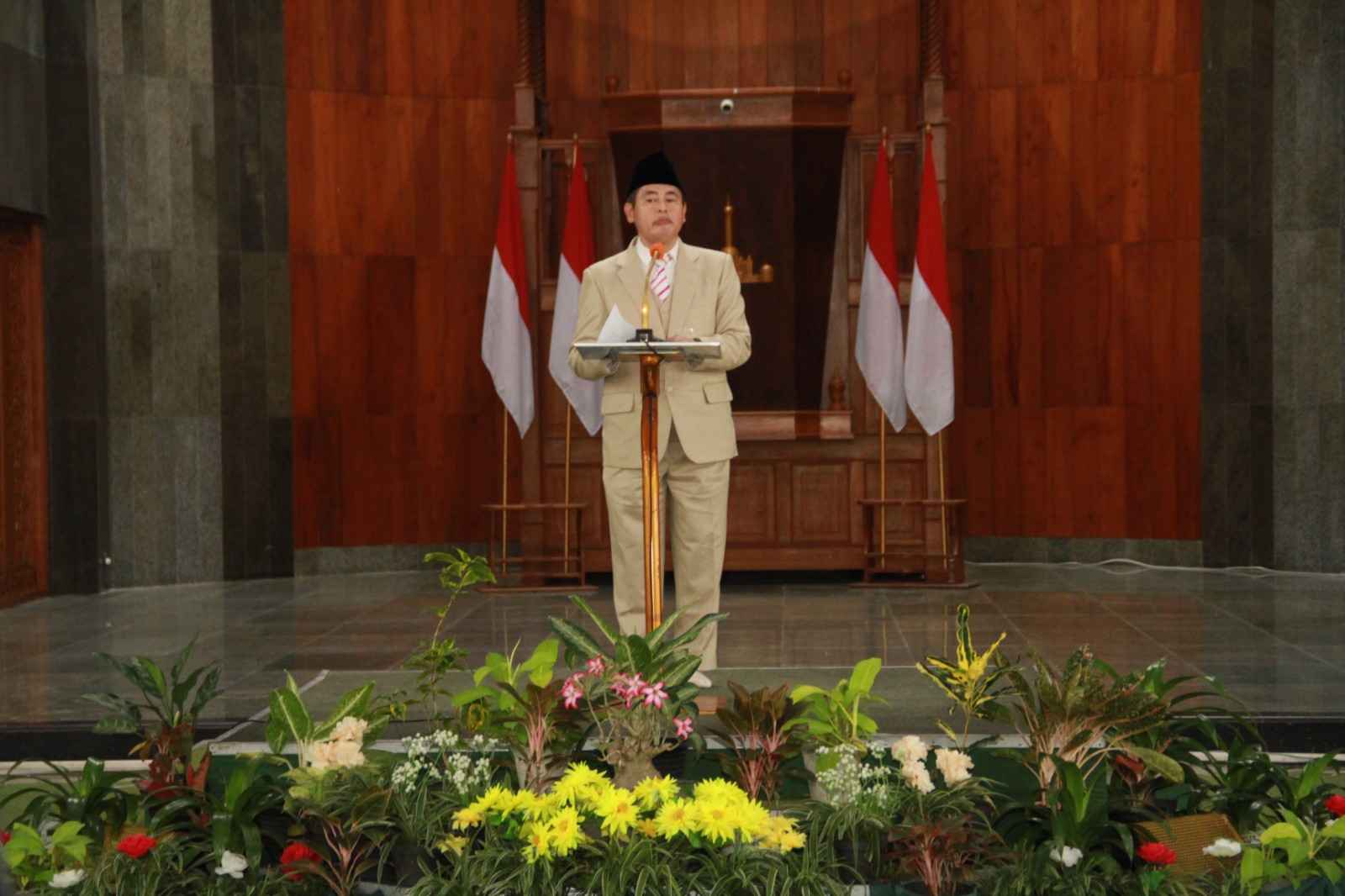
This idea was central to the remarks delivered by Datuk Sir Imam Prawoto, K.R.S.S., MBA, CRBC, during the 27th-anniversary celebration of Ma’had Al-Zaytun on Thursday, August 27, 2026. As the Chairman of the Indonesian Islamic Boarding School Foundation (*Yayasan Pesantren Indonesia*), he was entrusted to represent Syaykh Abdussalam Rasyidi Panji Gumilang in outlining Al-Zaytun’s strategic direction toward 2050.
The event was attended by a host of national figures, academics, professors, community leaders, retired military officers, guests from Malaysia and Canada, parents, educators, university students, and school pupils. The diversity of the attendees demonstrated that Al-Zaytun’s journey is not merely the concern of a single community; rather, it has created a space for engagement across professions, regions, nations, and generations.
In his speech, Datuk Imam interpreted the 27-year milestone as a testament to steadfastness. This journey, spanning nearly three decades, has been built upon hard work, smart work, and the courage to uphold a grand vision.
“This anniversary is not merely a celebration, but a moment for evaluation, consolidation, and projection toward Al-Zaytun 2050,” he stated.
Evaluation is essential for the institution to honestly assess its achievements and shortcomings. Consolidation is required to realign and strengthen its resources. Meanwhile, projection serves as a means to ensure the educational journey does not lose its way amidst the changing times.
This strategic direction is formulated through the “One Pipe Education System.” The concept envisions education as a continuous process that connects all stages of human life. The educational flow begins in early childhood, continues through primary and secondary schooling, and advances to higher education and postgraduate studies. However, the process does not conclude at graduation. Alumni remain integral to the educational system, as their knowledge, experience, and dedication are essential for sustaining the institution.
Education also extends from the classroom into the community. What students learn must take tangible form through their work and social contributions. Thus, educational success is measured not merely by the number of graduates or diplomas issued, but by the benefits generated.
Faith, knowledge, productive work, and moral character constitute the core elements of this educational flow. These four pillars are integrated with science, technology, entrepreneurship, and economic self-reliance.
The goal is not simply to produce individuals who possess vast knowledge, but to shape people capable of applying that knowledge responsibly. Competence must be coupled with morality, while professional skills should be directed toward service.
“We aim to produce not just diploma holders, but individuals who bring forth tangible work, strong character, and meaningful contributions,” asserted Datuk Imam.
By 2050, Al-Zaytun aims to produce technocrats skilled at manifesting the values and intent of Divine teachings within the reality of everyday life. The system is also expected to foster moral scientists, globally minded diplomats, modern farmers, technopreneurs, and dedicated leaders.
This framework demonstrates that religious education and technological mastery are not viewed as opposing poles. Divine values serve as the ethical foundation, while scientific knowledge acts as an instrument for improving life.
In this vision, the campus is more than just a collection of lecture halls; it is designed as a living laboratory that achieves self-reliance in food, energy, and water.
Within this environment, activities such as learning, working, worshiping, conducting research, and production are seamlessly integrated. Students do not merely grasp concepts from books but experience the practical application processes firsthand.
Food self-reliance can be learned through agriculture and livestock farming. Energy self-sufficiency is fostered through research and the utilization of renewable energy sources. Water management is integrated into ecological education, while production activities cultivate skills and an entrepreneurial spirit.
This concept is being expanded through *novum gradum*—a new initiative to develop education that is adaptable to the future. One manifestation of this is the blueprint for the Indonesia Raya Polytechnic, which aims to reach 500 regencies across the country.
Each educational center is designed as a smart campus that leverages the internet to interconnect various devices and systems. Facilities include eco-friendly buildings, integrated laboratories, “teaching factories,” and business incubators tailored to the specific potential of each region the “factory” model links learning to production processes as they occur in the real world of work. Students do not merely absorb theory; they gain hands-on experience in product manufacturing, quality control, technology application, and real-world problem-solving.
Meanwhile, business incubators are essential to help students transform their ideas into productive ventures. Through this approach, graduates are expected not only to seek employment but also to create jobs and drive the local economy.
The curriculum is designed around an outcome-based education approach, the “Merdeka Belajar Kampus Merdeka” (Freedom to Learn, Independent Campus) policy, and a dual system that bridges education with the industrial sector.
The fields of study being developed include data science, artificial intelligence, digital business, renewable energy, industrial economics, precision agriculture, and maritime logistics.
These chosen fields are closely linked to Indonesia’s future challenges. Digital transformation requires mastery of data and artificial intelligence. The environmental crisis demands the development of renewable energy. Food security necessitates precision agriculture. Meanwhile, Indonesia’s character as an archipelagic nation calls for capabilities in maritime logistics and technology.
However, a grand vision cannot be realized through statements alone. Datuk Imam acknowledges that expanding education across 500 regencies requires quality standardization, the equitable distribution of lecturers and educators, adequate facilities, talent retention, and sustainable funding.
Standardization is necessary to ensure that expanded access does not compromise quality. The equitable distribution of educators ensures that regions receive not just physical infrastructure, but also the human resources capable of bringing the learning process to life.
Talent retention presents another challenge. Top graduates need opportunities to innovate and develop their local regions. Therefore, the educational ecosystem must provide avenues for research, employment, entrepreneurship, and community service.
This entire agenda requires synergy among educational institutions, the business sector, the government, alumni, and the community. No single entity can execute it in isolation.
Within the “One Pipe Education System,” alumni hold a strategic position. They are not merely the endpoint of the educational pipeline, but rather a network that keeps the flow alive. Alumni can serve as mentors to students, liaisons with industry, facilitators of investment networks, and role models of community service. They can channel their experiences back into the institution to revitalize the learning process.
Looking toward 2050, Al-Zaytun aspires to have at least one million alumni who share a common DNA: love for their alma mater and a readiness to serve.
In this context, love for the alma mater goes beyond mere nostalgia. It is manifested through a willingness to contribute ideas, experience, networks, effort, and financial resources to ensure the sustainability of education.
Datuk Imam proposed the idea of alumni contributing 5 to 7.5 percent of their income. These contributions are intended to fund scholarships, research, “teaching factory” initiatives, and the establishment of new educational institutions modeled after Al-Zaytun.
This concept represents a form of intergenerational investment. Alumni who once received an education help create opportunities for the next generation. In this way, the benefits of education continue to circulate rather than remaining confined to individual interests.
Ultimately, Al-Zaytun’s Vision 2050 rests on three pillars: self-reliance, intellectual excellence, and universal peace.
Peace is not achieved by erasing differences to create uniformity. Human beings retain diverse identities, beliefs, cultures, and perspectives. The role of education is to weave these differences into a collective strength.
“Differences are not made uniform; instead, they are woven into a source of strength,” said Datuk Imam.
He then employed a growth metaphor to illustrate the continuity of education. Basic education plants the seed; secondary education waters and nurtures it; higher education and the alumni stage yield the fruit.
The hoped-for fruit consists of individuals who possess sharp intellects, steadfast morals, impactful achievements, and a broad commitment to service.
This metaphor demonstrates that every level of education plays an interconnected role. Failure at one stage can affect the subsequent ones. Conversely, when the entire process is well-nurtured, education succeeds in fostering individuals who grow into well-rounded human beings. Al-Zaytun’s 27th-anniversary commemoration served as a meeting point between its track record and its aspirations. Nearly three decades of experience form the foundation for looking toward 2050 and expanding investment in quality education as the nation approaches the centennial of its independence.
The remarks concluded with a prayer. Datuk Imam prayed for the health of Syaykh Al-Zaytun, Umi Farida Al-Widad, and all those present. He also prayed for the provision of sustenance and the capacity to continue ongoing development programs and to realize education across 500 regencies.
That prayer underscores the fact that a grand vision requires more than just sophisticated planning; it demands spiritual strength, moral steadfastness, collaborative effort, and a willingness to serve over the long term.
The message from Datuk Sir Imam Prawoto culminates in a single call to action: safeguard the pipeline of education so that faith, knowledge, achievement, and service continue to flow. For when education extends beyond the mere attainment of a diploma, Al-Zaytun can generate far-reaching benefits—from Al-Zaytun for Indonesia, and from Indonesia for world civilization.**
Indramayu Indonesia, September 5, 2026
——-