
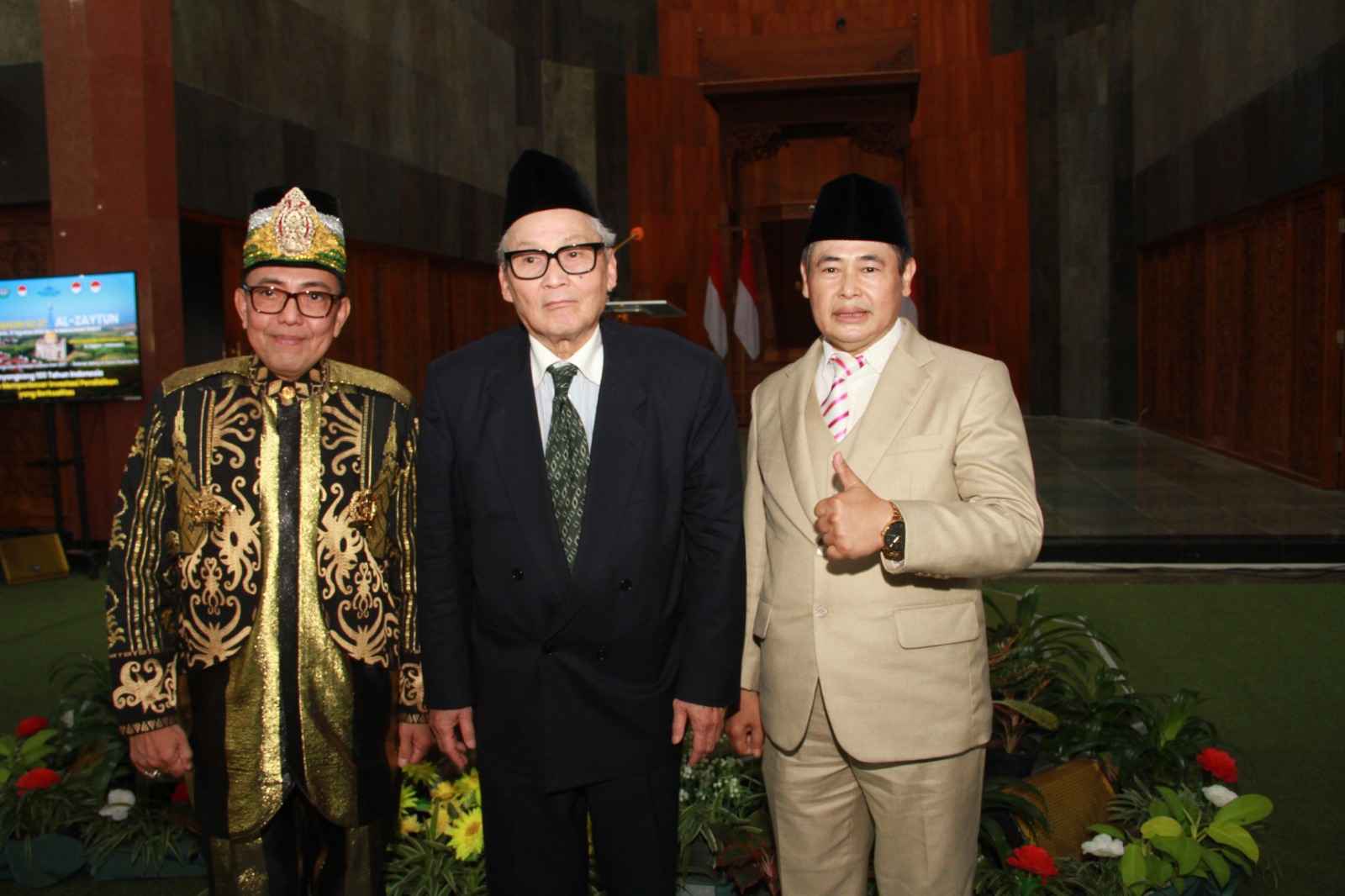
By: Ali Aminulloh
Amidst the grandeur of the Rahmatan Lil Alamin Mosque, the number 27 signifies more than just the passing of years for Ma’had Al-Zaytun. It has transformed into a vantage point looking toward the future—specifically the year 2045, when Indonesia marks its centennial. From the podium at Ma’had Al-Zaytun’s 27th-anniversary celebration, Dr. Sultan AMH Andrian Sulaiman, S.T., M.B.A., delivered a powerful message: a “Golden Indonesia” can only be realized if the nation has the courage to significantly increase investment in quality education.
The 27th-anniversary celebration of Ma’had Al-Zaytun, held on August 27, 2026, adopted the theme: “Welcoming 100 Years of Indonesian Independence by Increasing Investment in Quality Education.” This theme served as the central thread of the address given by the Sultan of Paser XXVIII—introduced as the “King of Nusantara” as well as the Founder and Patron of the Indonesia Raya Nusantara Education Foundation.
Before presenting his ideas, Sultan Andrian opened his remarks with greetings reflecting the nation’s religious and cultural diversity. Greetings ranging from the Islamic greeting, *Shalom*, *Om Swastiastu*, *Namo Buddhaya*, and *Rahayu*, to greetings of virtue and *Pancasila*, as well as the rousing cry of “*Merdeka!*” (Freedom!), echoed before an audience that included religious and cultural figures, academics, students, parents, farmer groups, MSME players, cooperative leaders, and guests from both home and abroad.
He paid his respects to Syaykh Al-Zaytun, Dr. Syaykh Abdussalam Rasyidi Panji Gumilang, M.P., along with Umi Faridah Al-Widad, M.P., and the entire extended Al-Zaytun family. He also extended his respects to Dr. Datu Imam Prawoto, KRSS, M.B.A., CRBC, the leadership of the Indonesia Raya Nusantara Education Foundation, and Peter B. Setiawan, who had traveled from Canada to attend the event. However, the warmest appreciation was reserved for the *santri* (Islamic boarding school students), university students, parents, and committee members who worked to prepare for the anniversary celebration. For Sultan Andrian, they are the vital elements that allow the grand vision for the future of education to find a space for dialogue and collective pursuit.
The Number 27 and the Road to 2045
The atmosphere became more relaxed when Sultan Andrian delivered an opening *pantun* (traditional rhyming verse):
After the number 27 comes 28,
After 28 comes 29.
Nusantara Foundation invests in education,
Benefiting Indonesia at its centennial.
The verse may sound simple, yet it holds a profound message. The journey from age 27 into the years ahead should not be viewed merely as a change of numbers. Each year must mark a new stage in preparing Indonesia’s human resources.
Sultan Andrian views the Al-Zaytun anniversary as a moment to align the institution’s journey with that of the nation. Al-Zaytun has reached the age of 27, while Indonesia is moving toward its centennial of independence in 2045. These two journeys are linked by a single keyword: education.
“I dedicate these remarks as a testament to my service to the Indonesian nation—particularly in the field of education—as we look toward the ‘Golden Indonesia’ centennial in 2045,” he stated.
In his view, education cannot be treated as a short-term expense; it is an investment in civilization. While the results may not be fully visible within a year or two, they will shape the face of the nation for decades to come. The classrooms built today, the teachers whose competencies are enhanced, the technologies introduced, and the character instilled in students will determine the quality of Indonesia’s future.
Education as a Right and a State Responsibility
Sultan Andrian then drew the audience’s attention to the constitutional basis of education. He reminded everyone that Article 31 of the 1945 Constitution of the Republic of Indonesia guarantees every citizen the right to education. The Constitution also mandates that the government fund basic education and prioritize the education budget, allocating at least 20 percent of both the national and regional budgets (APBN and APBD) to the sector.
Citing this constitutional basis underscores that quality education is not merely a favor bestowed upon the public; it is both a right of the citizenry and an obligation of the state. Consequently, the benefits of investment in education must not be confined to specific groups, regions, or those with financial means.
He also linked educational development to the *Asta Cita* (Eight Missions) of President Prabowo Subianto’s administration—specifically the mission to strengthen human resource development, science, technology, education, healthcare, and equality. Within this framework, the quality of education must advance in tandem with expanded access.
Delivering quality education for all requires the courage to improve learning processes, enhance teacher competence, strengthen vocational education, and familiarize students with technological advancements. It is not enough for schools to teach theory alone; students must be equipped with hard skills, soft skills, literacy, digital proficiency, creativity, communication, collaboration, and the courage to solve real-life problems.
**When a Lake Becomes an Educational Laboratory**
One compelling aspect of Sultan Andrian’s remarks was his observation of the water features within the Al-Zaytun complex. He described a lake covering approximately one hectare, with a depth of around 12 meters and a water level reaching roughly nine meters.
To some, a lake might simply be viewed as a body of water. However, within an educational setting, such a space can be developed into a maritime learning laboratory. There, students can test ideas, familiarize themselves with technology, conduct simulations, and bridge the gap between theory and reality.
“This is a field and a venue for implementing the work of our students through maritime simulations,” he stated with pride.
This observation highlights the importance of an educational ecosystem that extends beyond classroom walls. Gardens, rice fields, farms, workshops, laboratories, lakes, and even business units can serve as learning spaces when managed with clear educational objectives.
Such learning models enable students to understand that knowledge is not merely a collection of formulas and definitions. Knowledge must serve as a tool to interpret nature, manage resources, create technology, solve problems, and improve societal well-being.
Sultan Andrian’s impressions of the scientific and technological work produced by Al-Zaytun students reinforced his view that educational investment must encompass facilities, human resources, teaching methods, and spaces for fostering creativity. Technology should not merely be a display of modernity; it must be mastered, utilized, and developed to address the nation’s needs.
**Education That Embraces Everyone**
Investment in quality education must also be grounded in the principles of inclusivity and equity. Sultan Andrian emphasized the importance of creating equal learning opportunities for all segments of society, including women, youth, and people with disabilities.
This message is crucial because Indonesia’s future cannot be built by leaving some citizens behind. Progress enjoyed by only a select group will inevitably give rise to new inequalities. Conversely, inclusive education enables everyone to discover their potential and make their best contribution.
Equality does not mean making all students uniform. Equality means providing opportunities, support, and facilities tailored to their specific needs. Children from modest backgrounds, rural communities, women, youth, and persons with disabilities must all have equal pathways to growth through education.
This is where the theme of Al-Zaytun’s 27th anniversary finds its true meaning. Increasing investment in education does not simply mean erecting more buildings or purchasing technological equipment. Educational investment must expand opportunities for people to learn, develop, work, innovate, and live with dignity.
The Concept of 500 Integrated Modern Schools
In the following section, Sultan Andrian expressed support for the plan to build 500 integrated modern schools—a project slated to begin in 2027 under the Yayasan Pendidikan Indonesia Raya Nusantara (Indonesia Raya Nusantara Education Foundation). According to his remarks, this initiative aligns with the educational vision developed by Syaykh Al-Zaytun and the foundation’s leadership.
The plan was met with applause from the audience. However, the figure of 500 entails significant challenges. Integrated modern schools require a well-developed educational concept, high-quality educators, professional management, relevant learning facilities, and sustainable funding.
The term “modern” must not be limited to grand buildings or sophisticated digital devices. A modern school is one capable of adapting to the changing times without losing sight of human and national values. Meanwhile, “integrated” implies a synthesis of character building, mastery of knowledge, vocational skills, technological proficiency, health awareness, environmental concern, and social responsibility.
If developed consistently, integrated modern schools can serve as a nurturing ground for a generation that is not only academically intelligent but also independent, skilled, tolerant, creative, and deeply concerned about the future of the nation. From Anniversary Celebration to Education Movement
Towards the end of his remarks, Sultan Andrian once again used a *pantun* (traditional poetic verse) to convey his hopes:
Behold the row of eight Malay houses,
Beautiful homes, standing without a fence.
Modern education moves ever forward,
A golden generation stands ready to pursue it.
That concluding verse seemed to emphasize that the gateway to a “Golden Indonesia” must be thrown wide open. No social, economic, cultural, or geographical barriers should stand in the way of the nation’s children accessing quality education.
The Al-Zaytun’s 27th anniversary ultimately transcended a mere celebration of an educational institution’s journey; the commemoration served as a platform to renew a national commitment. Welcoming Indonesia’s centennial in 2045 requires more than just slogans and ceremonies; it demands the courage to invest in education starting now.
Speaking from the Rahmatan Lil Alamin Mosque, the 18th Sultan of Paser reminded the audience that a “Golden Generation” does not emerge overnight. Such a generation grows out of an educational process that is long-term, disciplined, inclusive, and forward-looking. Every dedicated teacher, every institution expanding access to learning, every technological advancement, and every child gaining an educational opportunity plays a part in the journey toward Indonesia’s centennial.
The cry of “Merdeka!” (Freedom!) that concluded the address took on a broader significance. True independence means freedom not only from colonial rule but also from ignorance, backwardness, inequality, and powerlessness. It is this path toward complete independence that is being forged through investments in quality education—starting today—for the sake of a Golden Indonesia in 2045.
Indramayu, August 30, 2026
——–


