(A Reflection on the International Day for the Remembrance of the Slave Trade and its Abolition)
By: Ali Aminulloh
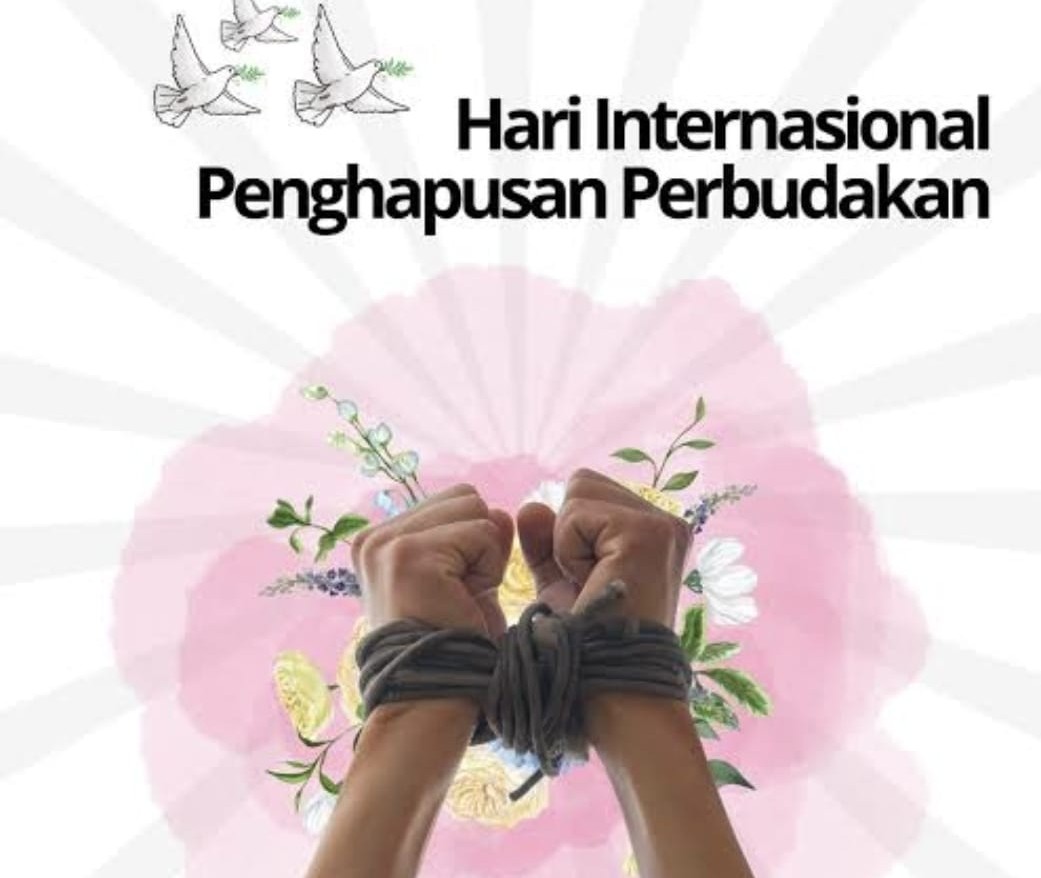
Iron chains may have been relegated to museums. Slave markets are no longer held openly. Yet, has slavery truly vanished? In various places, people are still forced to work; their wages are withheld, their passports confiscated, their freedoms curtailed, and their bodies exploited. Slavery does not necessarily die when the law abolishes it. It can change its guise—infiltrating employment contracts, hiding behind debt traps, and masking itself with promises of high-paying jobs.
Every August 23rd, the world observes the International Day for the Remembrance of the Slave Trade and its Abolition. This date marks the uprising of enslaved people in Saint-Domingue—now Haiti—on the night of August 22–23, 1791. That resistance evolved into the Haitian Revolution, ultimately leading to independence in 1804. They were not pleading for mercy; rather, they were fighting for the fundamental recognition that human beings cannot be owned, bought and sold, or treated as mere commodities.
The history of the transatlantic slave trade records that approximately 12.5 million Africans were forced onto ships, with only about 10.7 million arriving alive. Families were torn apart, cultures were destroyed, and skin color was used to justify a hierarchy of humanity. Yet, the greatest tragedy lies not merely in the staggering number of victims. The true tragedy is that a civilization once existed which regarded human trafficking as a legitimate economic activity.
Slave ships may have vanished, but exploitation has not ended. Global estimates indicate that approximately 49.6 million people were living in modern slavery in 2021. Of these, 27.6 million were in forced labor, while another 22 million were trapped in forced marriage. Forced labor is even estimated to generate illegal profits of around US$236 billion annually. This implies that modern slavery persists not because the world is unaware of its existence, but because there are still parties reaping massive profits from it.
Low wages or long working hours do not automatically constitute slavery. However, such conditions transform into forced labor when workers are not free to refuse or leave a job due to threats, violence, confinement, document confiscation, debt bondage, or wage theft. In Indonesia, such vulnerabilities are evident in the Benjina case, the trafficking of migrant workers, the exploitation of domestic workers, and online job scam networks. In 2025, 564 Indonesian victims of human trafficking were repatriated from Myanmar; they had departed full of hope, only to become trapped in exploitation.
Children, too, are not yet fully free. Nearly 138 million children worldwide remain engaged in child labor, with approximately 54 million performing hazardous work. In Indonesia, the number of child laborers is estimated to still reach around 1.05 million in 2025. Every child deprived of the opportunity to learn serves as a warning signal for the nation’s future. Children should be growing, learning, playing, and pursuing their aspirations, rather than being forced to shoulder the economic burdens of adults.
Pancasila provides a firm moral foundation for combating these conditions. The principle of “Belief in the One and Only God” teaches that human beings are God’s creatures, not commodities. “Just and Civilized Humanity” rejects the treatment of workers as mere production machines. “Social Justice for All the People of Indonesia” demands that development not only maximize profits for capital owners but also guarantee fair wages, safety, and a decent standard of living for workers. The 1945 Constitution even enshrines the right not to be enslaved as a fundamental human right that cannot be derogated from under any circumstances. Religious teachings converge in the defense of humanity. The Qur’an affirms that God has honored the children of Adam. Surah Al-Balad identifies the freeing of slaves as a path of virtue. In Christian teachings, the Epistle of James strongly condemns the withholding of workers’ wages. Hinduism teaches *Tat Twam Asi*—the principle that the suffering of others is also our own suffering. Buddhism instills *metta* and *karuna*—loving-kindness and compassion toward all beings. Confucianism teaches *ren* and *tepasalira*: do not do to others what you do not wish for yourself.
It is within this context that the educational philosophy of the Syaykh of Al-Zaytun, A.S. Panji Gumilang, gains its relevance. From its inception, Ma’had Al-Zaytun has defined itself as an “Educational Center for Cultivating a Culture of Tolerance and Peace, Aiming for a Healthy, Intelligent, and Humane Society.” Education must not merely produce skilled individuals; it must foster people who are free, knowledgeable, and conscious, and who are capable of respecting the dignity of their fellow human beings.
This spirit is powerfully encapsulated in the motto of the Al-Zaytun Indonesia Raya Polytechnic: “Planting Awareness, Nurtur fostering humanity.” Philosophical awareness invites us to question injustices that have come to be accepted as the norm. Ecological awareness reminds us that the exploitation of people and the destruction of nature stem from the same impulse: the drive for profit without regard for life itself. Social awareness inspires the courage to stand up for workers, protect women and children, and help victims break free from oppression.
Anti-Slavery Day is ultimately more than just a commemoration of past wounds; it serves as a mirror reflecting the chains that remain hidden today. As long as people are forced to work without freedom, as long as women and children are trafficked, and as long as poverty is used to strip away human dignity, the struggle to abolish slavery remains unfinished. A truly free world can only be built when human beings cease treating one another as mere instruments. The path to that world begins with a single endeavor: cultivating awareness and nurturing humanity.**
Indonesia, August 23, 2026
——–