REOPENING THE DOOR OF IJTIHAD: AL-ZAYTUN AND THE HOPE FOR THE REVIVAL OF ISLAMIC CIVILIZATION
*By: Ali Aminulloh*
(Adapted from the remarks of KH. Ahmad Lutfi Khudori, Family Representative from East Java)
A civilization does not always fall because of poverty or scarce resources. It declines when people are no longer courageous to ask questions, when students are afraid to differ from their teachers, and when knowledge no longer has room to grow. When thought is restricted, creativity fades, innovation stops, and society merely repeats the past without the courage to develop it.
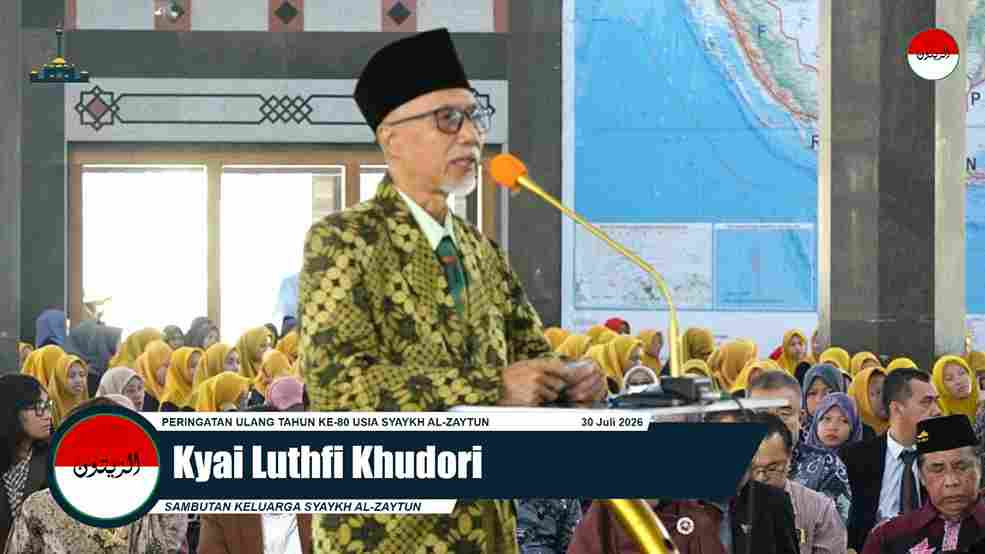
This was the central message delivered by KH. Ahmad Lutfi Khudori before the Al-Zaytun community during the 80th Birthday Commemoration of Syaykh Al-Zaytun, Abdussalam Rasyidi Panji Gumilang, on Thursday, July 30, 2026. The event, themed “Grateful for Achievements and Continuing to Move Forward,” was attended by the Syaykh’s family, Ma’had Al-Zaytun members, students, educators, and guests from various backgrounds.
Speaking as a representative of the family from Gresik, East Java, Ahmad Lutfi began with humility. The committee had introduced him as a “kiai.” He corrected them:
“The correct title is Mr. Ahmad Lutfi. I am a retired teacher.”
From that position, he invited the audience to reflect on a decades-long conversation about the causes of Muslim decline and the path toward revival.
Memories from Discussions in Surabaya
Every visit to Ma’had Al-Zaytun reminds him of the nights in Surabaya when he and Syaykh Al-Zaytun studied together. They often talked until late, debating the great challenges facing the Muslim world.
One question kept arising: Why are Muslims lagging behind other nations?
From their long discussions, they reached one key conclusion: one root of decline is the belief that the door of ijtihad has been closed.
When ijtihad is considered finished, knowledge becomes something only to be inherited and memorized, not developed. Students no longer dare to differ from their teachers. Scholars avoid views that challenge dominant thought. At that point, education loses its creative power.
When Islamic Civilization Reached Its Golden Age
Ahmad Lutfi recalled that Islamic civilization flourished from the 8th to the mid-13th century. It produced great scholars, scientists, and philosophers. Knowledge advanced because people were free to ask questions, test opinions, and develop new ideas.
The mujtahid imams did not merely repeat earlier views. They studied sources, understood their context, and answered the problems of their time. Muslim scientists translated and developed knowledge from Greece, Persia, and India. This openness did not erase Islamic identity. It became a source of strength.
Political Conflict and the Loss of Intellectual Courage
After the mid-13th century, political instability and dynastic conflicts weakened the Muslim world. As politics declined, so did science. Scholars lost freedom. Differing opinions were seen as threats.
The teacher-student relationship also changed. Students became afraid to surpass their teachers. Respect turned into fear of disagreement. Yet history shows that progress happens when new generations dare to continue and even correct their predecessors.
When the Mongol invasions came, they struck a civilization that was already internally weak. From the 13th to the 18th century, the Muslim world experienced a long decline.
Al-Zaytun as a Sign of Revival
For Ahmad Lutfi, Ma’had Al-Zaytun is a sign that the spirit of revival is alive. At Al-Zaytun, thought is not restricted. People are encouraged to use reason, express ideas, and develop knowledge.
This is built on three principles: freedom of thought, freedom of knowledge, and freedom of spirit.
1. Freedom of Thought : Space to use reason, to weigh and develop ideas.
2. Freedom of Knowledge : Knowledge must grow openly to answer life’s problems.
3. Freedom of Spirit : Inner strength so that freedom does not become arrogance, but remains guided by moral responsibility to God, humanity, and life.
Education for Respect and Responsibility
Ahmad Lutfi emphasized that at Al-Zaytun, people are taught to respect one another — regardless of faith, ethnicity, or background. This is vital for Indonesia, a diverse nation. Tolerance is not about erasing differences. It is about building life together amid differences.
He also stressed ecological responsibility. Humans must care for animals, plants, and the environment. Damaging nature ultimately harms humanity itself.
Freedom must always be paired with responsibility. Thought must seek truth. Knowledge must serve the public good. The spirit must guard ethics.
Prayers and Closing
On the occasion of Syaykh Al-Zaytun’s 80th birthday, Ahmad Lutfi prayed for his complete health, long life, and blessings. He expressed hope that the Syaykh’s ideas for building Indonesia Raya a sovereign, educated, prosperous, and united nation — may continue to be realized.
He closed by connecting past and present. Decades ago, the question of Muslim decline was discussed in late-night talks in Surabaya. Today, those ideas have taken form in Al-Zaytun.
“Revival is always possible as long as people dare to think, learn, and reopen the door of ijtihad,” he said, ending with a resounding “Merdeka!”
Indramayu, August 3, 2026
——