Building Humanity, Strengthening Pancasila, and Sowing Civilization
By Ali Aminulloh (Excerpted from Prof. Ermaya’s message on the 80th anniversary of Shaykh Al Zaytun)
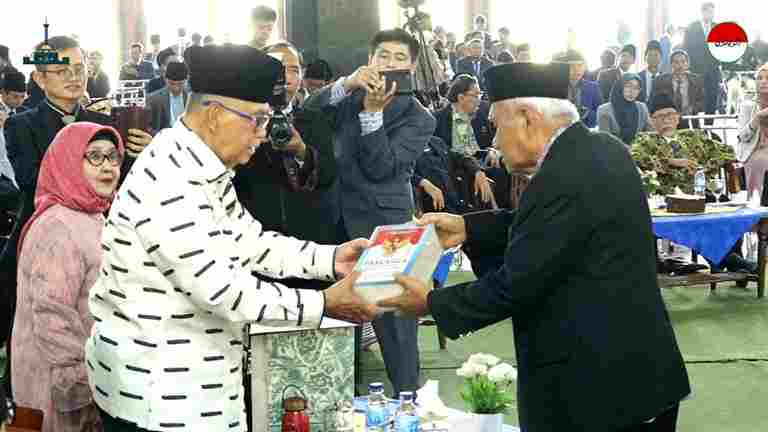
Thursday, July 30, 2026, marked the third visit of Prof. Dr. H. Ermaya Suradinata, S.H., M.H., M.S., to Ma’had Al-Zaytun. Her first visit took place when she presented a public lecture. The following year, the Professor of Government and Law returned to the Education Symposium. Her third visit had a different atmosphere: she came to attend the 80th birthday commemoration of Shaykh Al-Zaytun, Abdussalam Rasyidi Panji Gumilang.
In front of thousands of attendees who packed the commemoration arena, Prof. Ermaya was asked to deliver the anniversary message. He didn’t just wish her a happy birthday, but also delivered academic reflections on education, human development, freedom of thought, spirituality, diversity, Pancasila, and the future of Indonesian civilization.
For Prof. Ermaya, 80 years is not just a number in one’s biological journey. It marks a long journey filled with struggle, dedication, ideas, and concrete work. Therefore, his remarks evolved into a reading of Shaykh Al-Zaytun’s journey in developing humanity and preparing future generations.
Three Visits, One Common Thread of Thought
Prof. Ermaya’s third visit demonstrated that his relationship with Ma’had Al-Zaytun extends beyond ceremonial meetings. Throughout the three visits, there was a common thread: a focus on education, character development, leadership, and national life.
On his first visit, he attended an academic setting through a public lecture. On his second visit, he engaged in a broader conversation about the direction of education through an Education Symposium. Meanwhile, during his third visit, he witnessed firsthand the results of a long educational journey: a large community built through ideas, discipline, work, and the ideals of civilization.
The atmosphere of the anniversary celebration intensified when Prof. Ermaya opened his remarks with interfaith and national greetings. He conveyed the greetings of Islam, peace, Shalom, Om Swastiastu, Namo Buddhaya, Greetings of Virtue, Rahayu, Greetings of Pancasila, and the cry “Freedom.”
This series of greetings was not merely a formality. It reflected the view that Indonesia is built on a pluralistic social reality. Different religions, ethnicities, languages, customs, and cultures should not be a reason to distance themselves from one another. Instead, diversity should be a strength united by the ideals of nationality.
Prof. Ermaya then paid her respects to Ummi Faridah, the extended family of Sheikh Abdussalam Rasyidi Panji Gumilang, the Chairman of the Indonesian Islamic Boarding School Foundation, the entire academic community of Ma’had Al-Zaytun, national figures, friends, guests of honor, and all attendees.
She also mentioned several figures in attendance, including Major General (Ret.) Kivlan Zein, whom she had known since studying at the National Resilience Institute of the Republic of Indonesia, Prof. Connie Rahakundini Bakrie, Gita Wirjawan, the Sultan of Paser, and other invited guests. These mentions demonstrated that the anniversary commemoration was not only a gathering of the extended Al-Zaytun family, but also a space for camaraderie among various elements of the nation.
The formal atmosphere then eased when Prof. Ermaya opened her message with a pantun:
At Al-Zaytun, there are many birds,
Flying low, perching on teak trees.
May Sheikh Abdussalam Panji Gumilang,
Together with Ummi Faridah, always have a beautiful life.
The poem was warmly welcomed by the audience. Behind its simplicity, there is a prayer that Syaykh Al-Zaytun and Ummi Faridah’s journey of service will always be accompanied by health, happiness and blessings.
Eighty Years: Traces of Struggle and Devotion
Prof. Ermaya invited all attendees to be grateful for the blessings of Allah SWT. at the age of 80 Syaykh Abdussalam Rasyidi Panji Gumilang. Eighty years, according to him, is an age full of meaning because it witnesses a long journey of struggle, devotion and work.
He gives a symbolic meaning to the number eight. In its shape, the number eight is like a line that continues to rotate and is unbroken. This number describes a journey that continues to move, struggle that does not stop, and continuous devotion.
This meaning is seen as being in line with the journey of Shaykh Al-Zaytun. The ideas developed do not stop at discourse, but are translated through education, environmental management, agriculture, food security, infrastructure development and community development.
However, in the midst of respecting a figure’s journey, Prof. Ermaya does not forget the roots of the family that gave birth and formed her. He invited the audience to pray for Syaykh Al-Zaytun’s parents, namely the late K.H. Rashid and his beloved late mother.
Both parents gave birth, raised, educated, and passed on life’s values to their son. A parent’s legacy isn’t always material wealth. The most powerful legacy is values, courage, discipline, faith, a passion for learning, and steadfastness in life.
Prof. Ermaya prayed that all the good deeds of Sheikh Al-Zaytun’s parents would be accepted by Allah SWT and that they would be placed in the best places by His side. She also invited the audience to pray for Sheikh Al-Zaytun and Ummi Faridah, that they would be granted health, long life, strength, protection, and blessings in continuing their service.
In her view, 80 years is indeed a long journey by the standards of human life. However, that age is very short when compared to the eternal life in the afterlife. Awareness of the limitations of time should motivate humans to fill their lives with beneficial work.
Education Scientists Who Build Life
One of Prof. Ermaya’s position is that of Sheikh Panji Gumilang as a scholar in the field of education. A scientist, in this sense, is not merely someone who understands theories, writes concepts, or speaks in academic settings. A scientist is someone who is able to develop knowledge and apply it to the development of people and their lives.
Sheikh Al-Zaytun is seen not only as a speaker on education, but also as a builder of an educational environment. He did not merely explain the importance of independence, but also developed activities that support independence. He not only taught the relationship between humans and nature, but also developed agriculture, animal husbandry, food management, and environmental management as part of the educational system.
In this context, education is not limited to classroom learning activities. Education is a comprehensive process that shapes ways of thinking, working, relating to others, treating nature, and positioning oneself before God.
Prof. Ermaya sees Sheikh Al-Zaytun as successfully integrating the guidance of the Quran with the realities of modern life. Religious values do not stop at spiritual teachings that are merely read or memorized. These values are translated into real life, from education, agriculture, food security, community development, to the development of civilization.
Within this framework, the Quran serves as a source of values that provide direction, while science serves as an instrument for realizing these values in life. The two should not be in conflict. Religion and science can, in fact, strengthen each other.
Religious knowledge provides moral, spiritual, and humanitarian orientation. Science empowers humans to understand nature, solve problems, develop technology, manage resources, and improve the quality of life.
Prof. Ermaya emphasized that Shaykh Al-Zaytun always placed religious knowledge as the primary foundation. From this foundation, true knowledge that brings benefit is developed. When religious knowledge is combined with worldly knowledge, humans will emerge with morality, integrity, skills, and the ability to build civilization.
Bridging the Scriptures and the Realities of Life
Prof. Ermaya also drew attention to how Shaykh Al-Zaytun connected the text of the scriptures with the realities of life. The scriptures should not be separated from human problems. It must be able to provide orientation when humans face social change, technological development, environmental issues, food needs, economic development, and national dynamics.
Therefore, understanding religious texts is not sufficient merely by verbal means. Understanding must result in actions that improve life. Verses about preserving nature must be evident in ecological behavior. Teachings about brotherhood must be present in social life. The command to seek knowledge must be translated through quality educational institutions. The call to work must be realized in productivity and independence.
The relationship between holy scriptures and modern life requires an open mind. Texts must be understood with knowledge, context, and an awareness of their moral purpose. In this way, religion does not lose its sanctity, but is also not alienated from human life.
Prof. Ermaya understands this idea as an effort to shape people who have freedom of thought, but remain grounded in conscience and divine light. Freedom of thought does not mean humans can act without limits. Freedom actually demands greater moral responsibility.
A person who is free to think must be able to distinguish between freedom and arbitrariness. They must dare to ask questions, research, test, and develop ideas, but remain
consider truth, humanity, justice, and the common good.
Divine light and conscience serve as a compass to ensure freedom does not lose its direction. Therefore, education must produce individuals who are both free in thought and mature in morality.
Respecting Differences as the Foundation of National Life
For Prof. Ermaya, free and responsible thinking is directly related to national life. Indonesia was not built on a single identity. This nation consists of diverse ethnicities, cultures, languages, customs, religions, and beliefs.
This diversity requires leaders and citizens who respect differences. A leader must not only serve their own group. Leadership must nurture the entire community, including those with different views, backgrounds, and beliefs.
Prof. Ermaya connects this thinking to the ideals of the nation’s founders, especially Ir. Soekarno. Pancasila was not born in a vacuum. The foundation of the state was derived from historical realities, culture, social life, and the values that exist within the people of the archipelago.
Therefore, Pancasila should not simply be memorized as five principles. Pancasila must become the soul of the nation and be embodied in the way people are treated. Belief in God must give rise to respect for religion. Humanity must give rise to fair treatment. Unity must transcend group interests. Democracy must give rise to deliberation, while social justice must be realized through concrete policies and actions.
Prof. Ermaya saw this spirit growing and being practiced at Ma’had Al-Zaytun. The educational life built there strives to combine religiosity, nationalism, discipline, openness, productive work, and respect for diversity.
The interfaith greeting he delivered at the beginning of his speech symbolized this idea. Faith does not require one to be hostile to those who are different. Instead, the depth of faith should strengthen an attitude of respect for human dignity.
Building a Nation Must Begin with Humans
One of the most important points in Prof. Ermaya’s speech was the statement that at Al-Zaytun, humans are developed first. Therefore, building a nation must begin with developing its people.
Development is often measured through economic growth, buildings, roads, technology, and various physical projects. All of these are indeed important. However, material progress can lose its meaning if it is not accompanied by human development.
A magnificent building will not give birth to civilization if its people lack integrity. Advanced technology can become a source of destruction if not guided by morality. Natural resources can be depleted if managed irresponsibly. Power can turn into oppression if not controlled by conscience.
Developed countries, according to Prof. Ermaya, always have a strong national character. Progress is not determined solely by natural resources, but by people who are disciplined, honest, productive, knowledgeable, responsible, and have a vision for the future.
Indonesia will also become a great nation if its people possess integrity, morality, competence, and a fear of God. Fear of God in this context is not a debilitating fear, but rather an awareness that every power, knowledge, position, and decision must be accounted for.
Human development must be holistic. Education should not only pursue intellectual intelligence. It must also foster emotional, social, moral, spiritual, ecological, and national intelligence.
This is where Prof. Ermaya places the importance of character development. Education must make someone both competent and kind, skilled and honest, courageous and responsible, and independent in thinking while respecting the dignity of others.
Spirituality as the Guardian of the Direction of Knowledge
Prof. Ermaya reminds us that knowledge without spiritual development can lose its direction. Knowledge gives humans abilities, but spirituality helps determine how those abilities are used.
Science can create technology to advance life, but knowledge that is not guided by values can also produce tools of destruction. Economic capacity can increase prosperity, but without ethics, it can give rise to exploitation. Power can be used to serve the people, but without morality, it can turn into a tool for personal gain.
Therefore, character development, Sufism, closeness to God, and moral development occupy a vital place in education. Sufism, within this framework, is not an escape from worldly life. Rather, Sufism is a practice for purifying oneself from arrogance, greed, hatred, and the desire to dominate others.
Closeness to God must be foster closeness to humanity. Worship must refine morals. Religious knowledge must strengthen justice, compassion, responsibility, and a willingness to work for the common good.
Spirituality thus serves as the guardian of the direction of knowledge. It ensures that progress not only produces stronger humans, but also wiser ones.
Prayer for the Sustainability of Al-Zaytun’s Ideals
Towards the end of her remarks, Prof. Ermaya expressed her hope that Al-Zaytun’s presence would continue to bring blessings to Indonesia. She viewed the 80th birthday of Sheikh Al-Zaytun as an opportunity to pray for continued service.
The prayer was not only for the health and long life of Sheikh Abdussalam Rasyidi Panji Gumilang. It also contained the hope that his ideas on education, independence, nationalism, and the development of civilization would continue to be developed.
Longevity is meaningful when used to expand benefits. Health is meaningful when it supports devotion. Knowledge becomes valuable when it is passed on to the next generation. Educational institutions will become great if they can outlive their founders and continue to respond to the challenges of the times.
Prof. Ermaya hoped that Sheikh Al-Zaytun would be given the opportunity to continue realizing his lofty ideals in building education, the nation, and civilization. He also prayed that all these ideas would benefit not only the current generation but also future generations.
The anniversary message then concluded with a pantun:
Don’t cut a coconut by splitting it,
If you do, the water will spill out.
Let us be grateful to Allah,
May this meeting bring blessings.
Prof. Ermaya concluded his remarks with an interfaith greeting, the Pancasila greeting, and the cry of “Freedom.” The speech concluded, but his message left a lasting reflection.
The 80th anniversary of Sheikh Al-Zaytun is ultimately not merely a celebration of his age. It is a moment to re-examine the meaning of life, knowledge, education, nationality, and devotion.
From Prof. Ermaya’s message, Ermaya understands that civilization is not born solely from tall buildings and advanced technology. Civilization is born from people who are knowledgeable, possess character, are open-minded, respect diversity, love their nation, and always place God as the source of life’s orientation.
This is where education finds its most fundamental role: not merely delivering diplomas, but shaping individuals capable of safeguarding life and leading their nation toward progress.**
Indramayu, August 1, 2026
——