Odong-odong, People’s Transportation to the Epicenter of Education: The Story of a Joyful Educational Tour to Ma’had Al Zaytun
By Ali Aminuloh
At Ma’had Al Zaytun, an educational center that consistently promotes a culture of tolerance and peace, each educational visit not only offers knowledge but also showcases unique local culture and economic insights. On Wednesday, December 3, 2025, a lively scene once again unfolded amidst the Ma’had Al Zaytun campus, as the second wave of educational tourists arrived.
This time, the group was much larger. Seven Raudhatul Athfal (RA) institutions—RA Amslihah, RA Amanah PUI, RA Baiturrahim, RA Cahaya Qalby, RA Al Musyahadah, RA Siti Aminah, and RA Nurul Ihsan—brought a total of 481 visitors, consisting of 231 students and 250 teachers and accompanying parents.

Educational Tourism on Wheels of Public Transportation
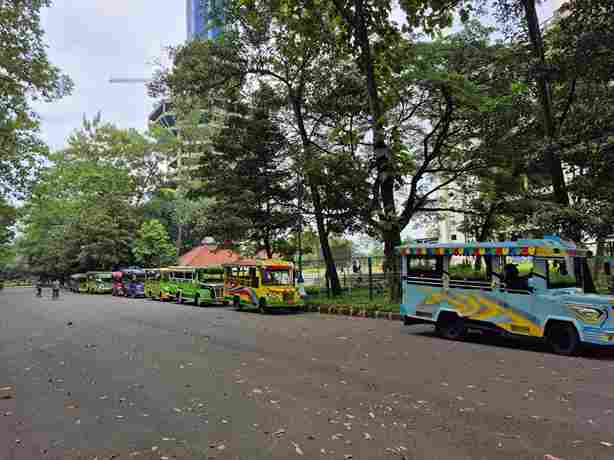
Their goal was the same: to see firsthand the educational complex, state-of-the-art industrial facilities like the Rice Palace, the Al Akbar Islamic boarding school, and the Al Zaytun Shop. However, what truly captivated their attention was the mode of transportation they used: 20 odong-odong (traditional Indonesian odong-odong) lined up to transport hundreds of visitors. These colorfully modified, distinctive vehicles are the most economical means of public tourism.
The phenomenon of odong-odong as a popular means of transportation for local tourism is inseparable from its history. The name “odong-odong” itself is rooted in Sundanese culture, specifically the traditional art form Sisingaan. This art form, which emerged around 1812, is essentially a symbol of the Sundanese people’s resistance against British colonialism in the 19th century, using the lion as a symbol of strength and courage.
In the 2000s, this symbolic spirit of resistance evolved into a popular children’s amusement ride, and then into an affordable tourist mode in Indramayu, replacing ordinary cars with cheerful modifications.

The Story of “Kaji Gaul” and Blessings in Old Age
Among the 20 vehicles neatly lined up, the author had the opportunity to chat with the owner of one, H. Dakhroji from Bongas. At 69 years old, with four children, sixteen grandchildren, and four great-grandchildren, Kaji Dakhroji still enjoys his profession as a motorcycle taxi (odong-odong) owner.
His car, a 1980 Kijang that he calls “Kaji Gaul,” has been specially modified at a specialist workshop in Anjatan. He has been in this business for five years, around 2020. According to Kaji Dakhroji, these motorcycle taxi (odong-odong) owners even have their own association.
“The fare for a motorcycle taxi (odong-odong) is based on distance,” he explained. For short routes, such as around Haurgeulis, the fare ranges from Rp 250,000 to Rp 300,000. For long trips, such as to Terisi, it costs Rp 400,000, Subang Rp 500,000, and Indramayu Rp 700,000. The furthest he’s ever traveled is even to Majalengka.

Reflections on the Business World: Blessings of Perseverance
Although this mode of transportation has simple administrative requirements—the vehicle registration certificate has been replaced by a sticker from the association—Kaji Dakhroji is grateful that his business has been running smoothly and safely.
On average, he gets one or two rentals a month. After deducting fuel costs, he can pocket Rp 1 million net per month. This amount feels sufficient because, “food, drink, and cigarettes are covered by the renter,” he said with a smile.
“I get money, a full stomach, and I’m happy. I’ve achieved all of this through this business,” he concluded, offering a profound reflection on the world of people-based entrepreneurship.
Kaji Dakhroji’s story is a reflection of a tenacious entrepreneurial spirit, proving his own adage: “Any business, if pursued with the heart, will bring blessings.” In the midst of technological developments, odong-odong is not just a means of transportation, but rather an economic wheel that supports families, as well as a means that brings inspiration and hope from the village gate to a center of tolerant education.**
Indonesia, December 3, 2025
——–