Building Civilization Through Love and Unity, Rev. Wim Wairata: The Nation’s Greatest Challenge Is Maintaining Humanity
By: Ali Aminulloh
Amidst the rapid flow of technological advancement, humans are increasingly easily connected to one another.
Ironically, however, at the same time, humans are also increasingly vulnerable to losing their connection with one another.
Technological advancements can shorten distances, but not always bring hearts closer.
Scientific advancements can improve the quality of life, but not always accompanied by an increase in the quality of humanity.
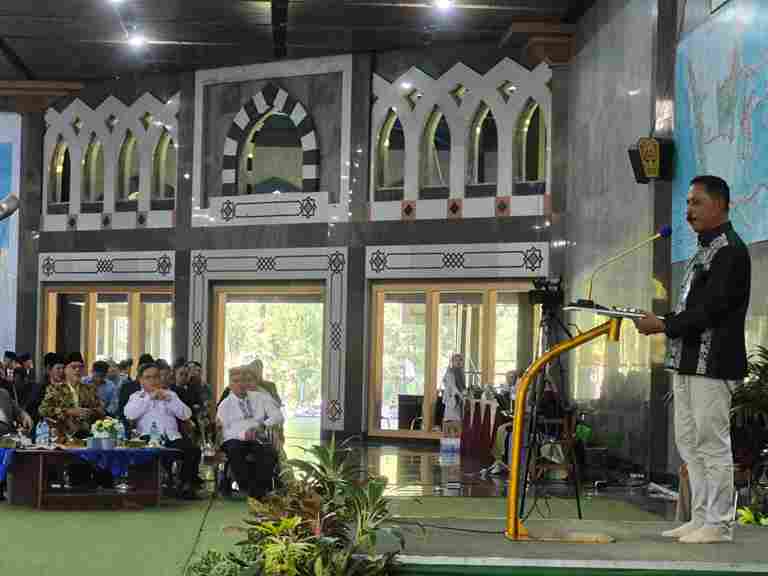
This anxiety was one of the main thoughts of Rev. Wim Wairata, M.Th., Chairman of the Indonesian Student Service Institute (LPMI), when he was a speaker at the Islamic New Year Commemoration of 1 Muharram 1448 Hijriah at the Rahmatan Lil ‘Alamin Mosque, Ma’had Al Zaytun, Tuesday (June 16, 2026).
Addressing thousands of attendees who filled the main hall of the mosque, he encouraged all attendees to view global challenges not only from an economic, technological, or political perspective, but also from a humanitarian and spiritual perspective.
When the World Loses Direction
According to Wim Wairata, the various problems facing the world today are rooted in one fundamental issue: the weakening of humanity’s connection to noble human values.
Social conflict, war, violence, moral crises, and increasing individualism are symptoms that emerge when humans begin to lose their true orientation in life.
Extraordinary technological advances do not automatically make humans wiser.
Economic progress does not necessarily make humans more caring for others.
Therefore, building a civilization cannot rely solely on intellectual intelligence.
Civilization also requires moral and spiritual intelligence.
According to him, a great nation is one that is able to maintain a balance between material progress and the advancement of human values.
Education that Humanizes Humanity
In his presentation, Wim Wairata positioned education as a crucial instrument in building civilization.
However, the education he meant was not merely education that produces graduates with high academic scores.
More than that, education must be able to humanize people.
Education must shape character.
Education must produce individuals with empathy, caring, integrity, and the ability to live together in diversity.
According to him, the greatest challenge of 21st-century education is not simply producing intelligent individuals, but rather producing wise individuals.
People who are able to use knowledge for the common good.
People who use technology as a means of building civilization, not a tool to destroy it.
Unity Begins with Love
One of the most powerful messages conveyed by Wim Wairata was the importance of building unity through love and respect for fellow human beings.
According to him, differences in religion, culture, language, or social background should not be a reason to distance oneself from others.
Instead, diversity should be a space for mutual learning and enrichment.
He invited all participants to see each other as brothers and sisters in national life.
Because, in essence, all citizens have the same responsibility to safeguard Indonesia.
Unity will not be born from suspicion.
Unity will not grow from prejudice.
Unity can only grow from respect, trust, and love for others.
Profound Impressions of Al Zaytun
Wim Wairata also shared his profound impressions during the activities at Al Zaytun.
According to him, what he witnessed at Al Zaytun demonstrated that living in diversity is not impossible.
He saw interfaith figures, academics, officials, Islamic boarding school students, students, and the general public interacting in an atmosphere of respect.
For him, this scene represents invaluable social capital for Indonesia.
In a world increasingly fragmented by various interests, spaces for dialogue like those established by Al Zaytun are becoming increasingly important.
Because a great nation needs places that can reconcile differences in an atmosphere of brotherhood.
Preparing a Generation of Peacemakers
According to Wim Wairata, Indonesia’s future is largely determined by the young generation being prepared today.
Therefore, education must be directed towards producing a generation of peacemakers.
A generation capable of living in diversity.
A generation capable of resolving conflict through dialogue.
A generation capable of working with anyone for the benefit of the nation.
This is the generation that will lead Indonesia to a brighter future.
In his view, a nation capable of producing a generation of peacemakers will possess far greater strength than one that relies solely on economic or military might.
Indonesia and Future Hopes
Toward the end of his presentation, Wim Wairata expressed optimism for Indonesia’s future.
He believes that the Indonesian nation possesses enormous assets in the form of cultural diversity, a spirit of mutual cooperation, and religious values that are deeply rooted in society.
This asset must continue to be nurtured through education, dialogue, and cooperation among elements of the nation.
From the podium at the Commemoration of 1 Muharram 1448 Hijriah at Al Zaytun, Wim Wairata delivered a message highly relevant to national life today.
That a nation’s progress is not only measured by physical development and economic growth.
A nation’s progress is also measured by its ability to safeguard humanity.
After all, a great nation is not the strongest or the richest.
A great nation is one that is able to nurture love, maintain unity, and uphold human dignity at every step of its journey.
And amidst increasingly complex global challenges, that message feels even more important to keep alive together.*
Indonesia, June 20, 2026
——