CONSISTENCY PREPARING A GENERATION OF NATIONAL LEADERS
By: Dr. Ali Aminulloh, M.Pd.I., ME (Lecturer at IAI Al-Azis)
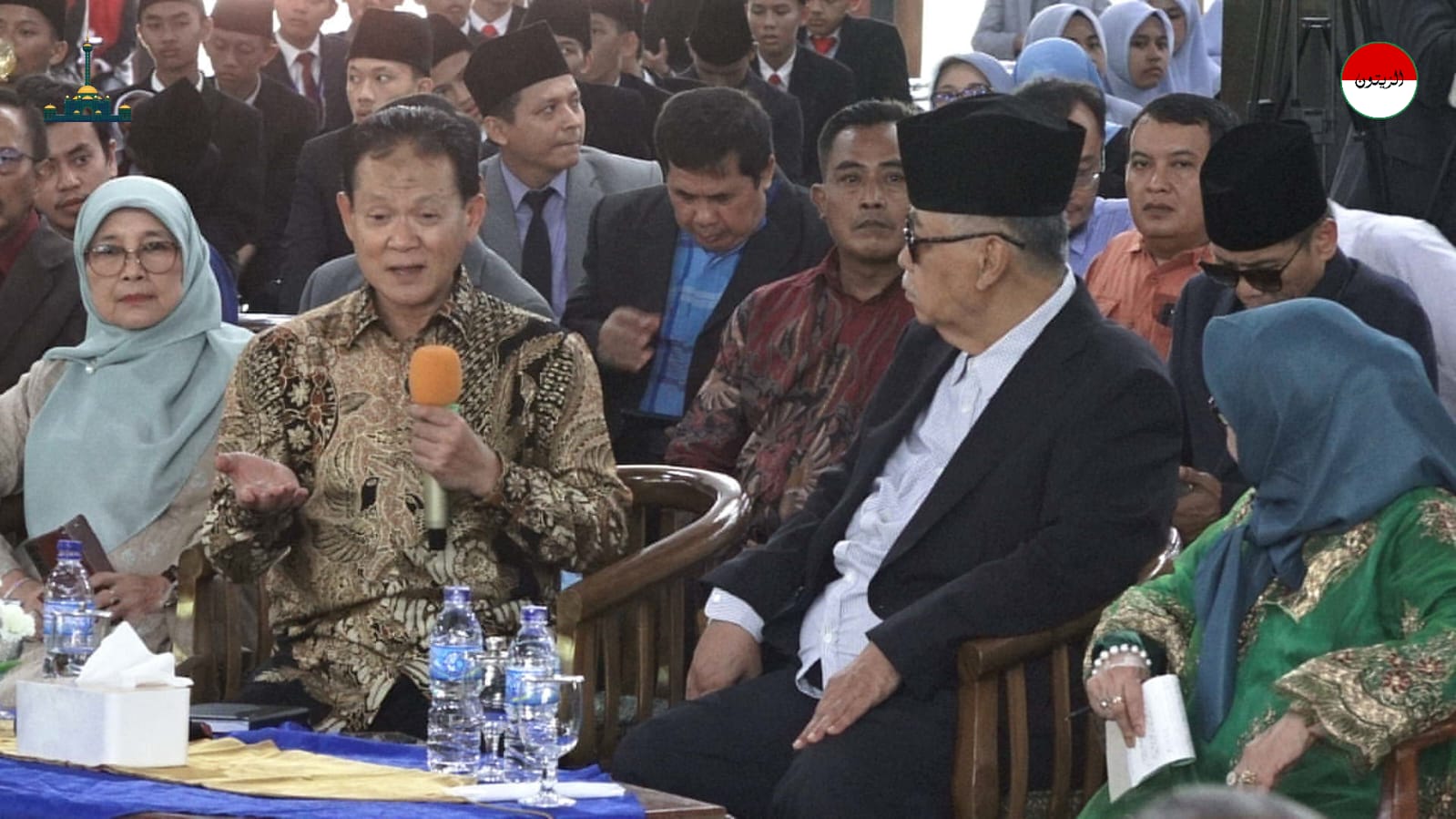
Al-Zaytun’s 43rd Student Training Presents Prof. Dr. Ir. Rokhmin Dahuri, MS. Discussing Indonesia’s Golden Path from Education tog Agro-Maritime
Al Zaytun Islamic Boarding School consistently upholds its long-standing commitment to educating humanity, not just teaching knowledge.
Since its inception on June 1, 2025, every Sunday, the Al-Zaytun Boarding School has consistently held Student Training (PPD): a forum for intellectual, spiritual, and leadership development that brings together students, teachers, lecturers, and educational administrators with national figures and professors from various disciplines. On Sunday, May 3, 2026, the forum entered its 43rd session.
This is no small number for a weekly agenda that demands persistent ideas, disciplined implementation, and a sincere vision.
In this 43rd session, Al Zaytun presented a figure with comprehensive experience in academia, bureaucracy, politics, and national activism: Prof. Dr. Ir. Rokhmin Dahuri, M.S.
He is known as a member of Commission IV of the Indonesian House of Representatives (DPR RI), former Minister of Maritime Affairs and Fisheries in the National Unity Cabinet and the Gotong Royong Cabinet, a senior academic, marine scientist, bureaucrat, politician, and national development activist.
His presence at PPD 43 was not merely a public lecture. He came bearing both intellectual angst and a powerful prescription for how Indonesia must be saved through transformation of education, the economy, and national leadership.
Not Just a Lecture, But a National Diagnosis
From the beginning of his presentation, Prof. Rokhmin Dahuri did not take the safe path of a ceremonial speaker.
He immediately positioned the PPD forum as a space for broad thinking about Indonesia’s future.
With material he described as equivalent to “168 pages of lectures in one semester,” Prof. Rokhmin encouraged participants to look at Indonesia not superficially, but at the root of the problem: why such a wealthy country is stumbling toward prosperity.
According to him, there are four absolute requirements for a nation to be advanced, prosperous, sovereign, and blessed by God.
First, the nation must have a sound development roadmap, drawn up by the best people, not just administrative consultants.
Second, it must have superior human resources.
Third, it requires strong political stability.
And fourth, it must be led by competent leaders with integrity.
For Prof. Rokhmin, Indonesia is not truly a poor country.
In fact, Indonesia is “a nation deeply loved by God,” with four basic assets: a large population, abundant natural resources, a demographic bonus, and a strategic geoeconomic position through which approximately 40 percent of global trade passes.
However, all of these assets have not been able to translate into prosperity because, in Prof. Rokhmin’s words, this nation has been entrenched in misguided governance for too long.
“We import and consume more, rather than produce and export,” was the line of criticism he developed before the PPD participants.
Poverty Must Not Be Normalized
Prof. Rokhmin’s presentation became even more pointed when he touched on poverty data.
He rejected overly lenient statistical measures.
According to him, poverty cannot be measured solely by mere survival, but by the ability to adequately meet six basic human needs: food, clothing, housing, health care, education, and transportation.
Referring to World Bank measurements, he stated that an ideal Indonesian family needs an income of around IDR 14 million per month to be considered prosperous.
Meanwhile, in many areas, including the Pantura coast, people still survive on IDR 2 million to IDR 3 million.
At this point, the public lecture did not stop as economic theory.
It transformed into a moral call: that officials, educators, and all elements of the nation must not relax in the face of such brutal social inequality.
Al Zaytun Deemed on the Right Track
Interestingly, amidst his harsh criticism of national governance, Prof. Rokhmin offered scientific appreciation for the educational model developed by Al Zaytun.
Comparing the Western educational system, which excels in science but lacks in spirituality, with the Islamic educational system, which emphasizes the integration of faith, morals, and knowledge, Prof. Rokhmin stated that Al Zaytun has successfully combined the two.
This school, he argued, not only teaches science and technology but also strengthens the faith and obedience of the Islamic faith (IMTAK).
It’s not just producing intelligent graduates but also developing character.
It’s not just teaching students to become job seekers but also training them to become entrepreneurs through agro-based, livestock, maritime, digital, and production independence.
“It’s on the right track,” concluded Prof. Rokhmin, after examining Al Zaytun through the lens of Islamic educational science and the West.
He even stated that, if implemented consistently, Al-Zaytun has the potential to become a center of excellence for the revival of modern Islamic education in Indonesia, and even globally.
This statement was no mere platitude. It came from a professor who has been involved in national policy throughout his life.
From the Lecture Platform to Real Problems in the North Coast
The PPD 43 Forum became even more lively as it entered the dialogue session.
The questions raised did not stop at the ideological level of education, but directly addressed a real issue for the people of North Coast: the government’s shrimp pond revitalization program.
In answering this question, Prof. Rokhmin again demonstrated his position not only as a scientist, but also as a legislator involved in overseeing state policy.
He stated that the government’s intention to revitalize approximately 78,000 hectares of abandoned shrimp ponds in the North Coast was a good step, but its implementation could be flawed if carried out in a monospecies manner, without market analysis, and without involving the people as the primary stakeholders.
According to him, if the entire region were forced to cultivate tilapia exclusively, the threat of disease, overproduction, and market failure would be significant.
Furthermore, he warned of the dangers of large corporations taking over full management, while coastal communities become mere laborers on their own land.
Therefore, he offered three corrections: multi-species ownership, market downstreaming, and the involvement of the people of the North Coast Coast (Pantura) as the primary beneficiaries.
For Prof. Rokhmin, development should not simply produce projects.
Development must produce real prosperity. And the people must be the subjects, not the spectators.
PPD Al Zaytun: A Forum That Not Only Teaches, But Raises Awareness
What makes the Al Zaytun Student Training different is that this forum doesn’t stop at transferring knowledge. PPD is building a culture of thinking.
Every Sunday, participants don’t just listen to speakers, but are forced to consider the nation’s situation, read reality, and then connect it to educational responsibilities.
This is education that prepares humans to become agents of history. Not graduates busy seeking a comfortable place, but a generation ready to improve the situation.
So, when the 43rd session presented Prof. Rokhmin Dahuri, what transpired was not just a public lecture, but a kind of national wake-up call: that Indonesia is too rich to remain poor, too great to continue mismanagement, and too religious to continue losing its moral compass.
At this point, Al Zaytun’s consistent implementation of the PPD for 43 consecutive weeks became more than just an institutional agenda.
It had become a silent endeavor to prepare future Indonesian leaders.
Leaders who are not only adept at calculating economic growth but also understand that progress without faith breeds greed.
Leaders who are not only fluent in technology but also understand that the welfare of the people is the primary measure of a nation’s success.
And if forums like these continue to be maintained, it is not impossible that from Al Zaytun’s learning spaces a generation will emerge that will answer Prof. Rokhmin Dahuri’s concerns: that Indonesia truly needs leaders who excel in knowledge, are strong in faith, and have the courage to side with the people.
Because great nations are not born by chance.
They are born from education pursued consistently.**
Indramayu, May 3, 2026
——-