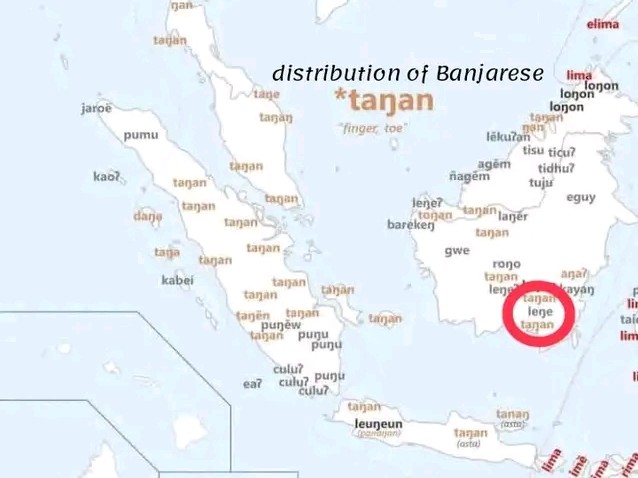
THE SPREAD OF THE BANJAR LANGUAGE TO VIETNAM, CAMBODIA, THE PENINSULA, SUMATRA, JAVA, AND BALI
By: Hamly Hadi, et al.
(History Observer)
According to Prof. Dr. Mahsun, a language expert from the University of Mataram who previously served as Head of the Language Agency at the Ministry of Education and Culture, every proto-language in various language families is a language that only recognizes three vowels: i, u, and a. According to Adelaar, the only language with three vowels is the Banjar Hulu language. Therefore, the Banjar language is Proto-Austronesian, or the origin of a language in the Austronesian language family.
1. The spread of the Banjar language to Vietnam and Cambodia was brought by the Champa kingdom founded by Rajendra Warman from the Tanjung Puri kingdom of South Kalimantan, bringing with it a large number of Banjar people.
2. The spread of the Banjar language to South Sumatra, Bangka Belitung, and Jambi was brought by the Srivijaya Kingdom, founded by Dapunta Hiyang Srijayanasa, who came from South Kalimantan and brought with him 20,000 Banjar people.
3. The spread of the Banjar language to West Sumatra was brought by the Dharmasraya and Pagaruyung Kingdoms, founded by descendants of the Srivijaya Banjar people.
4. The spread of the Banjar language to Malacca, Johor, and Perak was brought by the Malacca Kingdom, founded by Prameswara, a descendant of the Srivijaya Banjar people.
5. The spread of the Banjar language to Kelantan and Terengganu was brought by Banjar people from Champa who fled when the Khmer Empire attacked.
6. The spread of the Banjar language to West Kalimantan was brought by the Tanjung Pura and Wijayapura kingdoms, founded by the Srivijaya Banjar people.
7. The spread of the Banjar language to West and Central Java was brought by the Ancient Galuh Kingdom.
8. The spread of the Banjar language to East Java and Bali was brought by the ancient Barito people, who formed the foundation for the Javanese, Balinese, and Sasak tribes, and then continued through the Medang Kingdom, which was connected to Srivijaya through a political marriage with Dewi Tara of Srivijaya.
That is why the Dong Yen Chau inscription in Vietnam, dated 350 AD, uses the Banjar language.
The 7th-century Srivijaya inscriptions use the Banjar language.
Some bark manuscripts in Gumay, South Sumatra, also use the Banjar language.
The Tanjung Tanah manuscript from the Dharmasraya Kingdom also uses the Banjar language.
The Kerinci stone also uses the Banjar language.
The Terengganu inscription also uses the Banjar language.
The Laguna inscription from the Medang Kingdom, found in the Philippines, also uses the Banjar language.**
Banjarmasin, January 23, 2026
Caption:
Andin Banjar with Rafles Semende and Uli Kozok
——-