IAI Al-Azis Community Service Program in Sukajati: When Data is Wrong and the Future is at Stake
By: Ali Aminuloh
From Sukajati, Community Service Students Read Reality, Sowing Awareness
Numbers may seem convincing, but reality often says otherwise.
Indramayu is recorded as having a low Human Development Index, with an average length of schooling of only 6.7 years. However, in the villages, many residents have surpassed that. A paradox emerges: what is truly left behind is not the people, but the data.
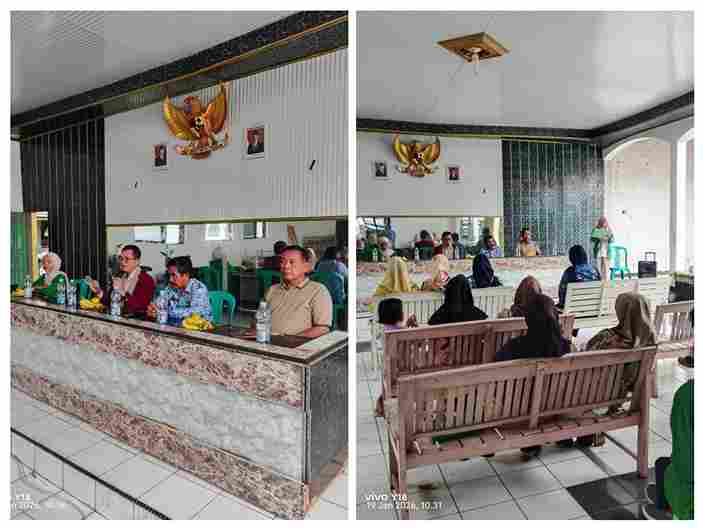
This paradox emerged during the Community Service Program Proposal Seminar held by IAI Al-Azis students in Sukajati Village, Haurgeulis District, Indramayu, on Monday (January 19, 2026). Held in the Village Hall from 10:00 AM to 11:15 AM, this forum was more than just a ceremonial event. It became a space for shared reflection between the campus and the village on the future of Indramayu’s people.
Two Campuses, One Village, One Challenge
This year, Sukajati served as the location for the Community Service Program (KKN) of two universities: IAI Al-Azis, which was present for the first time, and IAI Al Amin, which had been operating since last year. For efficiency, the work areas were divided into two: Al-Azis handled Blocks 1 and 2, while Al Amin handled Blocks 3 and 4.
The Acting Village Head of Sukajati, Aleh, along with the Head and members of the Village Consultative Body (BPD), village officials, Family Welfare Movement (PKK) activists, and the heads of neighborhood associations (RW) and neighborhood associations (RT) were in full attendance. The village provided the space, while the universities brought their ideas.
Tri Dharma Meets Real Issues
Because the Field Supervisor was unable to attend, the academic welcome was delivered by Dr. Ali Aminulloh, M.Pd.I., a non-DPL lecturer. He conveyed respectful greetings from the rector and the Al Zaytun family, then reiterated the essence of KKN as the implementation of the Tri Dharma of Higher Education: education, research, and community service, three things that must proceed simultaneously.
Students, he said, learn to live in society, research real-life issues, and simultaneously apply their knowledge. In this Community Service Program (KKN), research is directed at three core areas: education, law, and da’wah and communication, with the hope of producing concrete recommendations for improving Indramayu in the form of reputable scientific journals.
This is where the discussion heated up. Ust. Ali touched on the low Human Development Index (HDI) and the high ATS (Adolescent Education Status) figure, which is said to reach around 40,000. However, upon further investigation, many residents have actually pursued higher education, but are simply not yet registered in the population administration.
He gave a personal example: his Family Card still lists him as a bachelor’s degree graduate, even though he has actually completed a doctoral degree. This statement was echoed by the Village Consultative Body (BPD) Chair and the village officials present. The HDI problem isn’t just education, but also data updating.
From Data Validation to National Ideas
The KKN students offered a solution: sample-based ATS data collection and direct field validation, and then opened up the possibility of developing an Android-based application to facilitate updating residents’ education data. If successful, this idea has the potential to become a national model, as similar problems occur in many regions.
However, Ust. Ali emphasized one key: collaboration. Academics, village officials, and community leaders must work together. Students also need guidance, as they are learning, including understanding local culture.
Higher Education as a Path to Change
During the forum, Ust. Ali also encouraged the residents of Sukajati Village to view KKN (Community Service Program) not merely as a temporary visit, but as a bridge to higher education. He encouraged parents to send their children to IAI Al-Azis, while introducing existing study programs and plans for the development of new ones.
His message was simple yet strategic: sustainable change does not come from outside, but from the local people themselves.
This call became even more relevant when he linked it to the grand plan for the development of West Indramayu. With the designation of West Indramayu’s zero point as a new growth center, the pace of development is guaranteed to be rapid: industry, infrastructure, and the economy will accelerate.
However, he warned that if the quality of local human resources is not prepared, the community will become mere spectators in their own land. The key lies in education.
Ready Village, Students on the Move
Acting Village Head Aleh explained the conditions in Sukajati: 38 neighborhood units (RT) and 13 neighborhood units (RW), the area is dominated by housing and shops, with around 20 percent rice fields. The residents’ economy relies on home industries, especially tofu and tempeh production.
“We are open 24 hours a day,” he said. “We are happy and ready to make this collaboration with the KKN students a success.”
The Deputy Chairman of the Village Consultative Body (BPD), H. Wawan Darmawan, a former official from the Education Office, emphasized the urgency of improving the residents’ education. He emphasized the need to upgrade the six-year compulsory education to nine years, and ultimately to a 12-year vision. “West Indramayu will become an industrial area,” he said. “The minimum requirement for employment is high school. Don’t let residents become mere spectators.”
From Data to Digital
The work program was presented by the Head of the Sukajati KKN Group, Iskarimatunnisa, a student in the KPI Study Program. During over the next month, students will implement eight programs: ATS data collection and validation, anti-bullying education, creativity from waste, TPS sign and slogan creation, orphan assistance, environmental service, Posyandu mentoring, and digital marketing education for MSMEs, including product packaging design.
The event concluded with a prayer and a group photo, marking the agreement on the plan and the imminent real work ahead.
Epilogue: Human Development Begins with Honest Data
The KKN (Community Service Program) in Sukajati taught a fundamental lesson: human development does not begin with concrete figures and numbers, but with honesty in reading reality and a serious commitment to preparing the next generation. When data is flawed and the future is at stake, students emerge with a mirror: for the village, for the campus, and for all of us. From Sukajati, a resounding message resonates: if you want to be an agent of change, education is a path that cannot be delayed.**
Indramayu, January 20, 2026
——-