By: Hamly Hadi
(History Observer)
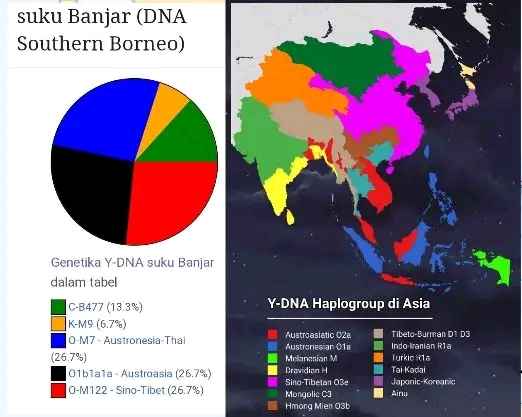
The Banjar tribe was formed thousands of years before Christ. Its DNA composition is 80.1% dominated by DNA from East Asia (now China), namely Austronesian from Taiwan, Austroasiatic from mainland Indochina and Sino-Tibetan from northern China bordering Mongolia, mixed with small amounts of ancient DNA such as Melanesian and Indo-Iranian.
1. C-B477 (Melanesian) 13.3%
The earliest inhabitants of the archipelago arrived from the African continent (out of Africa) around 60,000 years ago. After the arrival of the Austronesian and Austroasiatic peoples, they moved to eastern regions such as Papua and Benuaq, Australia.
2. K-M9 (Indo-Iranian) 6.7%
The Y-DNA haplogroup K-M9 is an ancient lineage that emerged around 47,000-50,000 years ago. Geneticist Spencer Wells argues that because haplogroup K has a wide geographic distribution, the lineage likely originated near the center of this range in the Middle East or Central Asia, perhaps in Iran or Pakistan.
3. O-M7 (Austronesian) 26.7%
Haplogroup O-M7 is associated with the expansion or migration of populations from China, believed to have originated in Taiwan around 3,000-4,000 years BC.
4. O1b1a1a (Austroasiatic) 26.7%
Haplogroup O1b1a1a (M95) is believed to have originated in mainland Indochina in the Mekong River Delta and migrated to the Indonesian archipelago around 500 years BC.
5. O-M122 (Sino-Tibetan) 26.7%
Haplogroup O-M122, sometimes referred to as O2 (formerly O3), is a genetic marker for many Sino-Tibetan-speaking groups, such as Chinese, Tibetans, Japanese, and Koreans.
The Y-chromosome DNA haplogroup O-M122 (often abbreviated as O) arrived in the Indonesian archipelago through several waves of migration, primarily associated with the spread of Austronesian speakers that began around 4,000 to 3,500 years ago (around 2000-1500 BC).**
Banjarmasin, January 8, 2026
——-