Rokania University’s Police Science Study Program Holds Community Service on the Dangers of Narcotics
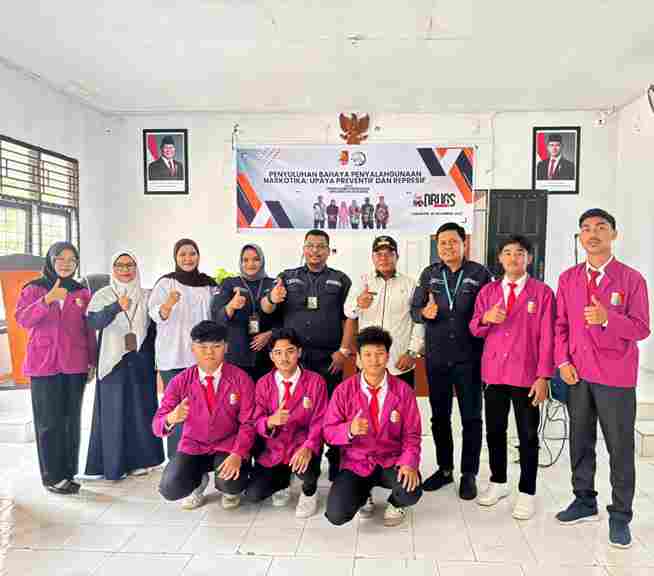
LANGKITIN ROHUL-JAYA NEWS.COM — The Rokania University Police Science Study Program held a Community Service (PKM) activity with the theme “The Dangers of Narcotics Abuse: Preventive and Repressive Efforts” in Langkitin Village, Rokan Hulu Regency, on Wednesday, December 10, 2025.
This activity is a manifestation of the implementation of the Tri Dharma of Higher Education and a tangible contribution from the university to raising public awareness of the threat of narcotics.
The event was chaired by Arfika Nurvita Sari, S.I.Kom., M.I.Kom., with the support of a team of lecturers:
Rabiuladawiyah, S.H., M.H., Resti Hefriyenni, S.H., M.H., Budi Hartono, S.H., M.H., Fat Haryanto Lisda, S.Sos., M.Krim., and Ramses Hutagaol, S.H., M.H.
The outreach took place in the Langkitin Village Hall and received a warm welcome from residents. Village officials, community leaders, youth, and a group of housewives were in attendance. The event was interactive, marked by a question-and-answer session and active discussion between the presenters and participants.
Rabiuladawiyah, S.H., M.H., Head of the Police Science Study Program at Rokania University, emphasized the importance of drug prevention efforts starting from the smallest community, the village.
“The dangers of narcotics aren’t just a threat in big cities. Villages are also vulnerable. Therefore, collaboration between academics and the community is crucial to breaking the chain of drug trafficking,” he said.
He added that Rokania University’s commitment to Langkitin Village extends beyond a single activity.
“We’re not just here once. There will be follow-up programs in the form of legal education, mentoring, research, and youth development. We hope Langkitin can become a model drug-free village,” said Rabiuladawiyah.
Langkitin Village Head, Refli Nasution, expressed his appreciation for this initiative. He stated that narcotics can be a gateway to various forms of crime in villages.
“If drugs enter, other crimes will emerge, including palm oil theft or the ‘palm oil ninja’ phenomenon. We don’t want that to happen in Langkitin. Therefore, we welcome the collaboration with Rokania University,” he explained.
In addition to the teaching team, this activity also involved students from the Police Science Study Program: Ahmad Habibi, Daffa Aulia Sadri, Dika Ananda Eka Putra, Diki Ananda Eka Putra, Pajar Ramadan Habibullah, and Nur Ash Shafirani.
The students’ involvement was part of the practical learning process in the field, ranging from community service, event coordination, documentation, and persuasive legal education to residents.
As part of the activities, an Implementation Agreement (IA) was signed between the Rokania University Police Science Study Program and the Langkitin Village Government. The collaboration covers various areas, including:
* student internships and practicums,
* sending lecturers as resource persons,
* research and studies,
* holding seminars,
* community service,
* youth development and empowerment,
* village security training,
* joint research, and
* strengthening community social capacity.
The Langkitin Village Head expressed high hopes for the continuation of this collaboration.
“We hope this synergy doesn’t stop at the signing. We want to see concrete activities follow, such as youth development, improving village security, and providing legal assistance to the community. With the support of the Rokania University Police Science Study Program, we are optimistic that Langkitin Village can develop into a strong, independent, and drug-free village,” said Refli Nasution.
During the training, participants enthusiastically asked questions about drug trafficking methods, legal implications, and preventative measures within the family environment. The teaching team emphasized the importance of prioritizing preventative efforts through education and social supervision, as well as repressive efforts through prompt reporting and law enforcement.
This Community Service Program (PKM) activity received a positive response from the community. Residents hope that similar activities can continue to be held as an effort to build a safe, healthy, and drug-free village.
Riski Nanda
——