When the Violin Harmonizes with the Angklung: A New Musical Milestone for Ma’had Al-Zaytun
By: Ali Aminulloh
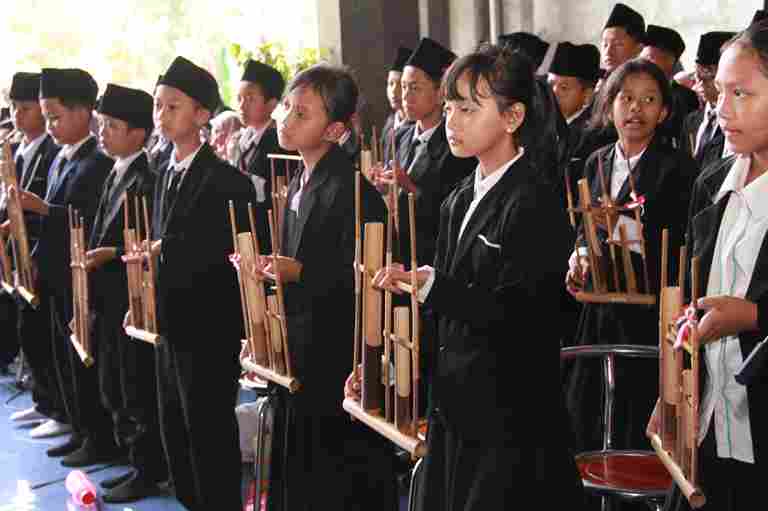
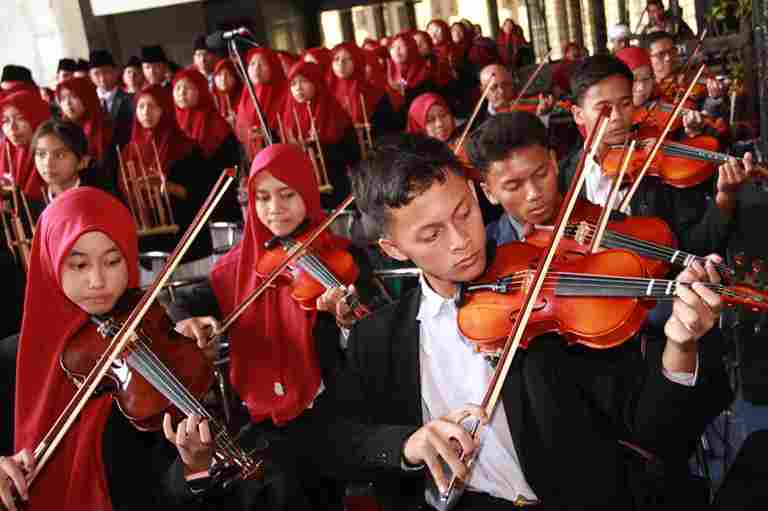
The sound of the violin flows gently, the piano builds harmony, while the *angklung* and *gendingan* evoke the distinctive resonance of the Indonesian archipelago. On stage, modern and traditional instruments do not stand apart; they converge in a single composition, giving rise to a musical language that reflects the ethos of education at Ma’had Al-Zaytun: grounded in national culture yet bold enough to step toward a global horizon.
This performance was a highlight of the 27th-anniversary celebration of Ma’had Al-Zaytun on August 27, 2026. For the first time, Al-Zaytun presented an orchestra that blended piano and violin with traditional instruments—specifically the *angklung* and *gendingan*.
The presence of this orchestra is more than just entertainment; it is part of an educational process designed with deliberate intent and long-term vision. A key feature of education at Ma’had Al-Zaytun is equipping students with solid artistic proficiency. Art is positioned as a vital element in shaping a well-rounded individual—one who is knowledgeable, skilled, appreciative of beauty, capable of collaboration, and deeply attached to their nation’s culture.
Advancing the Arts
Ma’had Al-Zaytun does not limit itself to basic artistic activities. The institution has taken a significant step forward by establishing an orchestra that serves as a space for learning, character building, and talent development among its students.
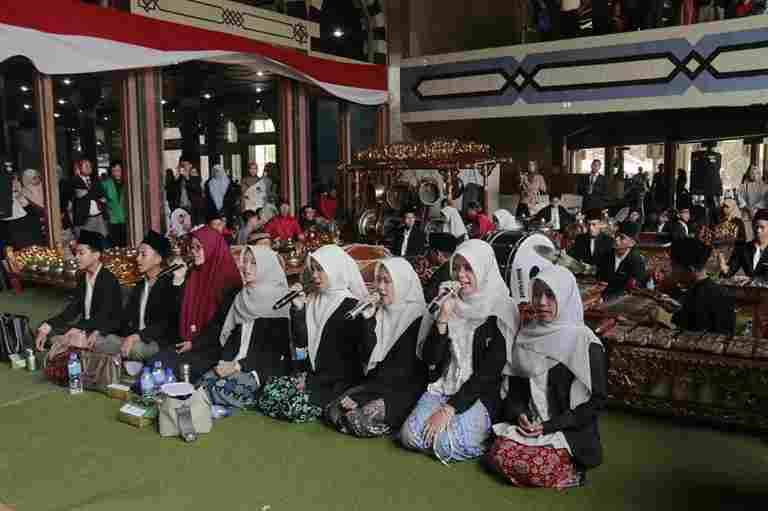
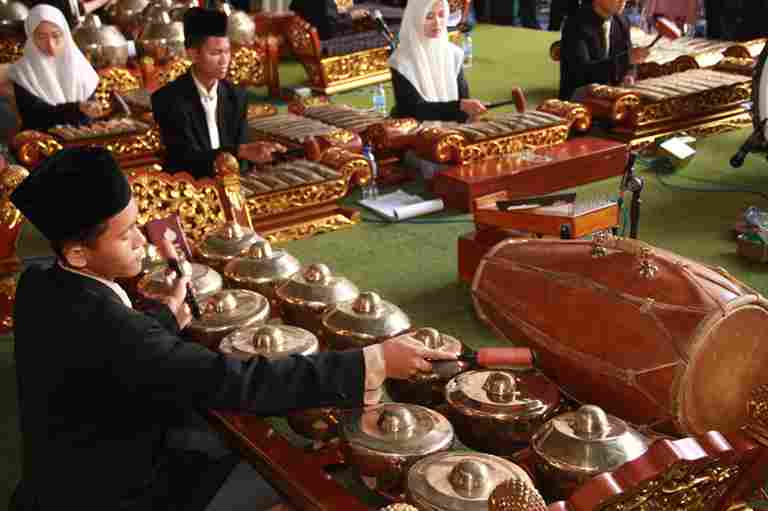
Generally, an orchestra is a large ensemble of musicians playing various instruments together under the direction of a conductor. Orchestral instruments are typically categorized into four main families: strings (such as violins and cellos), woodwinds (such as flutes and oboes), brass (such as trumpets and trombones), and percussion (such as timpani and cymbals). However, the Al-Zaytun orchestra offers a unique distinction. Within it, standard orchestral instruments blend with the richness of traditional Indonesian instruments. Pianos and violins engage in a musical dialogue with the *angklung* and *gendingan* (traditional ensemble music). This fusion creates a soundscape that is not only beautiful but also conveys a powerful cultural message.
Al-Zaytun seems to assert that progress need not come at the expense of traditional roots. Modern music can coexist with the cultural heritage of the Indonesian archipelago; the two can reinforce one another, sparking new creativity without sacrificing national identity.
From the Greek Stage to the Al-Zaytun Stage
The term “orchestra” derives from the Greek word *orkhestra*, which in ancient Greece referred to the stage area where the chorus sang and danced. By the 17th century—the Baroque era—early forms of the modern orchestra began to emerge in Europe, primarily to accompany opera performances.
During the 18th and 19th centuries—spanning the Classical and Romantic eras—great composers such as Joseph Haydn, Wolfgang Amadeus Mozart, and Ludwig van Beethoven helped standardize the composition and instrumentation of the orchestra. As the Romantic era unfolded, the number of performers grew, with some orchestras involving more than a hundred musicians.
Today, this long artistic journey has found a new venue for expression at Ma’had Al-Zaytun. The orchestra is not merely adopted as a foreign musical form but is developed through a creative encounter with Indonesian culture. The *angklung* and *gendingan* are not included as mere embellishments; rather, they are integral to the musical character being cultivated.
The orchestra’s formation has been guided by experienced instructors. Orchestral training is led by Veri Wijaya, S.Sn., from Solo, alongside Agung Setiawan, while *angklung* training is conducted by Dra. Dian Dianawati P, M.Sn., from the West Java Cultural Studio (*Sanggar Budaya Jawa Barat*). Through a structured training process, the students learn to master their instruments while grasping the discipline of making music within a large ensemble.
Harmony That Fosters Togetherness
In its debut performance, the Ma’had Al-Zaytun orchestra presented three songs: “Falling in Love,” “Gebyar-Gebyar,” and “Tanah Air.” Each piece evoked a distinct musical atmosphere, ranging from gentle, beautiful melodies to stirring expressions of patriotism and love for the homeland.
“Gebyar-Gebyar” radiated a fiery spirit of nationalism, while “Tanah Air” stirred deep emotion and a profound love for Indonesia in the audience. The inclusion of the *angklung* and traditional *gendingan* elements infused the music with the authentic soul of the archipelago.
Orchestras possess the advantage of a rich tonal palette, or timbre. The blend of diverse instruments creates a vast sonic spectrum, spanning from the softest, most delicate strains to grand, majestic compositions. Orchestras also command extraordinary dynamic range, capable of shifting seamlessly from subtle *pianissimo* passages to the thunderous power of *fortissimo*.
It also embodies a complex harmony. Multiple melodic lines can be played simultaneously without interfering with one another. Each musician has a distinct role, yet all must adhere to the same tempo, musical score, and conductor’s direction.
This is where the orchestra holds profound educational value. It is not enough for a musician to simply be skilled at playing their instrument; they must also listen to others, exercise restraint until their turn arrives, maintain precise timing, and blend their personal expression into the collective harmony.
The orchestra teaches us that beauty does not arise from sounds striving to stand out in isolation. Rather, beauty is created when diverse elements find their place within a unified whole.
The debut performance at Ma’had Al-Zaytun’s 27th anniversary marks the beginning of a new chapter. In line with the theme “Welcoming Indonesia’s Centenary of Independence by Increasing Investment in Quality Education,” the development of the orchestra serves as an investment in culture and education for future generations.
Through the orchestra, Ma’had Al-Zaytun does more than teach students to play notes; it trains them to build harmony, uphold discipline, respect diversity, and cherish Indonesian culture.
When the violin, piano, *angklung*, and traditional *gending* melodies blend together, what is heard is more than just music. Resonating within the sound is an aspiration: to shape a generation capable of standing tall on the global stage without losing the rhythm of their homeland.**
Indonesia, September 5, 2026
——-