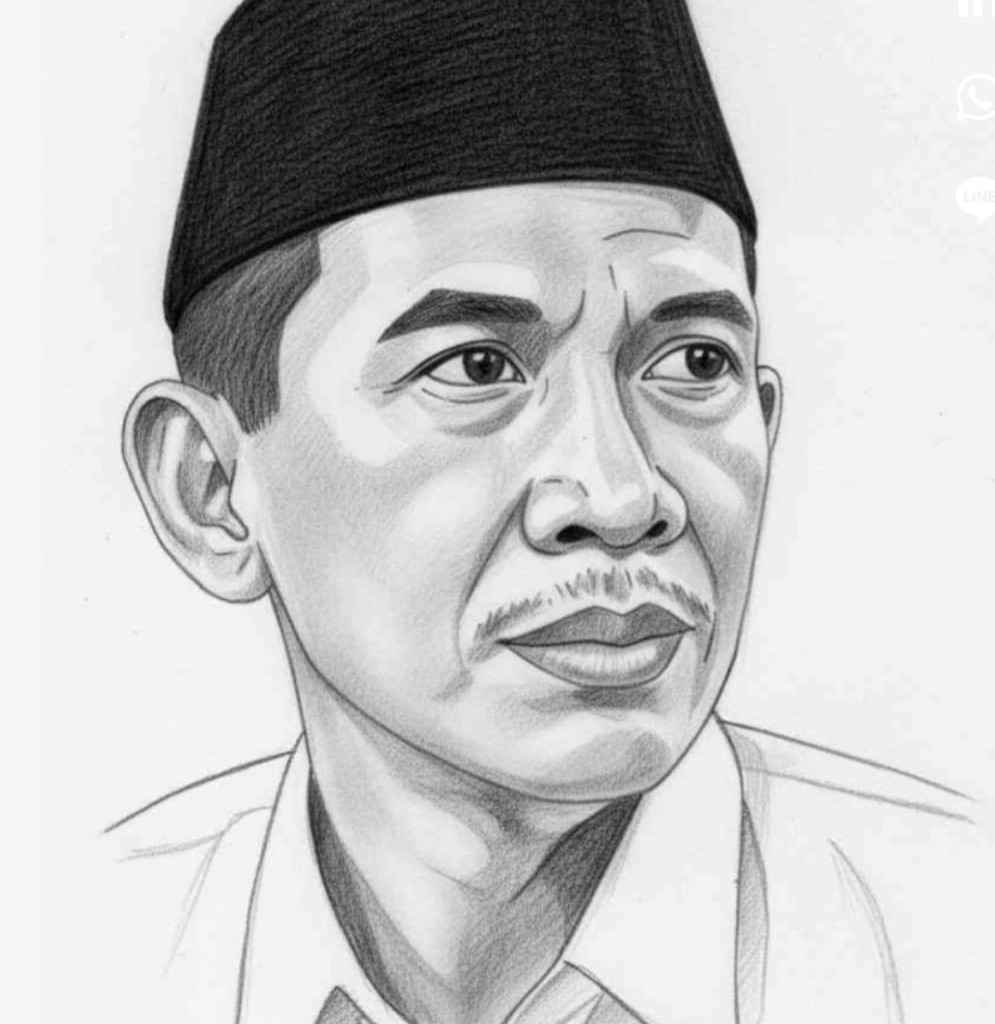
H. CUCUN, THE DEPUTY SPEAKER OF THE HOUSE OF REPUBLIC OF INDONESIA, NEEDS TO BE DEFENDED TO PREVENT PROVOCATION OF PUBLIC HATE AGAINST OFFICIALS
By: H. Adlan Daie
Political and Socio-Religious Analyst
H. Cucun, the deputy speaker of the House of Representatives of the Republic of Indonesia, is clearly imperfect in his position as a state official. Therefore, public criticism is crucial to maintain the “checks and balances” within a healthy and dignified democratic system.
However, he needs to be defended from the danger of provoking public hatred against state officials—precisely to prevent the destruction of the foundations of democracy due to the “anarchy” of public opinion.
The aforementioned view of political moderation is important in the context of H. Cucun’s statement about the unnecessary use of “nutritionists” in the MBG (Free Nutritious Meals) program at an event in Soreang, Bandung, West Java, which was subjected to intense and disproportionate bullying.
Even social media accounts run by the intellectual middle class, such as “Tempo” and “Nurchilis Madjid Society,” provocatively called for his resignation from his position as Deputy Speaker of the Indonesian House of Representatives, accusing him of lacking empathy for the people.
Mezar Assirry’s article, “Cucun Syamsurijal: Understanding the Psychology of Officials’ Communication Acrobatics,” and MT. Daniealdi’s article, “Questioning the Quality of Communication of Indonesian House of Representatives Leaders in the Gen Z Political Era,” published by “Kompas.com” (November 18, 2025), tended to amplify public hatred of officials.
Especially in the era of the social media boom, where even minor political events can easily be exaggerated, taken out of context, and overblown, inciting public hatred against state officials.
H. Cucun’s apology for his “carelessness” in the media—perhaps due to psychological exhaustion—in the author’s opinion, should have ended the debate. It needn’t have been capitalized on and politicized by provoking public “hatred” against the “arrogance” of officials.
This isn’t about H. Cucun personally, but allowing the “anarchy” of public opinion to continue unabated is clearly unhealthy for the collective effort to consolidate and build a mature democracy.
Public criticism must be prevented from being diverted into mass hatred against public officials, unless it is constructive criticism that is strong, dignified, and enlightening.
With a slight adaptation of Isabel Ortiz et al.’s study from 2006 to 2013 on the triggers and distortions of protests, it is clear that the massive public protests against H. Cucun are beginning to be diverted into public opinion anarchy, a phenomenon that could repeat what happened in the August 2025 protest riots.
The pattern is similar: social media algorithms are being used to amplify the protests, creating a catalyst for social division by sharpening hatred—and then transforming them into “attacking” riots, physical attacks.
This creates an “echo chamber,” a space where people group together to consolidate hatred against others, in this context, hatred against public officials. As a result, moderates become radicalized, and radicals can become even more extremist.
Even more dangerous, artificial intelligence (AI) is now becoming increasingly involved, emerging as a platform for “deepfakes”—a highly convincing fake video. Public protests are being more easily and quickly mobilized via mobile phone screens, inciting collective public emotion into a mass of physical protests on the streets, potentially triggering riots.
This means that social media accelerates the transmission of emotions. Short videos or brief provocative narratives undermine real events. Emotions congeal and overtake accuracy. The amplification of hatred often drowns out verification and healthy dialogue.
This is what is called an “agent provocateur” in the literature on social movements in the era of social media algorithms: individuals or small groups called “influencers,” specifically “buzzers,” who infiltrate with hidden agendas. They are not there to maintain “checks and balances.”
They appear on social media platforms to shift the direction of the national conversation into a catalyst for unrest in the name of democracy. Platforms are deliberately designed for engagement that tends to promote a single, explosive emotion—not one that calms and enlightens the public.
Democracy must be nurtured and protected from the anarchy of public opinion driven by a handful of individuals in the name of intellectuals and the falsehood of “civil society” movements that amplify public hatred toward public officials.
For us today, this is not the time to create chaos in the name of democracy, but rather a just social contract. Not the venting of “unlimited” anger, but the responsible courage to bring about a civilized democracy.
Otherwise, democracy, citing Francis Fukuyama as a noble and civilized path, is simply noise that does not produce a dignified system of “checks and balances” but rather fosters popular hatred towards the people public officials.
If this continues, not only Sahroni, Uya Kuya, Eko Patrio, and Nafa Urbach—members of the Indonesian House of Representatives—will be victims of this agitation, but it could also happen to H. Cucun and other members of the Indonesian House of Representatives.
Democracy has ultimately become nothing more than a platform for “massacres” of officials, a crime disguised in the name of democracy. It must be prevented from happening again. **
Indramayu, November 19, 2025
Wassalam.
——