From Silica Sand to Eggshells: Inspiration for Civilization from Al-Zaytun
by Dr. Ali Aminulloh, M.Pd.I., ME
A Sunday Full of Enlightenment
For many, Sunday is a day off. However, at Ma’had Al-Zaytun, every Sunday is a highly anticipated occasion. It’s not just a gathering, but a space for scientific encounters. Every week, professors from various universities attend, sharing their insights within the LSTEAMS (Law, Science, Technology, Engineering, Art, Mathematics, and Spiritual) framework.
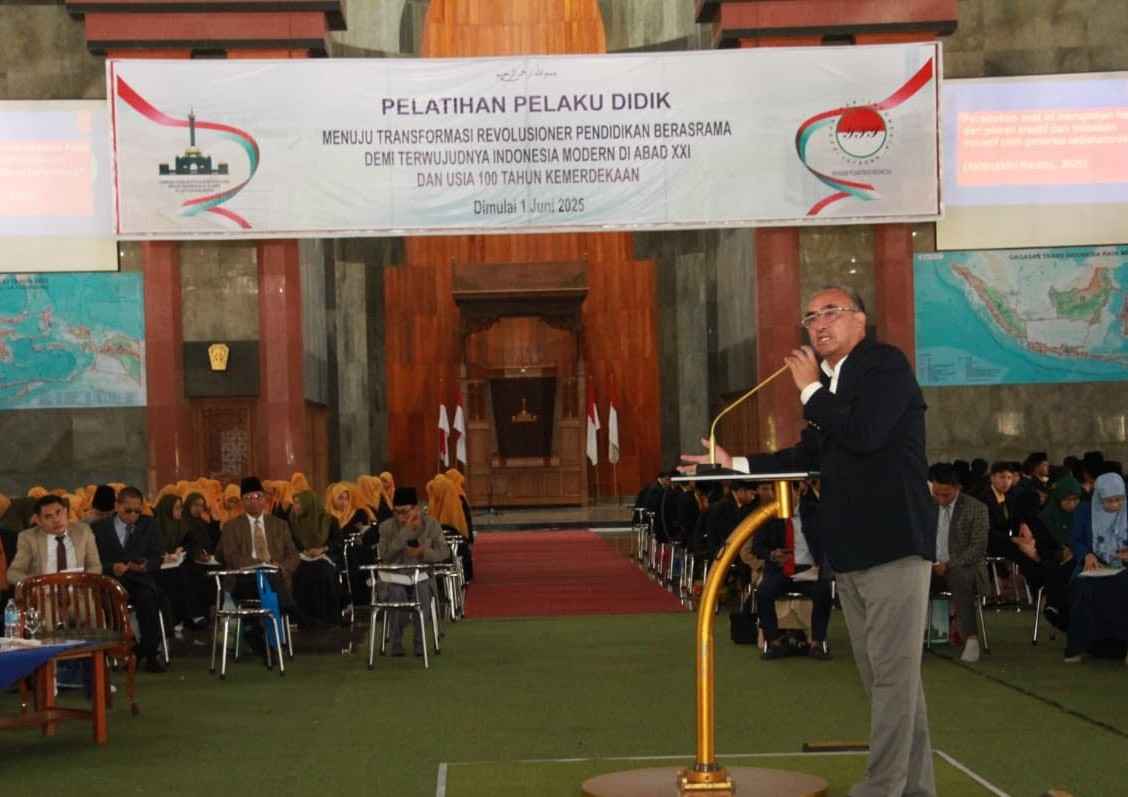
On Sunday, September 14, 2025, the atmosphere at the Rahmatan lil Alamin Mosque was filled with enthusiasm. The 15th Student Training Session featured a familiar figure in the world of physics: Prof. Dr. Akhiruddin Maddu, M.Si., Professor in the Department of Physics, Faculty of Mathematics and Natural Sciences, IPB University. With burning enthusiasm, he raised the theme: “Transforming Natural Resources into Advanced STEM-Based Materials.”
Behind his academic presentation, there lurked a simple yet compelling message: future civilization will only be born from creativity and innovation, not merely from memorizing theories.
Creativity and Innovation: The Flame of Civilization
“Creative thinking is the art of seeing problems from a new perspective,” said Prof. Akhiruddin. He emphasized that ideas without action are merely wishful thinking. Creativity only becomes valuable when realized in the form of real innovation.
To illustrate this point, he mentioned the story of the light bulb. From Edison’s energy-wasting incandescent bulb to the modern, energy-efficient LED, all were born from the courage of previous generations to think outside the box. “Imagine if no one dared to change, perhaps our world would still be shrouded in darkness,” he added.
According to him, cultivating a creative mindset must begin early, even in early childhood education. Literacy and curiosity about the natural world are the foundation for producing an innovative generation.
LSTEAMS: Collaboration That Transcends Boundaries
The progress of civilization, he continued, cannot rest on one field of science alone. The present era is an era of interdisciplinary collaboration.
He explained the LSTEAMS concept—a unique combination:
Law: values and morals as the basis for the direction of scientific development.
Science: the systematic process of understanding the world through observation and experimentation.
Technology: the concrete application of science that yields benefits.
Engineering: the ability to engineer, build, and solve problems.
Art: an aesthetic touch that makes work more meaningful.
Mathematics: a universal language that binds all disciplines.
Spiritual: the soul that guides science to provide broad benefits.
“Without morals, technology can be destructive. Without art, work is uninspired. Without mathematics, science loses its language. This is why collaboration is key,” he emphasized.
From Waste to Advanced Materials
The most captivating part of Prof. Akhiruddin’s speech was the story of his research on advanced materials. He showed how Indonesia’s natural wealth—even waste—can be processed into valuable assets.
Silica Sand: The white sand of the Riau Islands contains silicon, the basic ingredient in microprocessors. Ironically, Indonesia still sells it raw and then buys back the finished product at a high price.
Pineapple Peels & Rice Husks: In his hands, this waste material transforms into radar-absorbing nanocarbon, crucial for defense technology.
Eggshells & Bamboo Leaves: Who would have thought both could emit light, paving the way for the creation of environmentally friendly LEDs?
Each example conveys the same message: what is considered trash can become a gem when touched by creativity.
Ma’had Al-Zaytun: A Living Laboratory for Creativity
Prof. Akhiruddin’s admiration grew even more when he saw the work of Al-Zaytun students firsthand. He discovered a shipbuilding project using nails from scrap metal. “This is clear proof that these children not only dream, but also dare to engineer,” he said proudly.
He even proposed a visionary idea: why not one day become home to Indonesia’s first microchip factory? With abundant natural resources and an undying spirit of learning, it’s not impossible for such an idea to become a reality.
Epilogue: From Knowledge, Civilization is Born
At the end of his presentation, Prof. Akhiruddin left a message that resonated deeply: “Civilization can only change if there are creative and innovative people who dare to take action.”
Knowledge, he said, is not difficult. What’s difficult is our perspective. If we are willing to hone our creativity, open ourselves to collaboration, and see the potential in the small things around us, then even waste can become a blessing, and ideas can become world-changing technologies.
Al-Zaytun that day was not simply hosting a public lecture. He witnessed the emergence of a new civilization—from a spirit of learning, from curiosity, from the belief that knowledge is the light to guide humanity toward a more civilized future.**
Indramayu, September 14, 2025
—