The Supreme Council of Indonesian Confucianism Officially Sets Office in the Tepa Salira Foundation Building
Author: Jacob Ereste
Freelance Journalist
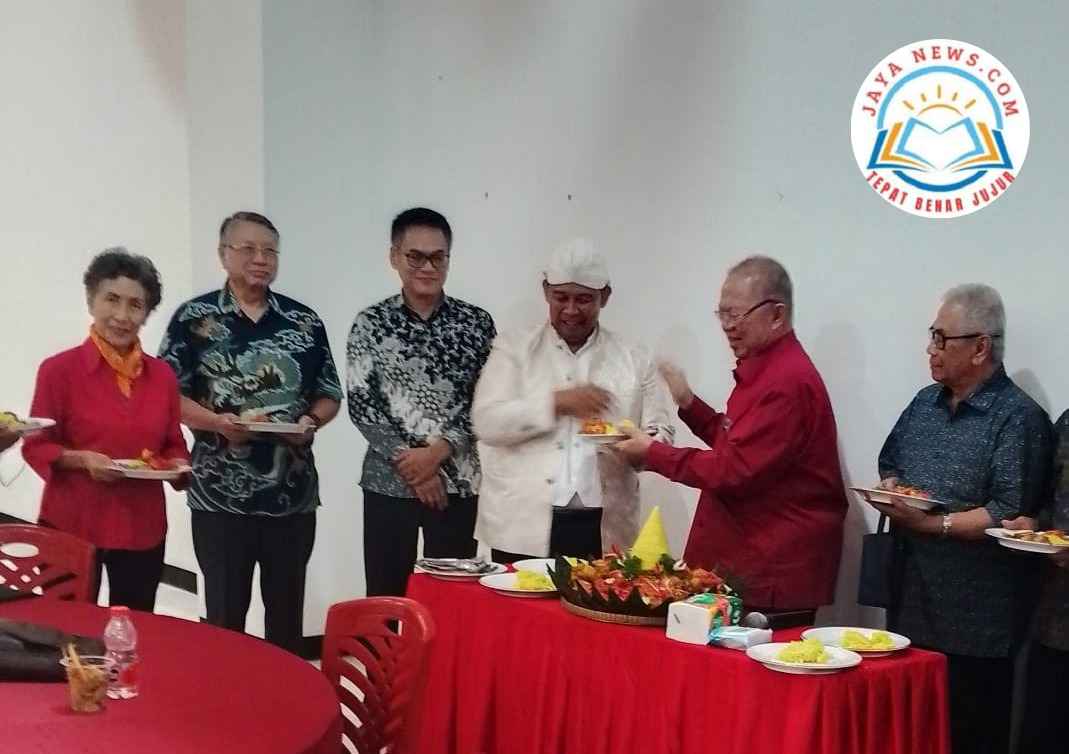
The General Chairperson of Matakin (The Supreme Council of Indonesian Confucianism) XS. Budi S Tanuwibowo and his staff inaugurated the use of the new Matakin Secretariat at the Riko Royal Sunter Complex. North Jakarta, Saturday, May 31, 2025, which occupies the Tepa Salira Foundation Building which was marked by the cutting of tumpeng rice and distributing it to a number of figures, including the Spiritual Leader of the Archipelago, Sri Eko Sriyanto Galgendu who was pleased to give a special speech and prayer in the language of the earth which is the hallmark of his appearance.
The Supreme Council of Indonesian Confucianism (Matakin) is an organization that regulates the development of Confucianism in Indonesia which has existed since 1923 and is the only Confucian organization recognized by the Indonesian government which has an organizational structure starting from the central, provincial and district and city levels called Makin.
Initially named Khonghucu Kauw Tjong Heee, it was founded in Yogyakarta (PKCHI in 1955) then changed again to Persatuan K’ing Chiao Hui Indonesia, until it developed again into Laski (Institute of the Confucian Religion, 1961) and Gapaksi (1963) which was intended as the Association of Confucian Religious Associations throughout Indonesia in 1964.
In 1967, this Chinese religious organization officially used the name Matakin (High Council of Confucian Religion of Indonesia) which has the task and function to supervise Confucian religious institutions in Indonesia.
Starting from guiding Confucianists in various regions, carrying out various religious activities, religious studies and social activities to bring Confucianists closer to society. Including dialogue, discussion and interfaith seminars to build harmonious relationships with people of other religions.
The organizational structure of Matakin is in charge of Makin (Indonesian Confucian Religious Council), Kakin (Indonesian Confucian Religious Service), Sakin (Indonesian Confucian Religious Section) and WUKL (Confucian Community Forum not represented by other organizations).
From various figures and religious leaders and Nusantara Spiritual Leaders, the role of the priest in Confucianism is also explained, called Xue Shi, the highest, who is tasked with guiding Jiao Sheng and Wen Shi in carrying out spiritual tasks that develop Confucian teachings.
Basically, Confucian religious leaders study and develop themselves on the holy path. Therefore, in addition to spreading the teachings and guidance of Confucianism, they are also tasked with providing spiritual services to every Confucian who needs guidance and care.
Belief in Confucianism is the existence of a prophet when he was a child named Kong Qiu alias Zhong Ni, as the son of Khong Shu Liang He and a mother named Yan Zheng Zai.
Syahdan, Confucianism comes from the word Rujiao which means a person who is soft-hearted, educated and virtuous. This religion of the Chinese community is said to have existed since the history of the Prophet Fuxi in 2852 BC (BCE) which was perfected by the Great Prophet Kongzi or better known as Confucianism as it is known today.
Confucianism in Indonesia is said to have existed since the 17th century, such as many of its relics in Pontianak, Kalimantan, there are places of worship for Confucius. Confucianism itself in Indonesia only existed at the end of the 19th century which refers to the formation of Khong Kauw Tjong Heee from the Confucian Community Association in Bandung in 1923. Even so, in the first wave in 1901, the Hoa Hwee Koan Chinese had been formed in Batavia, better known as the Batavia Chinese Association.
That is the story of Matakin who represents the Indonesian Confucian High Council called Matakin. This movement was marked by Chinese citizens seriously formulating the teachings, practices and traditions of Confucianism who came from various regions in Indonesia. And through Gus Dur (Abdurahman Wahid) Presidential Decree No. 6 of 2000 was issued which revoked Presidential Instruction No. 14 of 1967 concerning Religion, Beliefs and Customs of the Chinese which caused Confucianism to experience discrimination. And Presidential Decree No. 6 of 2000 became a turning point towards the official recognition of Confucianism in Indonesia until now, so that the Barong Say performance can be staged like other art performances in Indonesia. Because during the Gus Dur administration, not only did Presidential Instruction No. 6 of 1967 and Circular of the Minister of Home Affairs No. 477/74054/BA.01.2/4683/95 of 1978 revoke freedom for the arts.
Sunter, June 1, 2025
—-