By, Dr. Ali Aminulloh
A nation’s sovereignty is rooted in its ability to educate its people, develop technology, and meet its food needs. These three are interconnected: learning spaces generate knowledge, research transforms knowledge into innovation, and innovation finds its meaning when it meets societal needs. From this relationship, Prof. Ali Zum Mashar encouraged the younger generation to imagine an Indonesia that not only utilizes the work of other nations but also possesses the ability to create.
“Don’t be afraid to dream big. Don’t just be a user of technology, but also a creator of technology,” he advised.
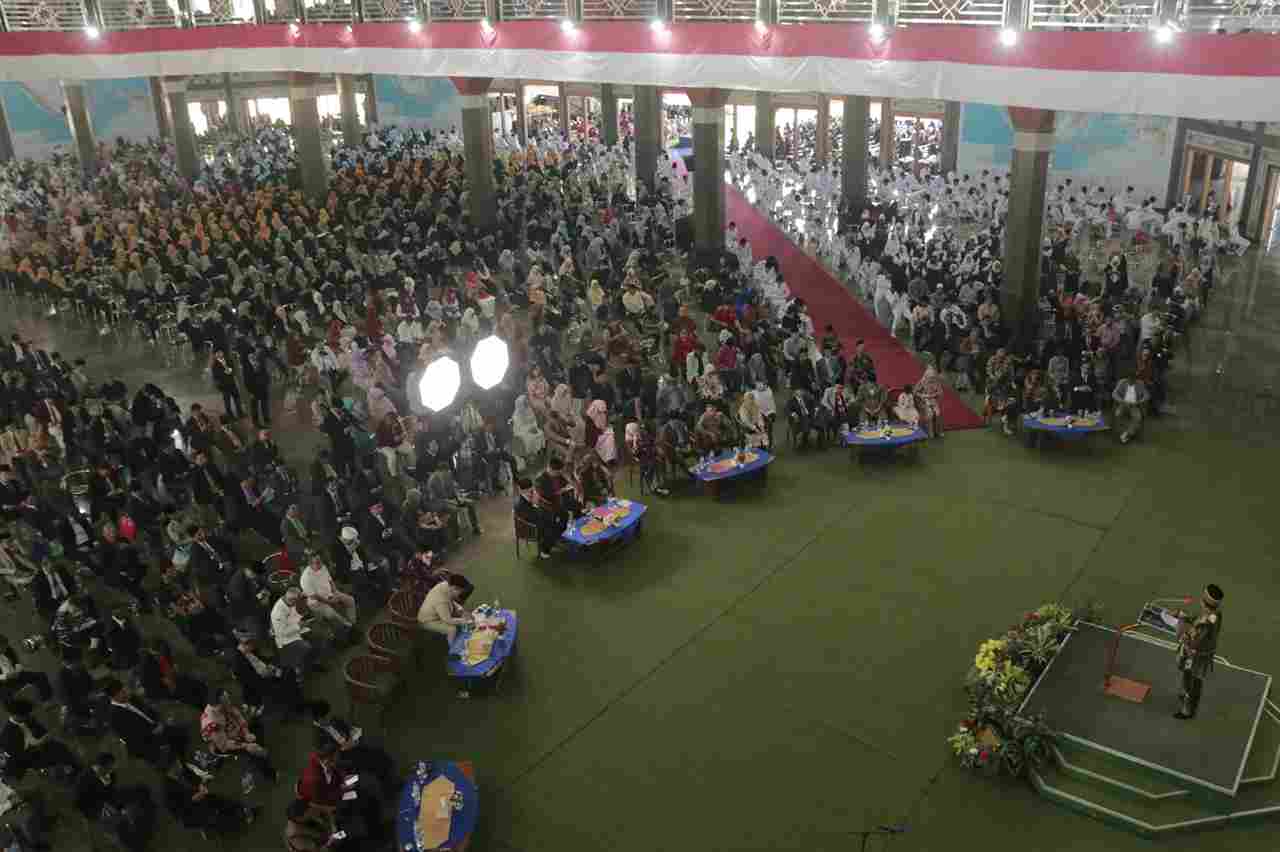
This call was the focus of his scientific speech at the 27th anniversary of Ma’had Al-Zaytun on Thursday, August 27, 2026. Numerous national figures, academics, professors, educators, guardians of students (pesantren), and students (pesantren) attended the celebration, which carried the theme of welcoming 100 years of Indonesian Independence by increasing investment in quality education.
The Director of the MIGO Center for Research, Development, and Application of Biotechnology in Serang, Banten, viewed the anniversary as an opportunity for reflection. While the long journey deserves gratitude, past successes should open the door to discussion about future responsibilities.
“At the same time, we ask: what will we give and contribute to this nation in the future?” he said.
This question shifts perspective: from what we already have to what remains to be done. For Prof. Ali, Golden Indonesia 2045 will not be realized simply because time passes. This ideal requires preparation, especially through the education of the younger generation.
In his speech, he identified three areas as the foundation of sovereignty: education, science and technology, and food. All three are interconnected and mutually reinforcing.
Education prepares individuals capable of thinking, learning, and taking responsibility. Mastery of science and technology enables these individuals to develop solutions. Meanwhile, food sovereignty becomes a field of service where knowledge directly interacts with the nation’s needs.
Within this framework, Islamic boarding school education and boarding school education have a broad scope of tasks. Religious deepening must go hand in hand with mastery of knowledge, skills, moral development, health, productivity, and independence.
Prof. Ali sees these values as part of the education developed by Al-Zaytun. He emphasized the importance of love for the homeland so that the skills acquired by students have a clear direction for service.
In his view, the educated generation needs to move from the habit of consuming to the ability to produce. They are expected to be able to produce something useful, find better ways of working, and participate in solving the nation’s problems.
“Don’t just be consumers,” he said, before urging the students to become a generation capable of producing something for the nation and state.
This message took concrete form when Prof. Ali recounted his research journey in the field of agriculture. He explained that five days before the event, he received the Food Hero award from a national television station and a state-owned enterprise.
However, he did not view the award as the end of the journey. This recognition, he said, was the result of a long process of exploring science and technology to find solutions for agriculture.
One area he is developing is the use of superior microbes to improve soil fertility. He linked this approach to the idea of an agricultural revolution: using knowledge and technology to overcome obstacles to food production.
In his words, soil is more than just a place to plant. Its fertility is an issue that needs to be understood and addressed through research. Thus, agricultural challenges can become both a source of scientific questions and opportunities for innovation.
Prof. Ali also presented achievements in the development of four soybean varieties. According to him, these varieties show higher productivity potential than the subtropical soybeans they were compared to.
He then mentioned the development of 12 Trisakti rice varieties, which, he explained, can be harvested in approximately two to two and a half months.
He presented these achievements as examples of how mastery of science can open up new possibilities. Obstacles that have been considered limiting should not close off research opportunities. In fact, from these obstacles, questions, experiments, and discoveries can begin.
In the framework of his speech, agricultural innovation has a goal that goes beyond the success of a single researcher. He hopes that this technology will help strengthen Indonesia’s ability to meet its own food needs, even contributing to the global food crisis contribution to global needs.
For the *santri* (Islamic boarding school students), that experience serves as a lesson in intellectual perseverance. Becoming an innovator requires a willingness to delve deeply into issues over an extended period. Mastery of knowledge does not stop at merely knowing the answers; it encompasses the courage to ask questions and the drive to find solutions.
Shifting from the topic of food, Prof. Ali returned to the subject of education. Just as agriculture requires dedicated researchers, the nation needs institutions capable of nurturing future researchers, leaders, and community catalysts.
He expressed his appreciation to Syaykh Abdussalam Rasyidi Panji Gumilang for his vision of developing a boarding-school-based education system. In Prof. Ali’s view, the Syaykh is a figure who champions education by prioritizing tolerance and love for the homeland as core values.
He believes that boarding-school education offers a unique opportunity to integrate character building, mastery of science and technology, and leadership training into daily life.
Knowledge provides the capacity to act, while character (*akhlaq*) helps determine the purpose of those actions. Leadership bridges the two through a sense of responsibility toward others. He hopes this integration will serve as the foundation for the “Golden Indonesia” generation.
This hope was linked to the vision of establishing 500 *pesantren* (Islamic boarding schools) or similar residential educational institutions. Prof. Ali welcomed the plan as a way to expand the reach of education, drawing upon the 27-year journey of Al-Zaytun as a source of valuable experience.
The figure of 500 mentioned in his address represents an aspiration for future development rather than a claim that all these institutions already exist. The challenge lies in translating the established educational experience into broader learning opportunities for the nation’s youth.
Ultimately, Prof. Ali united education, science, faith, piety (*taqwa*), and character within a shared mission of service. Education prepares the next generation. Mastery of technology strengthens their capabilities. Faith and character provide the moral grounding to ensure that progress is used to build a virtuous life. Al-Zaytun’s 27th-anniversary commemoration serves as a call to cultivate a generation of creators—a generation that is healthy, productive, and self-reliant; one that loves its nation and possesses the courage to apply knowledge to address real-world challenges.
From the classroom to the laboratory, and from research to the agricultural field, the journey demands the same level of perseverance. The Indonesia of 2045 requires young people capable of bridging the gap between knowledge and service.
Prof. Ali Zum Mashar’s message remains simple: dare to dream big, then equip those dreams with knowledge, skills, and strong character. For a nation’s sovereignty begins to take shape when its youth can declare: “We are not merely capable of using; we are also capable of creating.” **
Indramayu, September 4, 2026
——–