By Ali Aminulloh
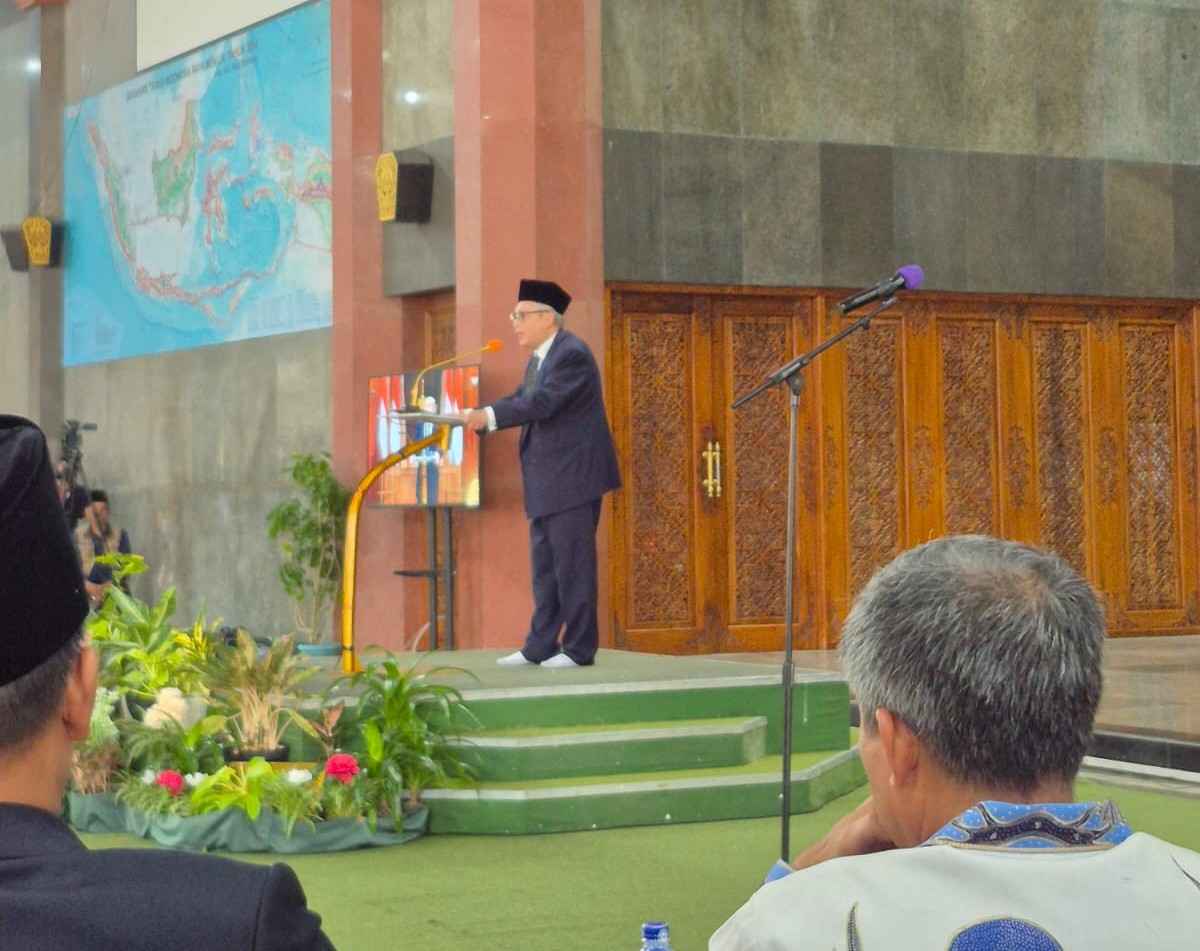
On Thursday, August 27, 2026, Al-Zaytun celebrated its 27th anniversary. The event was not merely a festive occasion; it brought together various figures, academics, and professors who added vibrancy to the celebration. Amidst the speeches delivered, the message from Kiai Peter Budiono Setiawan shone like the morning light: calm and warm, yet reaching far into the future. “Be like the sun,” he urged.
Peter, a friend of the Al-Zaytun *Syaykh* from Canada, stood before the leaders and educators with a deeply personal perspective. He was 73 years old that day. He did not open his remarks with a string of ceremonial praises; instead, he shared his inner reflections from his time at Al-Zaytun.
“This is a great honor for me. In this place, I feel a sense of serenity and peace,” he said.
That sense of serenity served as a gateway to an unusual reflection. Peter began his story with an email he had received from the Chan Zuckerberg Initiative, an organization founded by Mark Zuckerberg and Priscilla Chan. In the email, he read about advancements in protein research—part of the scientific endeavor to understand life and find solutions for various human diseases.
For Peter, progress always begins with the courage to ask questions and the willingness to keep learning. It was this curiosity that led him to use Grok, an artificial intelligence tool that became his conversational partner. Initially, he explored the biological connections between fruit flies and humans. Then, his question shifted: how did *Ma’had* Al-Zaytun begin?
Within seconds, as he recounted, the screen displayed a concise answer regarding the journey of *Syaykh* Abdussalam Rasyidi Panji Gumilang and the founding of Al-Zaytun. Yet, the machine’s speed was not the core of the story Peter wished to convey. Artificial intelligence may well summarize history in a few lines, but behind those lines lies a long human journey, quiet hard work, and sacrifices that often go unrecorded.
Peter recounts the trajectory of the Syaykh’s journey: starting from Gresik, working in Sabah, saving money, and finally returning to his homeland to realize his aspirations.
“Those savings could not have been amassed without effort, patience, and discipline. It simply wouldn’t have been possible,” he asserts.
Upon returning to Indonesia, development began on a tract of swampland that—as Peter notes—was purchased at a very low price at the time. Others might have seen only mud, stagnant water, and limitations. Yet, a vision sees possibilities. It is here that Peter identifies the brilliance of the development: the courage to discern future value in something initially deemed worthless.
With the support of experts, scientists, and foundations, the land gradually transformed into a hub of civilization. The Rahmatan lil ‘Alamin Mosque was erected as a center for worship, alongside educational facilities ranging from primary to tertiary levels, dormitories, guest accommodations, and sports fields. Currently, plans for vocational education through a polytechnic are also underway.
What has grown is not merely a collection of buildings, but an ecosystem for learning, communal living, cultivating discipline, and engaging with the world. This transformation from swamp to educational campus serves as a vivid metaphor for Al-Zaytun’s journey, demonstrating that limitations are not a final verdict.
When vision meets diligent effort, a quiet, desolate tract of land can become a fertile ground for knowledge. Savings accumulated through discipline can evolve into an institution. Even a dream once considered too distant can take shape in reality.
Peter does not turn a blind eye to the various obstacles encountered. He acknowledges that developing an area that was once swamp and wilderness inevitably involved challenges. Yet, he advocates an attitude that transcends mere complaining about difficulties.
“That is life. It keeps flowing. Don’t say there are no obstacles—there certainly are. But there is always a solution,” he says. The sentence was simple, yet it embodied the ethos of a struggle: problems must be faced, understood, and resolved while one keeps moving forward. After all, life never comes to a halt simply because we encounter obstacles.
Drawing on the history of Al-Zaytun’s journey, Peter then invited the audience to look toward the future. He touched upon advancements in space technology, the Starlink satellite network, and humanity’s ambition to continually expand the boundaries of knowledge. He offered a concise answer regarding the future: “You will see.”
His message was not merely about satellites or the possibility of humans living on other planets, but rather about the courage to envision something not yet visible today. In his view, education must prepare people to face a constantly changing world.
Then came the message that left the deepest impression.
“Be like sun.”
The sun, he noted, rises every morning. Its light sets life in motion, causing flowers to bloom and birds to sing. He also described the heart, which works ceaselessly to pump blood every day. Neither the sun nor the heart seeks applause; both faithfully fulfill their roles to ensure life continues.
It is here that education finds its deepest ethic: working consistently, providing benefits, and enlivening one’s surroundings without being preoccupied with demanding recognition. The sun never chooses who may receive its light. This message aligns with the values of love and tolerance that—according to Peter—are both taught and embodied in the life at Al-Zaytun.
Peter expressed both appreciation and a sense of responsibility to the Al-Zaytun community.
“You are a truly fortunate community, able to experience, enjoy, and witness the struggle of someone who acts selflessly,” he said.
That good fortune should not relegate them to the role of mere spectators. They are successors challenged to transform that example into tangible achievements. They must carry on the struggle through knowledge, skills, discipline, and the courage to face the changing times.
Peter places great hope in the generation growing up at Al-Zaytun. He believes individuals will emerge who are capable of bringing Indonesia into the global arena of competition—in trade, sports, and innovation—while simultaneously strengthening the nation as one of the world’s largest democracies.
This hope is not a prophecy that allows people to simply sit and wait; it is a call to prepare oneself—cultivating knowledge, character, skills, and courage—starting right now.
Towards the end of his remarks, a profound sense of gratitude resonated in his voice. Moved by the love and tolerance he experienced, Peter expressed a desire to prostrate in thanksgiving. He even remarked that this opportunity to speak before such leaders and educators might well be his last.
He concluded his address with repeated expressions of gratitude—simple words from someone who felt he had received a great honor.
Ultimately, Al-Zaytun’s 27th anniversary represents more than just a marker of the passage of time. It serves as a reminder that a swamp can be transformed into a place of learning, savings into an institution, and obstacles… …becomes the path, and gratitude becomes the energy for service.
From Peter Budiono, a simple yet profound message remains: be like the sun. Keep working, keep giving, and keep illuminating the future.
If that light is nurtured, Al-Zaytun’s journey will not end at the age of 27. It will live on in every individual who carries Indonesia’s love, tolerance, knowledge, and courage to the global stage.**
Indramayu, August 29, 2026
——-