When the World Burns, Poetry Guards the Soul
(Reflection on National Poetry Day, April 28)
By Ali Aminulloh
The world is on fire.
In many corners of the earth, explosions are heard louder than songs. Hatred spreads faster than hugs. Words born from human mouths no longer always provide shelter, but often become fragments of wounds. Modern humans have indeed conquered the heavens with technology, divided the oceans with science, and accelerated life with intelligent machines; but at the same time, humanity is also facing a far quieter threat: the drying up of the soul.
In the midst of these flames, poetry takes its place. It does not come with shouts, nor does it carry a sword. Poetry comes with a quiet silence, yet it is precisely from this silence that it preserves something most precious in humanity: feeling. When the world teaches humans to be tough, poetry reminds them to be gentle. When the world trains humans to win, poetry teaches them to understand. When the world produces noise, poetry provides a quiet space so that the heart can still hear itself.
Because, in truth, civilization is not built solely on intellectual sophistication. Civilization also requires a refined soul.
This awareness has been one of the guiding principles of education, initiated by Sheikh Al Zaytun, A.S. Panji Gumilang, through the formulation of LSTEAMS: Law, Science, Technology, Engineering, Art, Mathematics, and Spirituality. An educational framework that combines legal rigor, scientific precision, technological agility, technical precision, mathematical intelligence, spiritual strength, and, no less importantly, the subtlety of art. In this formulation, Art is not an add-on, but rather a balancing pillar to prevent humans from becoming intelligent but dry, clever but rude, advanced but devoid of conscience.
Poetry is one of the clearest facets of art.
Poetry is not merely a play on sound or a composition of metaphors. It is an inner exercise. In poetry, humans learn to weigh words so as not to hurt, learn to interpret events so as not to rush to accuse, learn to feel the suffering of others so as not to hate easily. Poetry trains the heart to be sensitive. And a sensitive heart is the first line of defense against the birth of violence.
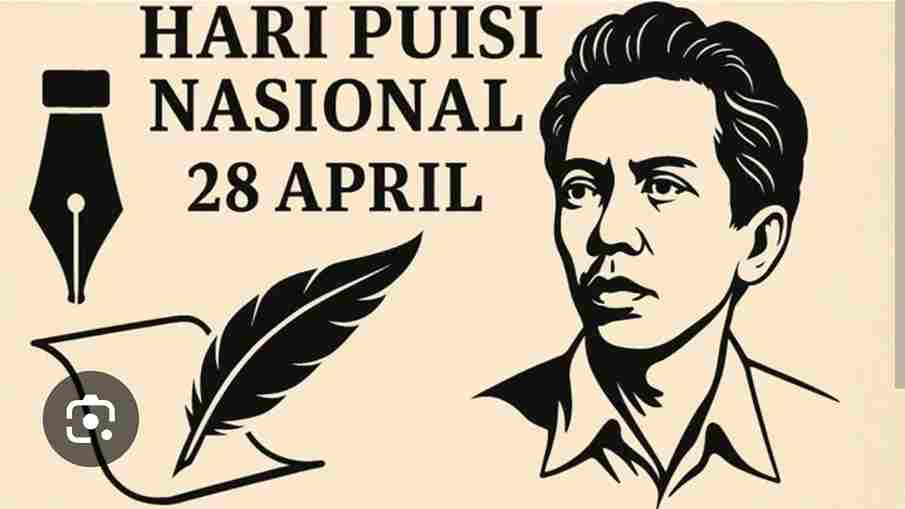
It is therefore no exaggeration to say that National Poetry Day, celebrated every April 28th, is not merely a literary event, but a cultural moment to nurture the deepest aspects of humanity.
This date was chosen to commemorate the death of Chairil Anwar on April 28, 1949. He was a poet who changed the course of Indonesian poetry. Before Chairil, poetry was largely confined to old forms, with a polite but often overly tame rhythm. Chairil brought freedom: straightforward words, a strong lyrical self, existential anxiety, and the courage to challenge the times. Through his poems such as Aku, Krawang-Bekasi, Diponegoro, and Doa, he proved that poetry is not only readable but can also shake the consciousness.
He wrote about life in a wild way, but it was precisely because of this wildness that Indonesian poetry found its new pulse. The nickname “The Wild Beast” that stuck to him was not merely an icon, but a symbol that words can become a field of human freedom. Although he was only 26 years old, Chairil left behind more than a dozen poems; He left this nation the courage to speak out.
That’s why the Language Development and Fostering Agency, along with the National Conference of Indonesian Writers, designated April 28th as National Poetry Day, a day to commemorate the services of this reformer of modern Indonesian poetry and to foster public appreciation for literature as the nation’s cultural heritage. To this day, its status remains cultural, not yet a national day by Presidential Decree, but that’s precisely where its vitality lies: it is nurtured by word lovers, teachers, students, poets, communities, and readers who still believe that poetry is necessary for preserving humanity.
Every year, its commemoration takes various forms: literary pilgrimages to Chairil’s grave, poetry readings, evenings of reflection, poetry writing competitions, musicals, literary discussions, anthology publications, and even poetry festivals that have now expanded into the digital world. In 2026, Poetry Day will once again be heard through various community activities and national poetry readings at Taman Ismail Marzuki, with one strong common thread: how to preserve the legacy of poetry so that it continues to breathe amidst mobile screens.
Indeed, times have changed. Today’s generation was born into a world of fast-paced content scrolling, short videos, endless notifications, and algorithms that demand instant gratification. Words must be short, meaning must be fleeting, emotion must be immediate. In such a world, poetry seems like something slow. It demands the pause. He asks people to read slowly. He asks people to feel.
But precisely because the world is moving too fast, poetry has become increasingly important.
Poetry is a pause.
It restores humans to a rare ability: reflection. In a single line of poetry, one can find oneself. In a single metaphor, one can understand a wound that prose cannot explain. In a simple stanza, one can feel the company of thousands of others who have experienced similar grief. That’s where poetry works: it connects solitude into an inner brotherhood.
This is why, in the era of artificial intelligence and technological dominance, poets are increasingly needed. Machines may be able to compose sentences, but they cannot fully evoke vibrations. Algorithms may be able to map habits, but they cannot measure tears. Data can calculate human behavior, but only poetry can touch the deepest spaces where humans harbor their hopes and fears.
Within the LSTEAMS educational framework, poetry is one way to nurture the elements of Art while simultaneously revitalizing the Spiritual. It teaches that intelligence cannot stand without compassion. Knowledge cannot grow without conscience. Because people who are good at math but fail to feel will easily treat others as mere numbers. People who are technologically advanced but lack empathy will easily cause destruction with a cold hand.
Poetry prevents this.
It keeps people attuned to the sorrows of others, sensitive to small beauties, and able to subdue egos before the greatness of life. Children accustomed to poetry will learn that words have manners. Teenagers raised with poetry will find it easier to channel their anxieties without hatred. Adults who nurture poetry within themselves will be more resilient against violence.
Because ultimately, violence often arises not from a lack of knowledge, but from a deadening of feeling.
National Poetry Day reminds us that this nation is not enough to simply prepare a generation of legal experts, scientists, technologists, engineers, or mathematicians. This nation must also prepare people who can cry when they see suffering, smile when they see beauty, and choose words that heal when the world is busy hurting.
So, commemorating Poetry Day is not just about remembering Chairil Anwar. It is an effort to ensure that amidst a world on fire, we still have room to nurture our souls.
Because as long as poetry is still read,
as long as words are still chosen with love,
as long as humans are still willing to stop feeling,
the world’s fires have not completely conquered everything.
There is still something that keeps humans human.
And that is called poetry.
Indonesia, April 28, 2026
——-