By: Adlan Daie
Political Analyst; General Secretary of the Indonesian Ulema Council (MUI), Indramayu Regency.
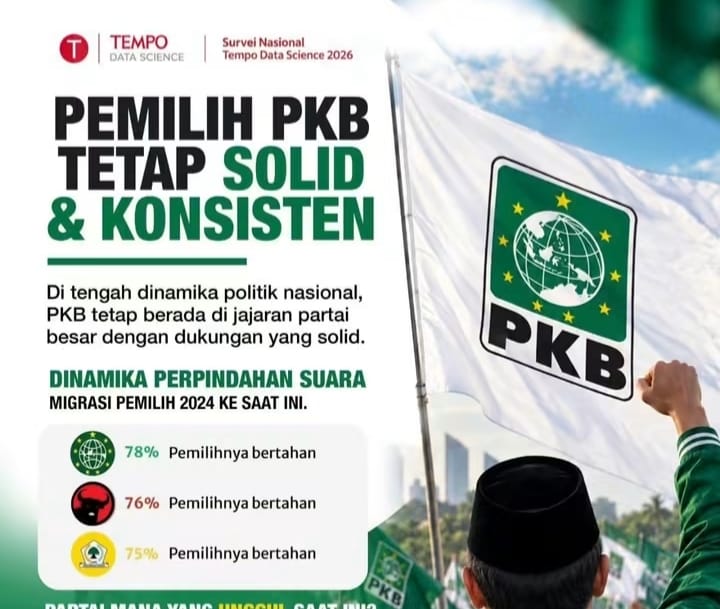
According to the national survey data update from *Tempo* magazine for August 2026—titled “Tempo Data Science 2026″—PKB demonstrates the highest level of electoral resilience when measured by voter loyalty. PKB’s voter loyalty stands at 78%, followed by PDIP at 76% and Golkar at 75%. In other words, 78% of PKB’s total voters from the 2024 election (representing 10.2% or 16 million PKB voters nationwide)—to borrow the title of a hit song by Fatin Sidqiyah—chose to remain “loyal” rather than being tempted to “give their hearts to another.” That is, 78% of PKB voters maintained PKB as their political choice, according to a national survey by *Tempo* magazine conducted in August 2026.
For political analysts who closely monitor PKB’s dynamics and electoral landscape, the “Data Science” findings from *Tempo* magazine are neither new nor surprising; however, they certainly offer a valuable opportunity to revisit the variables behind PKB’s electoral resilience.
The *Tempo* magazine data science findings regarding PKB serve to reaffirm data from a 2022 *Kompas* daily survey—conducted a year prior to the 2024 election—which showed that 78% of PKB voters remained “loyal” to the party as their political identity for the 2024 election, the highest rate of loyalty among all participating parties.
The consistency, solidity, and loyalty of PKB voters—as revealed by two highly credible national media outlets, *Tempo* magazine (2026) and *Kompas* daily (2022), across different timeframes—further validate earlier findings by the survey institute SMRC (Saiful Mujani Research and Consulting) from 2018.
The 2018 SMRC research identified PKB as the party with the strongest “party ID” (party identification) bond within the perception of its political constituency. “Party ID” is a metric used in voter behavior research to measure the psychological component of voter loyalty toward a specific party.
In the author’s interpretation, the *Tempo* (2026) data findings affirm that the election of KH Miftahul Akhyar as *Rois Aam* (Supreme Leader) and Gus Kikin as Chairman… The election of the PBNU General Chairman during the 35th NU Congress—perceived by the public as a “Palace-backed” duo that did not represent the PKB’s political constituency—will not result in an electoral deficit for the PKB.
In other words, although the PKB was “officially” born of the PBNU, the party’s electoral trends—according to the author’s analysis—do not hinge on the dynamics of structural leadership changes within the PBNU. The PKB and NU are bound by a social ecosystem wherein historical, ideological, and aspirational ties are “built-in,” transcending their structural entities.
The question remains: where does the loyal voter base of the PKB—the only party born from the womb of the NU—lie among the “NU member” variants identified by the 2025 Alvara Research Centre survey, which estimated this group at 57% of the population?
First, there are the NU members whom Alvara terms “Cultural Nahdliyin” (cultural NU members), comprising 29.62% of the survey findings. This is the largest subgroup of NU members.
According to Alvara’s findings, the “NU-ness” of this group is characterized by a rarity of participation in formal NU organizational activities; while their religious practices align with NU cultural traditions—such as *tahlilan* (commemorative prayers) and grave visitations—they are relatively “loose” regarding strict Sharia observance.
In the context of political anthropology, this specific variant of “NU members” aligns closely with what Clifford Geertz—in his 1956 research on voter behavior—termed “*abangan* voters” (traditional voters who supported nationalist parties in the 1955 election).
This implies that the NU members in this group—who do not belong to the *santri* (devout Islamic boarding school) social community—are difficult to cultivate into a PKB voter base (requiring high costs for minimal returns) and do not constitute a voter base for other Islamic parties either.
Second, there are the NU members whom the Alvara survey terms “Engaged Nahdliyin” (comprising 18% of the total); this group is relatively active in attending religious study sessions or activities initiated by NU bodies (such as Muslimat, Fatayat, Ansor, and other groups). …Hajj/Umrah guidance, social activities, and educational initiatives within the NU network.
The political choices of NU members in this subgroup are “fluid,” depending on the party’s multi-layered organizational structure and the incentives offered by its programs. PKB has the opportunity to boost its electoral appeal among this segment of NU members through skillful political adaptation.
Third, there is the social stratum of NU members known as the “core Nahdliyin,” comprising 9.4% of the total. This group consists of key NU drivers, activists leading NU’s autonomous bodies, networks of alumni from NU *pesantren* (Islamic boarding schools), and the *pesantren* subculture that serves as NU’s social ecosystem.
NU members in this category constitute PKB’s most loyal constituency; their political allegiance to the party remains steadfast despite the era of social disruption, the rise of “techno-populism,” and the increasingly structured, systemic, and massive nature of candidate “personalization” maneuvers within the “open-list” electoral system.
The explanation above serves to clarify that the term “NU members” within the aforementioned 57% segment clearly represents a massive voter base, yet their political preferences remain fluid.
They cannot be dictated to by the NU organizational structure; instead, their choices depend on the intensity of multi-layered party organizing and—naturally—on the enduring socio-political ecosystem variants (namely *santri*, *abangan*, and *priyayi*), even as ideological boundaries begin to blur.
Regarding projections for the 2029 election, PKB possesses a loyal voter base among the third group of NU members and has a strong opportunity to boost its electoral appeal among the second group.
By focusing its political efforts on these two segments of the NU community, PKB could break into the top three of the Bu 2029 election contenders, with a projected vote share of 15%.
This represents both an opportunity and a challenge for PKB.
Best regards.
Indramayu, September 15, 2026
——