By: Ali Aminulloh
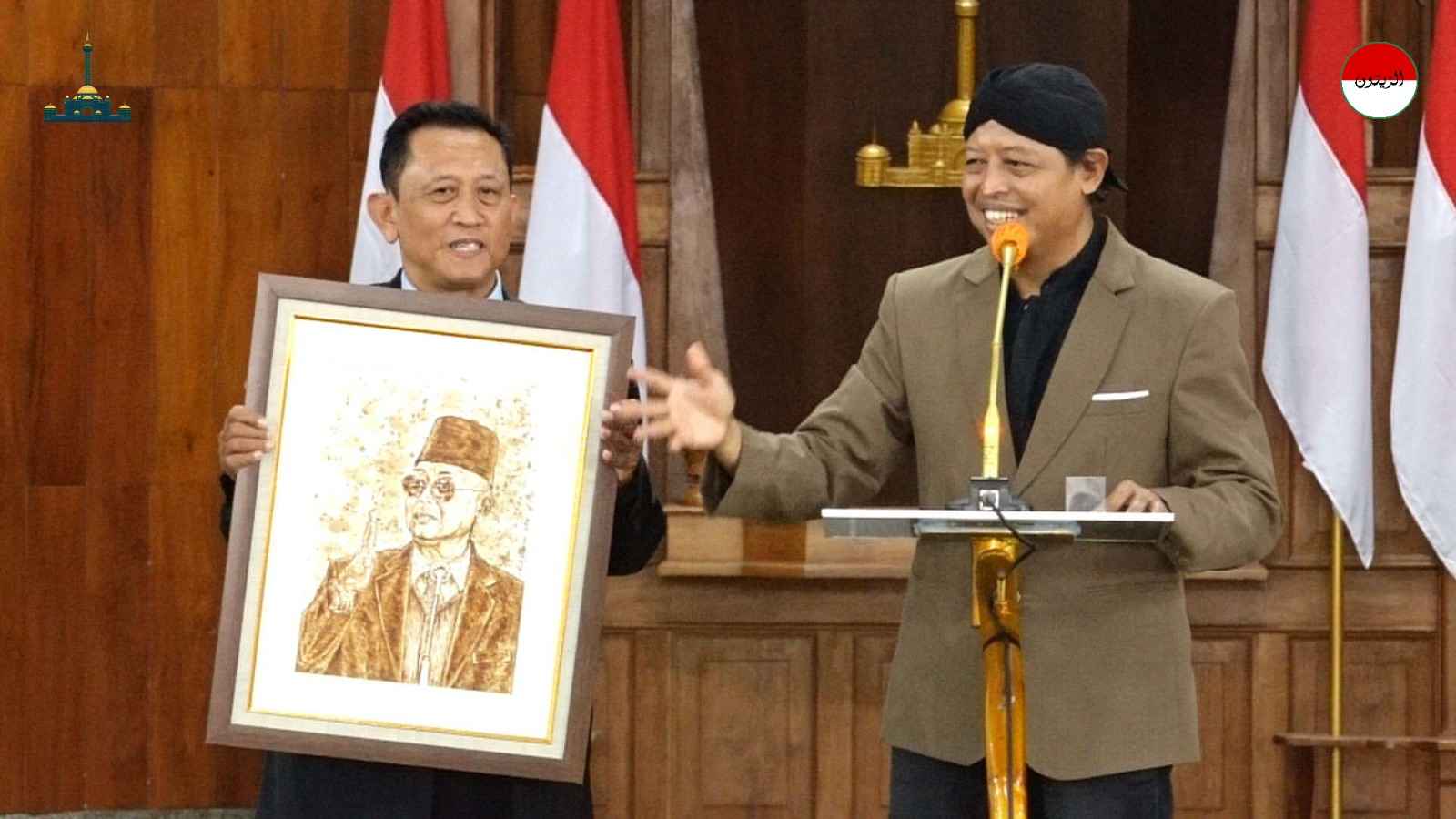
On Thursday, August 27, 2026, Al-Zaytun commemorated its 27th anniversary by hosting a gathering of prominent figures, academics, cultural experts, religious leaders, and professors. From Yogyakarta came a unique offering: a painting created using coffee from Al-Zaytun itself. The artwork was more than just a gift; it was a symbol of how education, culture, and art can serve as pathways to fostering peace.
This message was conveyed by Dr. Haryadi Baskoro, M.Hum., an expert on Yogyakarta’s Special Region status. He opened his remarks with a patriotic rallying cry that was met with enthusiastic cheers from the audience.
“Merdeka! Once more, Merdeka! Once more, Merdeka!”
Haryadi attended as a representative of a network of academics, cultural figures, and religious leaders from Yogyakarta who have been offering their appreciation and support to Al-Zaytun since 2024. He also conveyed warm greetings from Prof. Jagal Waseso, Prof. Sutrisna Wibawa, Prof. Bramantyo, Reverend Yusuf Langke, Onwin, Yopi, and other friends of Al-Zaytun in Yogyakarta.
“Since 2024, we from Jogja have seen a divine light in this place,” he stated.
This perspective gave rise to various cultural and intellectual initiatives. In 2024, the Yogyakarta network supported the development of the Digital Encyclopedia of Tolerance and Peace. The program was designed not only for the advancement of Al-Zaytun but also as an intellectual contribution to Indonesia.
A year later, in 2025, they returned with a book titled *Menjadi Indonesia di Ma’had Al-Zaytun* (Becoming Indonesian at Ma’had Al-Zaytun). The book was part of an effort to document the values of nationhood, pluralism, tolerance, and peace that flourish within the life of the Al-Zaytun community. In 2026, this intellectual endeavor will continue with the drafting of a book examining Al-Zaytun as a hub or foundation for the Republic of Indonesia’s national resilience. The book is being prepared in collaboration with Prof. Jagal Wiseso Marseno, a former Rector of Universitas Gadjah Mada who was also active in Lemhannas (the National Resilience Institute). The work is scheduled to be unveiled in November, coinciding with the International Day for Tolerance.
During Al-Zaytun’s 27th-anniversary celebration, Haryadi conveyed three key messages from Yogyakarta’s community of academics, cultural figures, educators, religious leaders, and artists.
The first message concerns national resilience. Haryadi recalled that Yogyakarta once served as a bulwark for the Republic of Indonesia. From 1946 to 1949, when the nation faced a critical situation, Yogyakarta stepped up to serve as the capital of the Republic. It is because of this historical role that Yogyakarta is known as the “City of the Republic.”
According to Haryadi, Indonesia is currently facing various national challenges. In this context, Al-Zaytun is expected to play a role as a center for strengthening the republic through education, culture, tolerance, peace, and national resilience.
“Al-Zaytun will become a hub for the republic—a bulwark for Indonesia for a thousand years,” he asserted.
The “bulwark” in question is not merely a physical structure. It consists of individuals who are knowledgeable and possess strong character; who love their nation, respect diversity, and are prepared to face the changing times. From this perspective, national resilience must begin with the resilience of the individual, shaped through education.
The second message emphasizes the importance of treating education as a long-term investment. Haryadi explained that educators in Yogyakarta, together with Sri Sultan, are developing character education rooted in local culture. This education aims to cultivate exceptional individuals who possess intelligence, strong personalities, and deep cultural roots.
He hopes that this concept of character education based on local cultural values can be developed in every region across Indonesia. Each region possesses a wealth of traditions, languages, arts, and wisdom that can serve as sources for shaping students’ character. Al-Zaytun is viewed as an ideal setting for cultivating this idea because the spirit of the *Nusantara* (the Indonesian archipelago) is embodied within it. Students arrive from various regions with diverse cultural backgrounds, yet they are united by a shared educational experience.
“The *Nusantara* lives within Ma’had Al-Zaytun,” he said.
A third message came from the artistic community of Yogyakarta. Haryadi commended the flourishing arts activities at Al-Zaytun, ranging from vocal music and *angklung* to *gamelan*. To him, art is not merely entertainment; it possesses the power to refine the human spirit and bring people closer together.
He then recalled a message from Raden Mas Panji Sosrokartono—the older brother of Raden Ajeng Kartini—which had been conveyed to Bung Karno in 1932:
“Bung, never abandon art, for art softens feelings of hatred.”
This message feels particularly relevant in a society easily fractured by differences. Art has the capacity to bring people together without the need to first inquire about religion, ethnicity, social group, or viewpoints its politics. Through art, tensions can be softened and a sense of brotherhood fostered.
As a symbol of this support, Haryadi—along with Andreas, a professorial candidate from Duta Wacana Christian University, and Hirman—presented a painting by Rudi Winarso to Syaykh Abdussalam Rasyidi Panji Gumilang. The painting was created using a unique medium: coffee originating from Al-Zaytun itself.
Coffee, typically brewed as a beverage, is transformed by an artist’s hand into colors and lines that convey meaning. This offering reinforces the message that something simple can become a work of great value when touched by creativity and humanity.
The coffee painting also serves as a symbol of Al-Zaytun’s own journey. Just as coffee beans can be transformed into a work of art, education can transform diversity into strength, differences into harmony, and challenges into a path toward progress.
Al-Zaytun’s 27th-anniversary commemoration ultimately became more than just a celebration of an educational institution’s journey. It served as a convergence of the republic’s history, investment in education, character building, the culture of the archipelago, and art that fosters peace.
As we look toward the centennial of Indonesia’s independence, quality education must continue to be expanded and strengthened. Indonesia needs not only an intelligent generation but also individuals of strong character and culture—people who are tolerant and capable of nurturing a shared life together.
Haryadi Baskoro’s message from Yogyakarta remains powerful: the republic is upheld not merely by physical might, but also by an education that enlightens the mind, a culture deeply rooted in tradition, and art that softens hatred.**
Indramayu, August 30, 2026
——–