Conquering a Language in Two Days: Al Zaytun’s English Learning Revolution
By: Ali Aminulloh
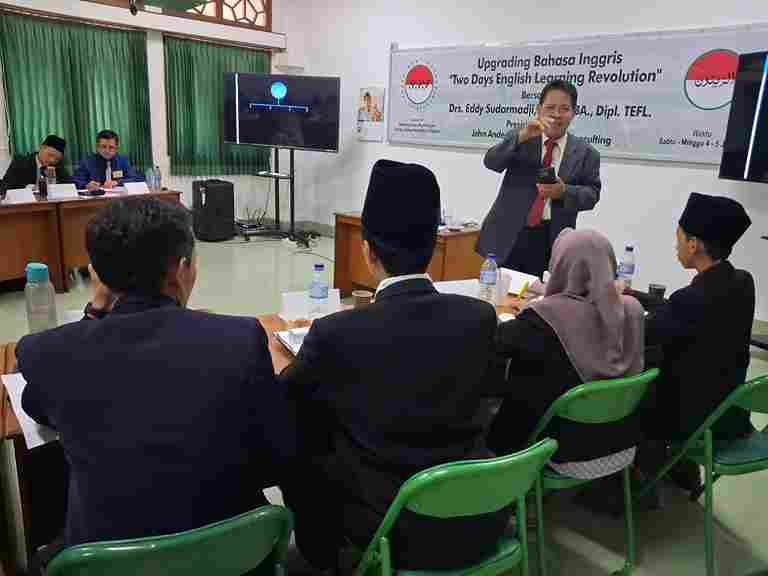
INDRAMAYU-JAYANEWS. – Imagine if something previously considered complicated, frightening, and even a cause for many to give up suddenly felt simple, enjoyable, and easy to understand. That was the atmosphere that prevailed for two days in the Abu Bakar Building Teachers’ Council training room, Mahad Al Zaytun. In that room, English was no longer viewed as a subject to be memorized, but rather as a life skill that could be understood through correct thinking. Those two short days marked the beginning of a major movement: building a language culture in a boarding school environment.
As a follow-up to the Continuous Learning Actor Training previously held by the Rahmatan Lil ‘Alamin Mosque LKM, the training has now entered a more specific phase through classes with limited participants to ensure a more intensive learning process. On July 4–5, 2026, the training, titled “Two-Day English Learning Revolution,” was held, featuring Drs. Eddy Sudarmadji, M.M., M.B.A., Dipl. TEFL, President Director of John Anderson Training and Consulting, served as the instructor.
The training, which took place in the Teachers’ Council Meeting Room, Abu Bakar Building, Mahad Al Zaytun, Indramayu, was attended by approximately 40 participants from various backgrounds. They included teachers from Islamic Senior High Schools (MA), Islamic Junior High Schools (MTs), Islamic Junior High Schools (MI), Community Service Center (PKBM) tutors, dormitory administrators and counselors, and students from grades VIII through XII, both male and female. The diverse backgrounds of the participants demonstrated that the spirit of learning knows no professional or age boundaries.
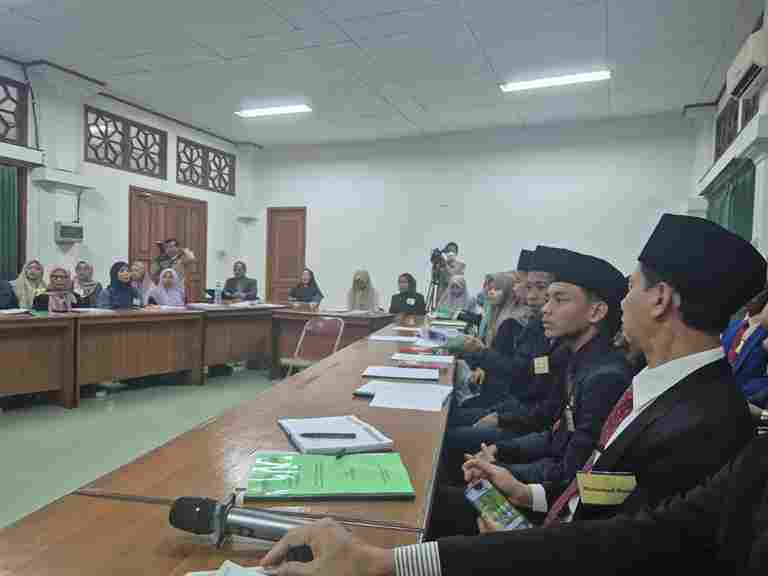
The opening ceremony took place solemnly on Saturday morning, July 4, 2026. The event began with the singing of the three stanzas of the national anthem, Indonesia Raya, followed by the recitation of the Sapta Janji Dharma Bakti (Sapta Janji Dharma Bakti) in three languages, symbolizing openness to world civilization without losing the nation’s identity.
The General Chair of the Committee, Eji Anugrah Romadhon, S.S., M.A.P., in his remarks expressed his appreciation to the instructors for sharing their experiences and proven English language learning methods. According to him, the use of the term “revolution” in the training theme is not just a slogan, but rather aligns with the strong spirit of transformation in boarding school education that has been continuously developed at Mahad Al Zaytun.
He hopes the training will provide concrete provisions for teachers and students to foster a culture of English communication in everyday life within the Al Zaytun environment.
For two full days, participants participated in approximately thirteen hours of intensive learning. The first day ran from 8:00 a.m. to 3:00 p.m. WIB with a break, and then continued on Sunday for the same duration until the closing ceremony.
However, from the beginning of the training, Drs. Eddy Sudarmadji challenged the participants’ thinking. He posed a simple yet thought-provoking question, “Is it possible to master basic English in just two days?”
His answer inspired everyone.
“The impossible is nothing.”
That phrase energized the entire training session.
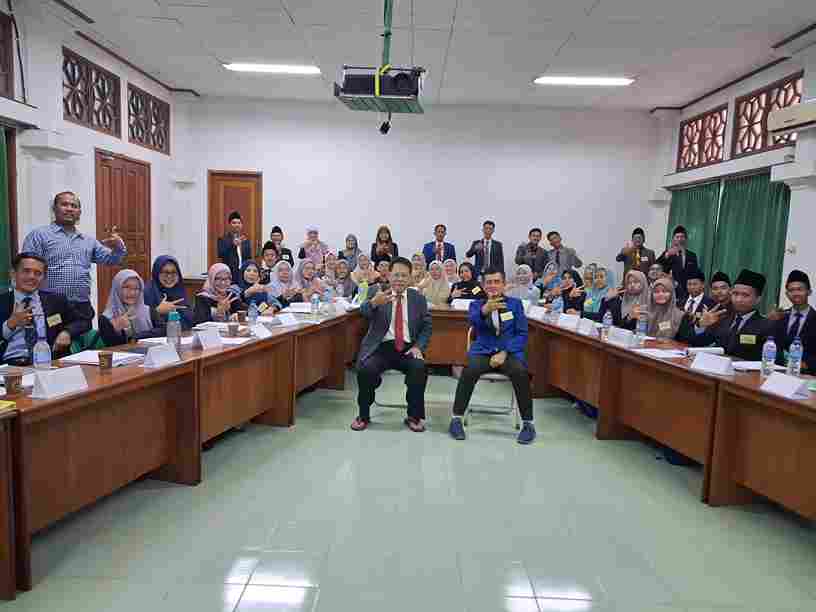
The instructor then explained that the main goal of the training was not simply memorizing formulas, but rather building fluency and courage, changing mindsets about English (mindset and paradigm), understanding the fundamental structure of English, mastering approximately ninety percent of the most difficult parts of grammar, developing independent learning skills, producing future English instructors, and overcoming the emotional, psychological, and cognitive barriers that have long prevented many people from learning a foreign language.
The most interesting part was when participants were introduced to a new paradigm in understanding English grammar.
Previously, many people viewed grammar as a collection of sixteen tenses that had to be memorized one by one. In this training, all of these concepts were dissected into a much simpler form.
According to the instructor, the core of English lies in the predicate. Unlike in Indonesian, the predicate in English is not just a verb, but is the center that determines the form of the entire sentence.
The predicate has two main dimensions.
The first dimension is Time, which consists of Present, Past, Future, and Past Future.
The second dimension is the Process Dimension, which is a state or process consisting of Simple, Continuous, Perfect, and Perfect Continuous.
When these two dimensions are combined, sixteen tenses are born, which are often considered complex. With this approach, participants no longer memorize sixteen formulas separately but instead understand the logic of their formation.
The method of delivering the material is far from boring. Participants are encouraged to move, engage in dialogue, construct simple sentences, and then develop them various forms of questions were asked based on sentence elements such as subjects, predicates, objects, and complements. Each concept was directly put into practice through interactive activities, transforming the classroom atmosphere into a lively, laughter-filled, and enjoyable one.
Thirteen hours of learning flew by without a trace. No fatigue was visible. Instead, renewed enthusiasm, confidence, and the belief that anyone can learn English if they use the right methods were evident.
In the closing session, each participant reflected on their learning experience. Many admitted that this was the first time they fully understood the relationship between time, process, and sentence structure. Grammar, which had previously been a source of fear, had now become something logical and easy to understand.
The event was then closed by Dr. Ali Aminulloh, M.Pd.I., M.A., representing the committee. He expressed his appreciation and gratitude to the instructors who had opened up new perspectives on English learning.
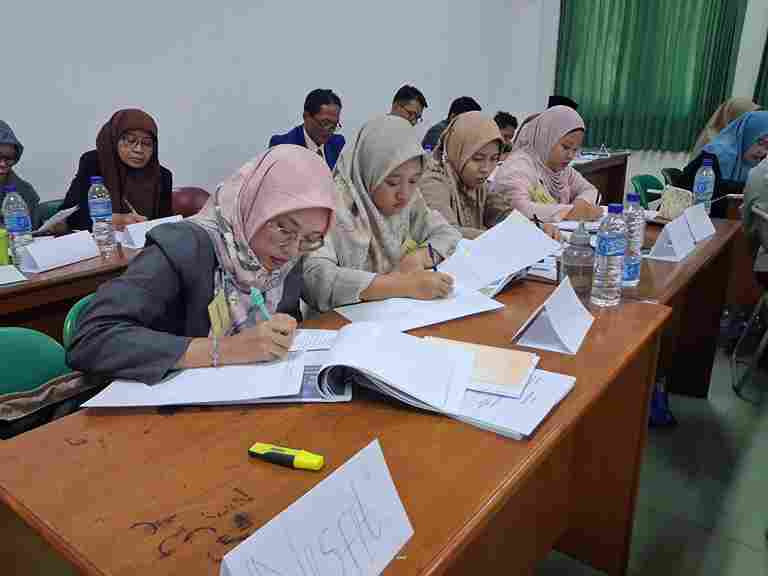
According to him, the main strength of this training lay not only in the material but also in the method. Grammar, which had previously been synonymous with memorization, had been broken down into a system of thinking that was simple, easy to understand, and applicable to all groups.
This was evident in the success of participants from various levels, from eighth to twelfth graders, English teachers, and even non-native English teachers, who all successfully completed the training.
At the end of his remarks, Ali Aminulloh emphasized that this training was not the end, but rather the starting point for a language movement at Mahad Al Zaytun.
A shared commitment emerged. The participants agreed to disseminate this learning method to their colleagues, teachers, and all students. English would no longer be viewed solely as a classroom subject, but as a culture of communication that would be continuously nurtured in everyday life.
Perhaps great revolutions don’t always begin in grand halls or with thousands of participants. Sometimes, they are born from a simple learning space, from the courage to change one’s mindset, and from the belief that everyone is capable of learning faster than they previously imagined.
At Mahad Al Zaytun, that revolution is beginning. Not just a revolution in mastering English, but a revolution in learning methods that fosters courage, builds self-confidence, and produces a generation of lifelong learners.**
Red
——