Al Zaytun Community Learning Center Prepares Tutors for the AI Era: Upgrading Competencies is the Foundation for Building Quality Education
By Ali Aminulloh
INDRAMAYU-JAYANEWS.COM – Facing changing times is not simply about keeping up with technological developments, but about preparing people capable of mastering technology with knowledge, character, and wisdom. It is through training spaces like these that the future of education is truly being prepared.
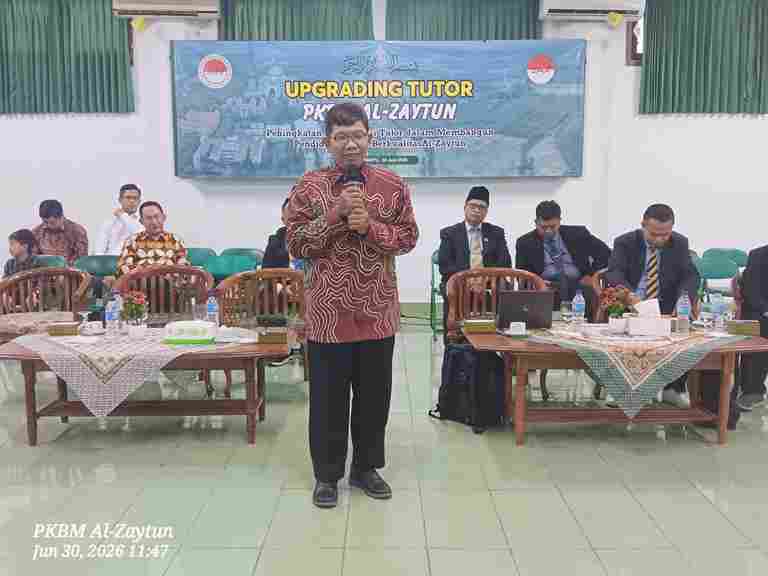
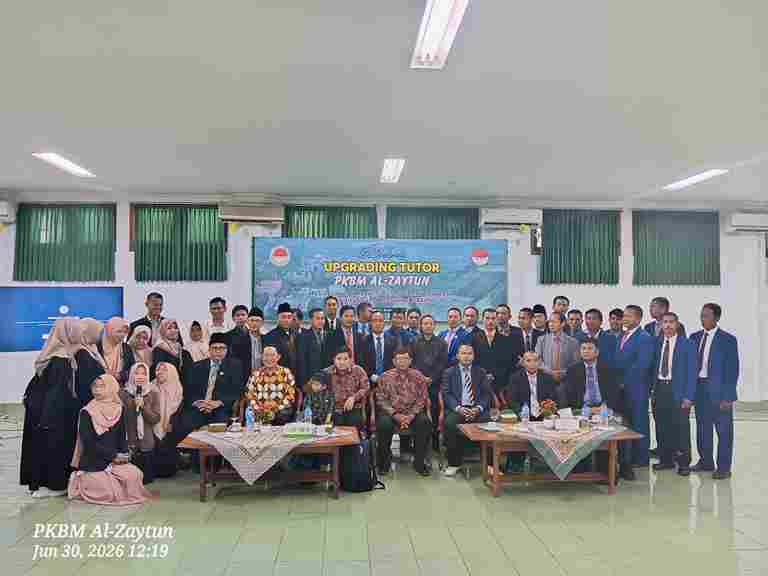
Al Zaytun Community Learning Center (PKBM) continues to strengthen its commitment to improving the quality of education through the development of its human resource competencies. Ahead of the start of the 2026/2027 Academic Year, Al Zaytun PKBM held another Tutor Upgrading on Tuesday, June 30, 2026, with the theme “Improving Tutor Competencies in Building Quality Education.”
The event, attended by all PKBM Al Zaytun tutors, featured two speakers with expertise in the field of education. The first speaker, Dr. Ali Aminulloh, M.Pd.I., M.E., Head of PKBM Al Zaytun and a lecturer at IAI Al Azis, delivered a presentation on “Utilizing Artificial Intelligence (AI) in Education.” Next, Prof. Dr. Sujarwo, M.Pd., Professor of Non-Formal Education at Yogyakarta State University (UNY), presented on improving tutor competency in achieving quality education at Mahad Al Zaytun.
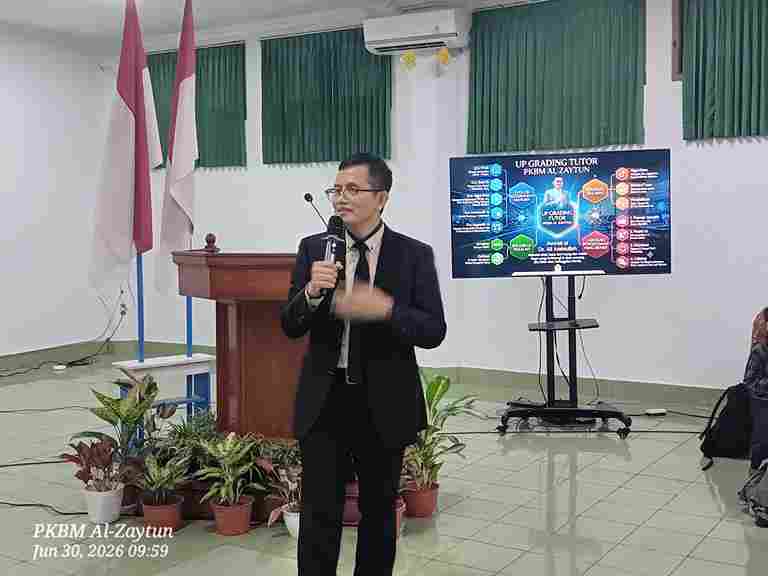
Beginning his presentation, Dr. Ali Aminulloh invited the tutors to view the changing times from a more philosophical perspective.
“Humans are never separated from space and time,” he said.
According to him, every human being has a space to serve and exists in a constantly changing time. In the context of space, the participants are PKBM Al Zaytun tutors who have the responsibility to educate society. Meanwhile, in the context of time, the world is entering an era of digital transformation marked by the rapid development of artificial intelligence (AI).
Therefore, he believed that a tutor is not only sufficient to master the learning material, but must also be able to understand the changing times and adapt to technological developments.
In his presentation, Dr. Ali explained the evolutionary journey of human intelligence. He described how, in the Print Era, avid readers became a source of knowledge. This then evolved into the Search Era, when the ability to search for information through search engines became the primary means of acquiring knowledge.
The next change was the Algorithmic Era, a time when information came to humans through social media and various digital platforms. This era presents a major challenge in the form of the post-truth phenomenon, where repeatedly expressed opinions are often considered truth, even though they are not necessarily supported by facts.
“One of the tasks of today’s tutors is to maintain students’ critical thinking skills so they don’t easily get caught up in the flow of unverified information,” he explained.
He continued, saying that the world of education is now entering the Generative AI Era, a time when the ability to formulate questions or prompts becomes a crucial competency. The more precisely someone instructs AI, the higher the quality of the information obtained.
In the future, technological development is even predicted to enter the Agentic AI Era, when artificial intelligence is capable of making and executing decisions. However, according to Dr. According to Dr. Ali, no matter how advanced AI becomes, humans remain in control because only humans possess values, conscience, ethics, and moral responsibility.
He also dismissed concerns that AI would replace teachers.
“AI is a tool, not a substitute for teachers. Education still requires the touch of the heart, role models, and character building that only humans can provide,” he emphasized.
To ensure that the use of AI truly benefits learning, Dr. Ali introduced four key principles to the tutors. First, develop clear and specific prompts. Second, position AI as a partner, not a decision-maker. Third, understand that AI results still require analysis and refinement by the tutor. Fourth, validate through a process of checking and rechecking so that all information used is truly accurate and accountable.
“Those who can synergize with current developments will win the future. Conversely, those who resist change will be left behind by the train of history,” he advised.
Entering the next session, Prof. Dr. Sujarwo, M.Pd. encouraged the tutors to understand that the quality of education is ultimately determined by the quality of its educators. According to the Professor of Non-Formal Education at Yogyakarta State University, tutors are the spearhead of educational success because they interact directly with students daily.
He explained that improving tutor competency cannot be done incidentally, but must become a lifelong learning culture. Tutors are required to continuously improve their skills improve pedagogical, professional, social, and personal competencies to meet the challenges of an increasingly dynamic society.
According to Prof. Sujarwo, quality education is born from tutors who never stop learning. Tutors must be able to design learning that is creative, enjoyable, and relevant to students’ needs, while also utilizing technological developments without abandoning humanitarian values.
He also emphasized that competency development is not solely aimed at improving teaching skills, but also at developing the character of educators who possess integrity, dedication, a spirit of service, and are able to serve as role models in society.
In the context of Mahad Al Zaytun, he argued, tutors have a broader responsibility than simply delivering material. They also play a role in shaping a learning culture and student character, as well as instilling the values of discipline, independence, tolerance, and a spirit of civilization-building.
Therefore, the Tutor Upgrading activity is a strategic investment in improving the quality of education. As tutor competency continues to grow, the quality of the learning process will also improve, ultimately producing graduates with intellectual intelligence, emotional maturity, strong character, and readiness to face changing times.
The enthusiastic training demonstrated PKBM Al Zaytun’s commitment to continuously providing education that adapts to technological developments without losing its identity as an educational institution oriented towards the development of the whole person.
By combining Dr. Ali Aminulloh’s insights on the use of AI in education with the strengthening of tutor competencies delivered by Prof. Dr. Sujarwo, PKBM Al Zaytun’s Tutor Upgrading program is not only a routine activity to improve the capacity of educators, but also a concrete effort to prepare tutors to be able to oversee the delivery of quality education that is relevant to current developments, while remaining grounded in humanitarian values.
Amidst the rapid flow of digital transformation, PKBM Al Zaytun chooses not to be merely a spectator of change. By continuously strengthening tutor competencies, the institution is emphasizing an important message: the future of education will be determined by educators who continue to learn, adapt, and utilize technology as a means to elevate humanity.**
Red
——