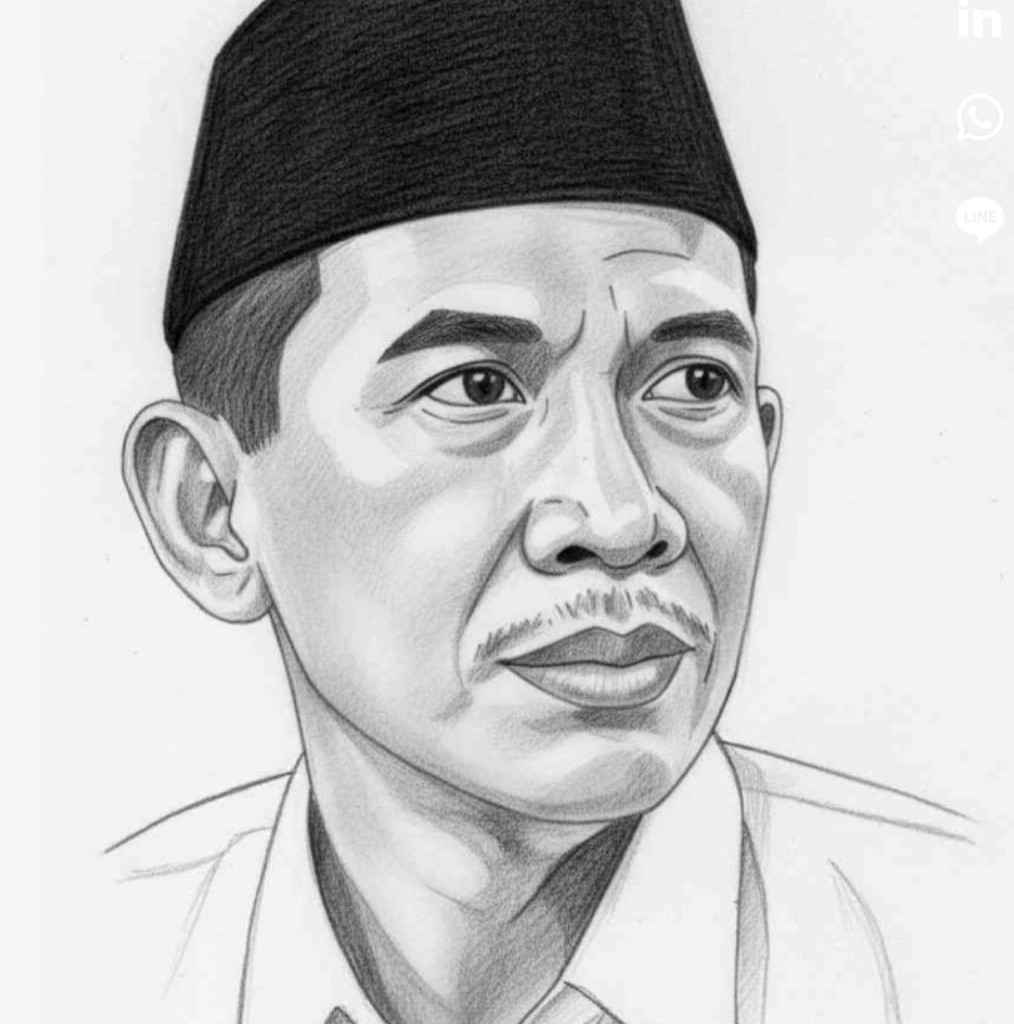
*ONCE AGAIN ABOUT THE REASONS WHY KH. SAID AQIL SIRADJ IS MORE THAN JUST WORTHY TO BE THE ROIS AM OF PBNU*
By: H. Adlan Daie.
Political analyst, Secretary General of the Indonesian Ulema Council (MUI) for Indramayu Regency.
KH. Said Aqil Siradj is one of the few Nahdlatul Ulama (NU) figures with extensive experience within the highest structure of NU: the Nahdlatul Ulama Executive Board (PBNU).
Because of his experience, he is more than worthy of being the Rois Am of PBNU. Wisdom is born from experience, and wisdom is born from journeys.
He has matured within the dynamics of PBNU across political regimes since 1989, following the 28th NU Congress in Krapyak, Yogyakarta, and now exists as a structural part of PBNU.
In the “maqom” of Rois Am, this experience becomes even more valuable. Because the Rois Am is not an executor, not a technical player, but a guide, a guardian of values, and a nurturer of the wellspring of wisdom.
That is the author’s second reason why KH Said Aqil Siradj is more than worthy of being the Rois Am of the PBNU (National Nahdlatul Ulama Council) in the projection of the 35th NU Congress in August 2026. Experience is the price of wisdom and discernment in guiding direction, preserving traditions, and upholding “values.”
This complements the author’s first reason in the article entitled “KH Said Aqil Siradj, a Santri Par Excellence, More Than Just Worthy of Being the Rois Am of the PBNU” (published by “kreatorjabar, 2/6/2025), namely that he has the authority to master “Al kutul mu’tabaroh”—the authoritative standard texts of NU Islamic boarding schools.
From these two perspectives, his mastery of the standard Islamic boarding school texts and his extensive experience in the PBNU (National Board of Nahdlatul Ulama) complement each other. Once again, he is more than worthy of being the Rais Am of the PBNU, guiding the policy direction of the PBNU as the largest Islamic organization in Indonesia.
He is the former general chairman of the PBNU for two terms (2010-2021). He experienced the implementation of policies amidst several changes in the PBNU’s Rois Am during his tenure, but he did not experience the turbulent conflict that occurred some time ago between the Rois Am and the PBNU General Chairman.
The Rois Am position is not merely a structural position within the PBNU but also a symbol of the dignity and highest authority within the NU structure, holding the direction and control of the organization’s ulama (Islamic scholars). Therefore, the criteria for becoming a Rois Am are strictly defined in the NU’s Articles of Association (AD/ART): they must be “faqih,” “munadhdhim,” “murarrik,” and “mutawarri.”
First, “faqih,” meaning a profound mastery of religious knowledge. Because the Rais Am is the supreme leader of the NU Jam’iyah, a religious organization, he must possess the ability to direct the organization’s course within the socio-religious spectrum.
Second, “Munadhdhim” must understand and adhere to the ethical principles of organizational governance. NU is a major Islamic organization, and the Rais Am is the captain who guides the organization in the direction of its values and the policies it intends to instill in its society.
Third, “muharrik” means mobilizing. Because NU is a movement of ulama (Islamic scholars) striving to improve the morals of the community, the Rais Am must be like a dynamo that can energize the entire infrastructure and network of NU as an ulama movement and an Islamic organization.
Fourth, “mutawarri” means maintaining social relationships away from unhealthy social and political environments. In the philosophy of Ki Hajar Dewantoro, it must be “ing ngarso sung tulodo, ing madyo mangon karso, Tut Wuri Handayani.”
The four criteria above are indeed strict and demanding, but that’s the price of becoming the Rois Am of the Nahdlatul Ulama Executive Board (PBNU), the highest leadership of the NU organization, an Islamic organization that hundreds of millions of Muslims in Indonesia rely on for their socio-religious behavior.
KH Said Aqil Siradj relatively fulfills these four criteria. He is not only a jurist but also a master of the Al-Mu’tabaroh texts within the NU pesantren tradition, from the “matan” (Islamic texts) to the “syarah” (Islamic texts).
Experienced as a “munadhdhim” (religious leader) and “muharrik” (religious leader), he managed and mobilized the NU organizational structure during his two terms as chairman of the PBNU without political turbulence or escalation of conflict.
In terms of “sanity,” he is not only free from corrupt behavior but also free from oligarchic influence. He is not only a vocal advocate for upholding the four pillars of nationality (Pancasila, Bhinneka Tunggal Ika, the Unitary State of the Republic of Indonesia, the PBNU Constitution), but also a vocal critic of inequality and injustice.
In short, although certainly not free from human weaknesses, KH Said Aqil Siradj, approaching the ideal criteria above, is one of the few NU figures more than worthy of becoming the PBNU Rois Am at the projected 35th NU Congress in August 2026.
The problem is that NU is a political force (though not a political party). Each Congress doesn’t always operate within an ideal framework, but is constantly faced with a “tug of war” between idealism and pragmatism, so that the NU Congress stage often presents unexpected surprises.
It is in this context that Professor Burhanudin Muhtadi reads NU. He argues, “It wouldn’t be the NU we know if it didn’t present “Men of surprise,” he wrote, “unexpected surprises at the Congress arena.” That’s the fun of the NU Congress; let’s wait and see.**
Indramayu, May 7, 2026
Wassalam.
—–