MAY DAY 2026: WHEN WORKERS SEEK JUSTICE
(Reflection on Labor Day, May 1)
By Ali Aminulloh
From the Blood of Chicago to the Streets of Jakarta, May 1 Is Never Just a Red Date
The morning sky on May 1 always carries two different faces.
For some, it’s just a red calendar: a holiday, a day to lie down, a day to hang out with family. But for millions of workers, May 1 is the day when the sweat that has fallen silently becomes a sound that echoes in the streets.
On that day, the hands that daily drive factory machines, lift cement, sew clothes, deliver packages, press computer keys, and keep the nation’s economy moving, stand up and say: we exist, we work, and we have the right to a decent life.
That is International Workers’ Day.
That is what the world knows as May Day.
In 2026, Labor Day will be celebrated with a new spirit: “Collaboration to Achieve Industrial Progress and Worker Welfare,” echoing the slogan “One Determination, One Goal, Shared Prosperity.” This theme has emerged in various national commemorations as a call to action to ensure industrial growth does not occur without justice for workers.
But is May Day really just about ceremonies and slogans? The answer is: no.
May Day is a memory.
May Day is a historical wound that has not yet fully healed.
What is May Day?
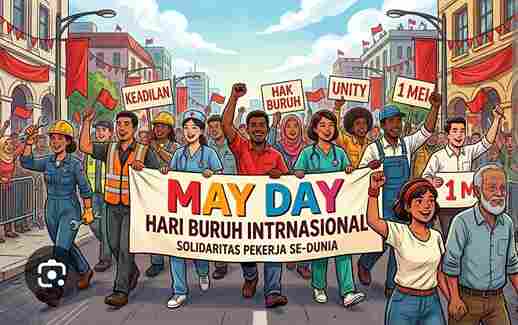
International Labor Day is an annual commemoration every May 1st to honor the struggle of workers to demand their basic rights: humane working hours, decent wages, social protection, and the dignity of work.
In Indonesia, this date is not merely a global symbol. The state recognizes it as a national holiday, affirming that workers are not tools of production, but rather a key element in national development.
In reality, magnificent buildings would be lifeless without the people who work within them.
Factories are nothing but dead metal without laborers.
Offices are nothing but empty rooms without workers.
So, commemorating Labor Day is truly commemorating the heart of economic life itself.
Why is it called May Day?
The term May Day comes from the words “May,” meaning the month of May, and “Day,” meaning day.
However, this term did not arise in a vacuum. It is tied to a major tragedy in the history of global labor.
On May 1, 1886, approximately 300,000 workers in Chicago, USA, took to the streets to demand what now seems commonplace but was then considered rebellion: an eight-hour workday.
At the time, workers were forced to work 12 to 16 hours for low wages and with no guarantee of safety.
The action culminated in the Haymarket Riot on May 4, 1886. Bombs exploded. Police fired. Workers died. Activists were hanged.
Blood was spilled.
But from that blood was born a global awareness that workers were not slaves to industry.
Three years later, the International Labor Congress in Paris declared May 1 as May Day, a day of global workers’ solidarity.
So, every time someone mentions May Day, the world is actually saying another unspoken word: resistance.
Indonesia Also Held Workers’ Wounds
Indonesia has known Labor Day since the national movement.
Workers used it as a tool to fight against colonial forced labor, wage inequality, and oppression by foreign companies.
Under President Sukarno, Labor Day was once recognized as an important day for the working people.
However, during the New Order era, May Day was long viewed with suspicion due to its close association with leftist movements. Workers were no longer given a platform, and their voices were often silenced rather than heard.
Only after the Reformation was May 1st revived as a day of aspirations. And since the administration of Susilo Bambang Yudhoyono, Labor Day has been officially declared a national holiday.
The meaning is clear: the state has finally recognized that workers’ voices can no longer be kept behind factory walls.
May Day 2026: Workers No Longer Just Demand Wages
This year’s May Day feels different.
Whereas labor issues once revolved solely around wage increases and working hours, now the issues are far more complex. The world of work is changing rapidly: digitalization, artificial intelligence, outsourcing, app workers, mass layoffs, and even uncertainty about social security.
Therefore, May Day 2026 is not just a banner parade.
It is a stage for the anxieties of the times.
Some of the major agendas voiced by national labor groups this year include:
– demands for a realistic minimum wage increase,
– evaluation of labor regulations deemed to make layoffs too easy,
– protection for digital workers such as motorcycle taxi drivers and couriers,
– strengthening job loss insurance,
– ending the practice of union busting or the silencing of labor unions.
These issues emerge alongside growing demands that industrial progress should not be built on the fragility of workers’ well-being.
Because today’s workers are facing a new enemy:
not just machines, but algorithms.
How is May Day Celebrated? Highways Become Pulpits
Every May 1st, industrial cities change their face.
Monas, DPR, Cikarang, Karawang, Batam, Surabaya, and Medan have all become gathering points for people with one common theme: voices.
Some marched.
Some gave speeches.
Some went on strike.
Some even set up entertainment stages, cheap markets, and social dialogues.
Governments in several regions are now trying to make May Day more inclusive through job fairs, free healthcare services, and even bazaars for workers’ micro, small, and medium enterprises (MSMEs). The Bandung City Government, for example, celebrated May Day with a fun walk, cheap markets, and public services as symbols of a dialogical approach.
But one thing remains unchanged:
The streets remain the most honest platform for those who feel unheard.
May Day Is Not a Day of Anger, But a Day of Remembrance
Often, people view labor demonstrations as a tiring routine: traffic jams, noise, and disruption.
In reality, May Day isn’t about causing trouble.
It’s about reminding the nation that behind every tall building, every toll road, every online shopping package, every meal served, there are the hands of workers whose names are rarely mentioned.
We enjoy the fruits of their labor every day, but often forget to consider whether they themselves are living well.
May Day comes every year to smack that forgetfulness away.
National prosperity is never born from mere speeches, but from the people who go to work every morning with simple hopes: that their children can eat, their families can survive, and their futures are not hung in the balance of uncertainty.
May 1st Always Leaves Questions
So every time the calendar turns to May 1st, the question is no longer:
“Where are the demonstrations today?”
But: has this country treated its workers as human beings?
As long as that answer remains unanswered,
as long as there are wages that are insufficient to buy a living,
as long as there are workers who are easily discarded when machines are no longer needed,
so long will May Day live on.
Not just as a holiday.
But as a day when history reminds us: the progress of a nation is built by hands that are often invisible.**
Indonesia, May 1, 2026
——