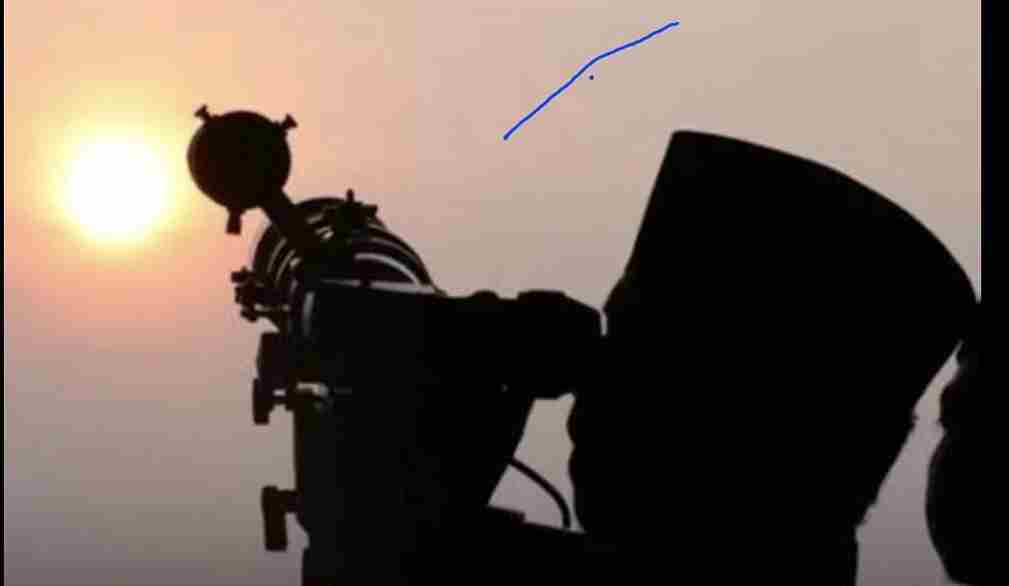
The Crescent Moon, Science, and the Ego of Interpretation: Why Is the Start of Ramadan Always Different?
By Dr. Ali Aminulloh, M.Pd.I. ME
Between rukyat (sighting) and hisab (calculation), between text and technology, between faith and social certainty.
Every time Ramadan approaches, Muslims are once again faced with a classic question: when do we start fasting? Ironically, in an era when solar eclipses can be predicted hundreds of years in advance, when the moon’s orbit is mapped to the precision of seconds, Muslims are often divided over determining the start of the Islamic month. It’s a paradox: a scientifically measurable issue becomes a matter of theological and social debate.
Astronomically, the moon’s orbit around the earth is a highly precise system. Modern astronomy can calculate conjunctions (ijtima’), lunar elongation, the height of the crescent, and even its visibility using proven mathematical models. Institutions like NASA can even predict eclipses more than 100 years in advance with near-perfect accuracy. If eclipses are a much more complex phenomenon that can be calculated, why is the start of Ramadan, based on the lunar synodic cycle (approximately 29.53 days), still debated?
The root of the problem lies not in science, but in how the text is understood. A frequently quoted hadith reads:
“Shûmû li ru’yatihi wa afthirû li ru’yatihi…”
(Fast by seeing it and break your fast by seeing it).
The key word in the debate lies in the word ru’yah. Some interpret it literally: seeing with the naked eye (rukyat bil fi’li). Others understand it as “knowing with certainty,” including through hisab (astronomical calculations).
In the Quran, the word ra’a and its derivatives do not always have a physical visual meaning. In Surah Yusuf, verse 43 of the Quran, there is the phrase:
“Innî arâ sab’a baqarâtin…”
(Indeed, I saw seven cows…)
Here, “seeing” refers to a dream, not a sensory vision. In fact, in many other verses, ru’yah connotes inner understanding or knowledge.
Similarly, in Surah Al-Baqarah, verse 185:
“Faman syahida minkumus syahra fal yashumhu.”
(Whoever witnesses the moon, let him fast.)
The word shahida does not always mean seeing with the eyes, but can also mean being present, knowing, or experiencing. In the study of ushul fiqh (Islamic jurisprudence), this kind of shift in meaning is very possible depending on the context (‘urf and maqasid).
Herein lies the philosophical question: should the text be understood as a permanent technical instruction, or as a methodological guide appropriate to the capacity of the times? During the Prophet’s time, Arab society was a Muslim society that had not yet mastered complex astronomical calculations. Thus, rukyat became the most rational method at that time. But was that method fixed (ta’abbudi) or contextual (ta’aqquli)? This is the realm of ijtihad.
Scientifically, the modern hisab approach even uses crescent visibility criteria such as the Odeh criterion or Danjon limit, which are based on global observation data. This science is not merely “desk theory,” but the accumulated result of hundreds of years of celestial observations. Many contemporary scholars, including Yusuf al-Qaradawi and a number of international astronomy experts, argue that a precise hisab can be the basis for establishing the Islamic calendar for the sake of certainty for the community.
Yet differences persist. The social impact is real. Uncertainty about the start of Ramadan and Eid al-Fitr impacts educational schedules, the economy, transportation, and even public policy. The business world needs calendar certainty. The state needs time synchronization. The community needs a sense of calm.
This is where a sensitive question arises: is there a financial dimension to the rukyat tradition? And Allah knows best. However, the facts show that the budget for crescent observation in various locations is not small, reaching billions of rupiah for operations, travel, equipment, and isbat (the isbat) sessions. The crescent moon becomes the “most sought-after object” at the end of Sha’ban and Ramadan. The question is: is the high cost still relevant if technology can provide more consistent and affordable results?
This issue is not merely technical, but touches on what we could call a trilogy of awareness:
1. Philosophical Awareness
Do we dare to distinguish between text and method? Between the goals of sharia and how to achieve them? The goal of Ramadan is obedience and piety, not repetitive technical debates.
2. Ecological Awareness
Islam is a religion that respects the cosmos. The Quran repeatedly mentions the orbits of the sun and moon as signs (ayat) of order. Ignoring the scientific certainty of the moon’s orbit could potentially disregard the precise nature of the sunnatullah.
3. Social Awareness
Unity among the Ummah does not mean standardizing schools of thought, but rather seeking common ground for mutual benefit. A global Hijri calendar based on hisab (calculation) could be a social solution to prevent divisions in the most sacred moment of worship.
Ultimately, the difference in the start of Ramadan is not due to the difficulty of calculating the moon. It’s not because science isn’t capable yet. The root of the problem lies in the difference in paradigms for understanding texts and their relationships.
The path of revelation and knowledge.
Perhaps what we need to reflect on is no longer “where is the crescent moon visible?”, but “where is our reason in interpreting the signs of the sky?”
Because the moon always moves with certainty. What isn’t always certain is how we interpret it.
And Allah knows best.**
Indonesia, February 18, 2026
——-