By: H. Adlan Daie
Political and socio-religious analyst
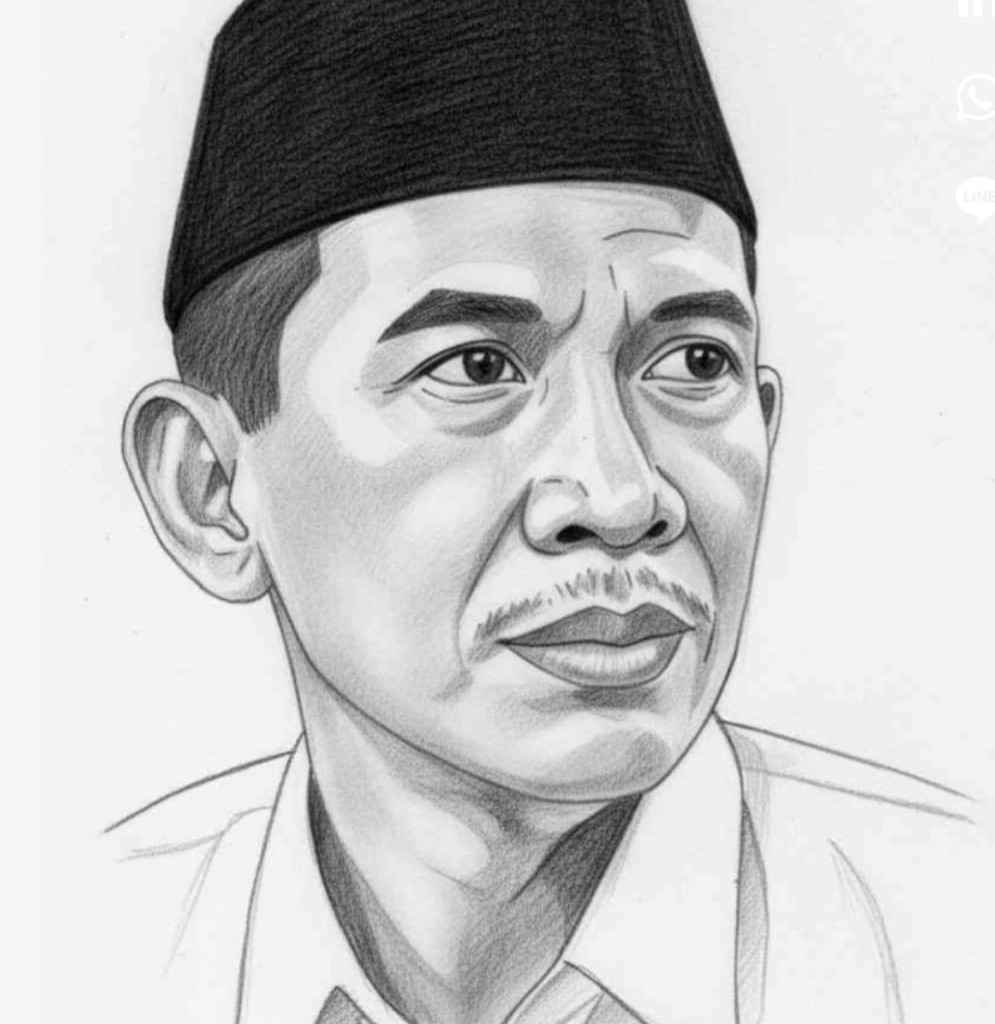
KH. Zulfa Mustofa, Deputy Chairman of the Nahdlatul Ulama (PBNU), is clearly a kiai (Islamic cleric). His profound religious knowledge is undeniable. But is he adept at navigating the political landscape and able to resist the allure of political charm when entering the main stage of the PBNU elite conflict?
Did KH Zulfa Mustofa fall into a political trap, take advantage of political opportunities, or was he unable to resist the allure of political power relations?
This is a “sexy” and interesting question to read after KH Zulfa Mustofa chose to become a key “actor” on the main stage of the PBNU dualism conflict, becoming Acting Chairman of the PBNU at the instigation of the PBNU Rois Am faction, KH Miftahul Akhyar.
KH Zulfa Mustofa is one of the most “flaming” preachers in the NU global orbit, transcending factional and political groups. His in-depth sermon material and fluent mastery of the scriptures are complemented by refreshing humor.
Now, this “luxury” is shrinking within NU, a consequence of KH Zulfa Mustofa’s choice to take center stage within one of the conflicting factions within the Central Board of Nahdlatul Ulama (PBNU). It’s both complex and tempting.
In terms of the principles of “Usul fiqh,” KH Zulfa Mustofa is certainly fluent in the context of the methodology of “istimbatul hukm” (Islamic jurisprudence), drawing conclusions from Islamic jurisprudence. However, political choices are extremely complex, requiring extensive experience and a mature resilience to be “battered” and resist the temptations of a million political allurements.
The construction of NU’s “political DNA,” according to Mitsuo Nakamura, a foreign observer of NU, differs from that of “modernist” Islamic organizations, even political parties, which are easily read from a “black and white” organizational mechanism, simpler and rarely offer surprises.
NU, on the other hand, is the exact opposite. This is because NU’s social ecosystem was formed first through the tradition of Islamic boarding schools (pesantren) networks, then structured into an organizational formalism called Jam’iyyah Nahdlatul Ulama, NU’s Islamic organization.
In this context, the assertion of KH Makruf Amin, former Rois Am of PBNU, that NU is greater than just PBNU, is relevant. Reading NU is more complex and cannot be simply conquered by the organization’s structural power relations. The cultural strength of Islamic boarding schools is an inseparable variable in reading NU.
Therefore, relying solely on, for example, the “backing” of political elements from “outside,” history shows that NU has not always won the conflictual space to conquer NU.
If that happens, the costs will be high, further weakening NU’s independence as a mass organization, weakening its ability to stand “tawashut,” at the middle ground between the interests of the people and the state.
In the complex construction of NU’s “political DNA,” KH Zulfa’s political expertise and skills are being tested amidst the allure of the glare of the spotlight of the conflictual political stage of the PBNU dualism.
This is a political test that is not simple but also useful for KH Zulfa Mustofa to hone his “rhythmic political dance,” to quote Emha Ainun Nadjib’s narrative style, with all the potential for unexpected surprises.
Above all, it is crucial to recognize that NU is an Islamic organization. In Islamic legal tradition, an action is considered right not because it wins administratively due to political backing, but because it must be morally legitimate and bring benefit to the community.
An Islamic organization, especially NU with its tens of millions of followers, will collapse not when its structure collapses, but when its moral compass no longer guides the actions of its leaders. KH Zulfa stands squarely between these two difficult choices.**
Indramayu, December 11, 2025
Wassalam.
——-