Kosakata :
Growing a Home Within Words
JAKARTA-JAYA NEWS.COM – Notes from the West Jakarta Vocabulary Inauguration, July 18, 2025
By: Emi Suy
“A great nation not only records its history, but also writes it with love and awareness.”
~ Pramoedya Ananta Toer
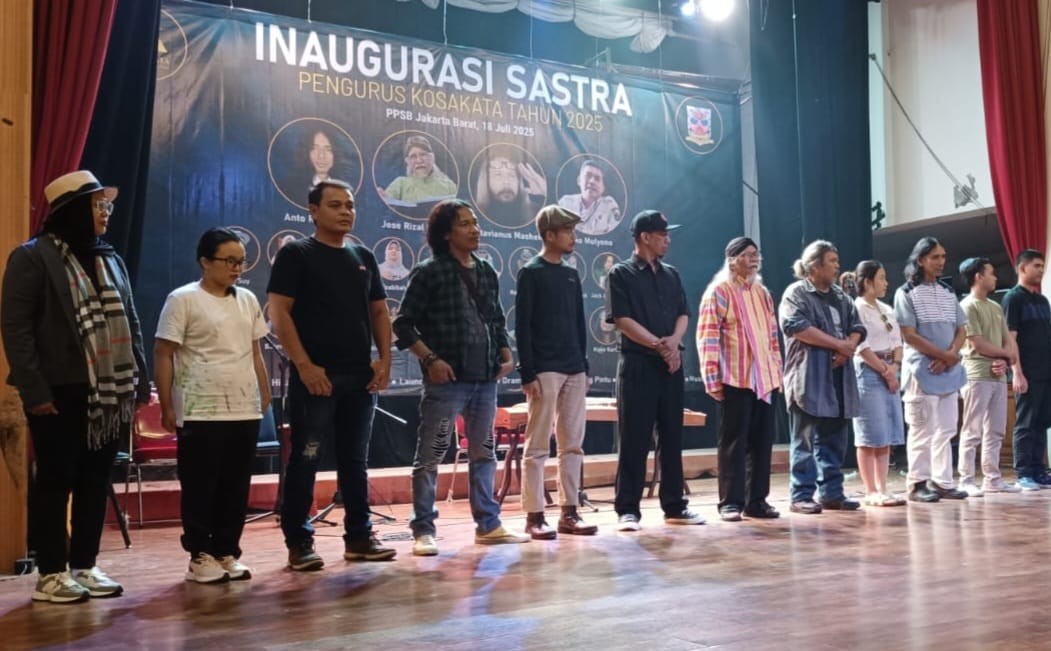
On a clear day—amidst blue skies and hopeful steps—Friday, July 18, 2025, a new home for words and awareness was officially born in the heart of West Jakarta.
Not just a physical home, but a home of meaning. A home planted in the soil of civilization, watered by collaboration, and sheltered by the spirit of community.
The PPSB (Arts and Culture Training Center) building that day was not only a gathering place for people, but a kind of altar where words were revered.
The event, titled the Literary Inauguration, was no ordinary ceremony. It became a cultural ritual that rekindled the belief that literature is not merely intellectual entertainment, but the heart of human civilization.
Gambus music played, taking us to the roots. The Betawi gate was solemnly opened, as if giving blessings from the land of Jakarta. Traditional dances seemed to etch hope directly into the surface of time—that literature should no longer be a guest in its own home.
However, it wasn’t just the series of events that left a lasting impression. What was most touching was something softer yet deeper: the birth of Vocabulary—a collective space built not solely by thought, but by feeling, by love, by anxiety that finally found form and a forum.
Those Who Read Words Are Like Lighting a Lamp
That day, the poets didn’t just appear to read poetry. They were there like lighting a torch. Jose Rizal Manua with his fiery voice, Octavianus Masheka with his gentle bitterness, and Anto Ristargie with his deep, soft voice, seemed to affirm that poetry still has a place, even in the midst of an increasingly busy, louder, and increasingly alienating city.
When the book “Kosakata ‘Embracing the World'” was presented to the Head of the West Jakarta Cultural Agency, Mr. Joko Mulyono, we felt as if we were witnessing a time-honored milestone.
Literature is no longer a scattered whisper on the outskirts of town. It has a name. It has a community. It has returned and found its place.
In his remarks, Mr. Joko Mulyono stated honestly and humbly:
“I admit that literature has not received the attention and support it deserves from the West Jakarta Cultural Agency. This is an important evaluation for us. Kosakata is not just a community, but the beginning of our seriousness in building a system that supports the sustainable growth of literature.”
This statement was not merely a ceremonial quote. It was recognition, and in the world of policy, recognition is the beginning of transformation. It signified that literature was beginning to be seen not as an accessory, but as a pillar.
A Structure that Seeds the Future
The formation of the West Jakarta Kosakata board for the 2025–2027 period was also announced. But once again, this is not a list of names, but rather a formation of roots that will foster the future.
Advisory Board: Jose Rizal Manua, Anto Ristargie, Octavianus Masheka
Chairperson: Adinda Putri Suhendra
Secretary: Muhammad Fadhlurrahman Azzami
Treasurer: Alieffeian Deinar
Division Coordinator: Chintya
Main Divisions:
Literacy: Emi Suy & Romy Sastra
Events & Production: Cahyo, Zee Ra, Dove
Publication: Hery Tany & Puji Pribadi.
This structure is a tree. And most encouragingly: many of them are young people. Regeneration, which until now felt like a fragile hope, is now manifesting in these names.
A Breathing Ecosystem: Words, Habits, Community
Literature is not just an activity. It is a way of life. It grows in small habits: reading poetry before bed, writing a paragraph on scrap paper, listening to a conversation without interrupting, or contemplating in silence.
The PPSB building is now a home for possibility. For the courage to fail, for honest experimentation, and for voices that have felt unworthy enough to speak.
From personal and collective experience, I have learned: what literature needs is not just a stage, but an embrace. Not just praise, but a space that allows words to grow without being required to be perfect.
Vocabulary exists as such a space. A space that doesn’t judge. A space that trusts. It is there that we learn from people, not just from theory. From awkwardness, from laughter, from tears, and from the passion that is continually reconnected through writing.
Jakarta, Words, and Cultural Responsibility
Jakarta may be a fast-paced city. But every city, no matter how fast, harbors a longing for silence. And literature is the clearest form of silence—a silence that doesn’t distance, but rather brings us closer: to meaning, to others, to ourselves.
Imam Ma’arif of the Jakarta Arts Council once said: literature is the loneliest branch of art. Perhaps true. But precisely in this loneliness that literature guards the city’s conscience.
Vocabulary, no matter how small today, is the key to that immense responsibility. It is at this key that we can dream: of a Jakarta Literature Festival that is not only lively, but meaningful. Of literacy as a way of life, not a slogan. Of UNESCO awarding Jakarta the title of World City of Literacy, not because of claims, but because of real work.
Conclusion: Here, Words Find Their People
That day, literature no longer stood alone. It walked together. And most importantly: it was revived.
In the midst of a fast-paced and digital world, literature remains slow. But that is precisely why it is important. It calls us to pause, reflect, and re-examine the values often lost amidst notifications and algorithms.
“As long as words are cared for, the nation’s hope is not truly extinguished.”
~ Goenawan Mohamad
Vocabulary exists to care for words. And in words, we care for the nation. It is in this home that we grow, learn from each other, and heal each other. Because a true home is always a place where wounds can speak and hope is not banished.
Author Bio
Emi Suy is the pen name of Emi Suyanti, born in Magetan, East Java, on February 2, 1979. She is known as a female poet who consistently voices spirituality, wounds, and womanhood through her mellow and reflective poems. Her work is recorded in the books “What and Who Are Indonesian Poets” (Indonesian Poetry Day Foundation, 2018), and “What and Who Are Indonesian Women Writers” (Our Vocabulary, 2024).
Her works include: “Tirakat Padam Api” (2011), “Silent Alarm” (2017), “Silent Verses” (2018), “Silent Fire” (2020), “Mother Cooks Rice Until Our Age is Ripe” (2022), “Interval” (essay, 2023), and “Algorithm of Silence” (with Riri Satria, 2023). Her poetry has appeared in various national media outlets such as Kompas, Media Indonesia, Banjarmasin Post, Suara Merdeka, and Pikiran Rakyat, as well as in over 200 collaborative anthologies.
She also pursues photography and fine art. Her work was selected for The Power of Woman (Bandung, 2016) and Small is Cool (KIK) 2025, alongside 500 artists from 13 countries. In the literary field, Emi received the Best Poetry Book award from the National Library of Indonesia (2019), the Basa-Basi Award (2019), and was nominated for the Poetry Day Foundation Poetry Book Competition (2020).
She has performed poetry readings at various national and international literary forums, such as the 12th Nusantara Poets Meeting (Kudus), the Gunung Bintan International Literary Festival (Tanjung Pinang), and the 2nd Southeast Asian Poets Meeting (Padangpanjang).
In addition to writing, Emi is active as the founder of the Jejak Langkah Community, co-founder of Jagat Sastra Milenia (JSM), and has now chosen an independent path to maintain her authentic aesthetic voice. She is currently active in the West Jakarta KOSAKATA community as a member of the Literacy Division. (***)
Contributor: Lasman Simanjuntak
—