
By:
Masduki Duryat
(Committee Member, MTsN 4 Indramayu)
Imagine a *madrasah* (Islamic junior high school) situated along the Pantura Highway—the busiest, noisiest thoroughfare on the island of Java—where thousands of buses traveling between Jakarta and Cirebon pass by daily, never once glancing its way. Yet, on this particular day, the eyes of all West Java turned toward it. Such was the scene at the campus of MTsN 4 Indramayu.
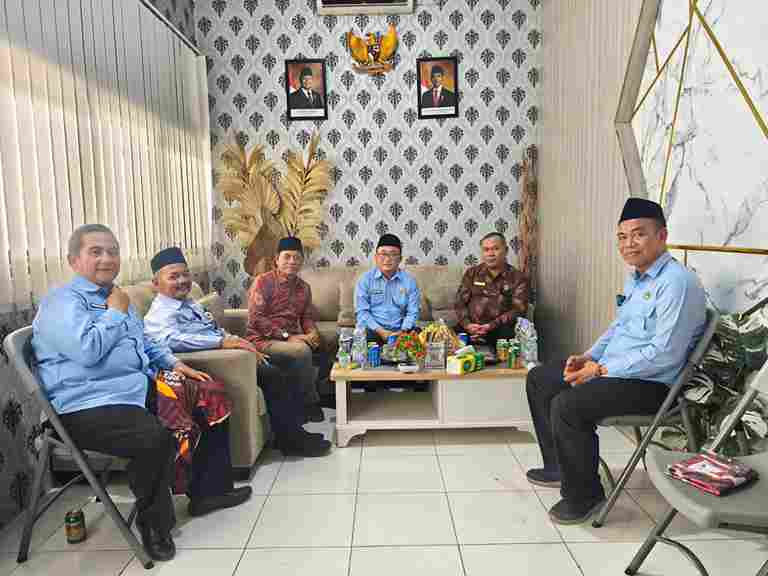
The 31st anniversary of MTsN 4 Indramayu, which also served as the kick-off for the 81st *Hari Amal Bhakti* (Anniversary/Day of Devoted Service) of the Ministry of Religious Affairs, was no ordinary event. It was attended by the Head of the West Java Regional Office of the Ministry of Religious Affairs, various division heads, the Head of the Indramayu Regency Ministry of Religious Affairs office, section chiefs, heads of local *KUA* (Religious Affairs Offices), and the principals of all *MTsN* (state-run Islamic junior high schools) across Indramayu Regency. Such an honor is not bestowed lightly; it is earned through achievement.
*A Showcase No Longer Shying Away*
The location of MTsN 4 Indramayu is both highly strategic and unforgiving. Situated on the Pantura Highway, it serves as a public showcase for religious-based education, viewed by thousands of passersby every single day. If the *madrasah* were dilapidated, it would not only be a source of embarrassment for Indramayu, but it would also tarnish the image of *madrasah* education throughout Indonesia. Conversely, if it excels, the pride extends far beyond Indramayu.
MTsN 4 Indramayu has chosen to excel. In terms of performance, the school is rich in achievements: it hosts a *tahfidz* (Quranic memorization) boarding program, organizes West Java-wide futsal tournaments and academic olympiads, and carries out charitable outreach. These are not merely ceremonial activities; they serve as proof of a significant thesis: that *madrasah* education is in no way inferior to that of public schools.
For decades, *madrasah* institutions were often viewed as a “second choice”—a fallback for students who failed to gain admission to public schools. This is the stigma that MTsN 4 Indramayu is currently dismantling. From the perspective of the sociology of education, a stigma is a form of symbolic violence that perpetuates injustice [Bourdieu, *Reproduction in Education*]. MTsN 4 proves that a *madrasah* (Islamic junior high school) can be a first choice, rather than a last resort.
*An Anniversary Is Not About Counting Years, But Measuring Impact*
For MTsN 4 Indramayu, an anniversary is more than just marking the number 31; it is an occasion for contemplation and reflection on the roles played and the impact achieved.
The question that must be posed on this 31st anniversary is a fundamental one: to what extent has this *madrasah* contributed to “educating the nation,” as mandated by the fourth paragraph of the Preamble to the 1945 Constitution? To what extent has the memorization of the Quran (*tahfidz*) truly translated into character, rather than remaining mere rote memorization? And to what extent have the trophies won in futsal tournaments and academic olympiads actually transformed the lives of children in Indramayu—children who come from families of farmers and fishermen?
An anniversary that merely celebrates a number will quickly lose its meaning. An anniversary that reflects on impact, however, paves the way for a new direction. This is where the maturity of MTsN 4 Indramayu lies.
*A Theme That Is More Than Just a Slogan*
Under the leadership of Adi Mesya, the *madrasah* has adopted a sharp and purposeful theme: *”Moving with Spirit, Creating with Creativity, and Sharing with Sincerity.”*
These three concepts are deeply intertwined. Moving without creativity becomes nothing more than a routine. Creating without sincerity becomes merely a display of achievements. And sharing without spirit becomes nothing more than a public relations exercise.
This theme aligns with the educational philosophy of Ki Hadjar Dewantara: *Ing Ngarsa Sung Tuladha* (leading by example), *Ing Madya Mangun Karsa* (fostering motivation from within the group), and *Tut Wuri Handayani* (providing encouragement from behind) [Ki Hadjar Dewantara, *Education*]. A madrasah principal must lead by example from the front, inspire enthusiasm from the center, and provide encouragement from the rear. Adi Mesya appears to grasp this.
Yet, critical reflection remains essential. The challenges ahead are far more formidable. The kick-off for the 81st Anniversary of the Ministry of Religious Affairs (HAB) should serve as a catalyst to address fundamental questions: how can a madrasah remain moderate amidst the onslaught of digital radicalism? How can the memorization of the Quran (*tahfidz*) coexist with scientific literacy? And how can students from the Pantura (North Coast) region compete with their peers in Jakarta without shedding their identity as *santri* (Islamic boarding school students)?
If MTsN 4 Indramayu succeeds in answering these questions, it will become more than just a showcase for Indramayu; it will emerge as a beacon for all madrasahs in West Java. This 31st anniversary is not the end of the journey—it is a starting point, proving that even from the fringes of the Pantura, a great civilization can be built.
Indramayu, November 18, 2026
—-


