Measuring Public Piety, Testing the Morality of Power
By:
Dr. H. Masduki Duryat, M.Pd.I., CLA., CFLS
(Rector of the Al-Amin Institute of Islamic Studies, Indramayu, and Postgraduate Lecturer at UIN Siber Syekh Nurjati Cirebon)
There is a question that appears simple, yet it truly shakes the philosophical foundations of local governance: if “religiosity” is adopted as the vision of an administration, how can its achievement be measured? If the parameters for religiosity are difficult to define, is it still appropriate to retain the term “religious” within a development vision? Or, perhaps, has religiosity merely served as a political ornament—sounding grand in speeches, yet lacking any tangible presence in the lives of the people?
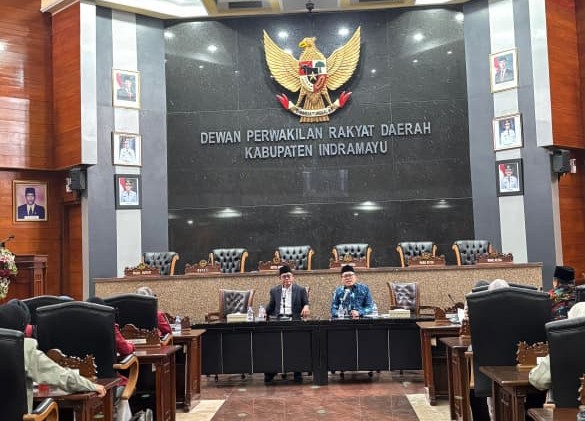
This critical question emerged during an audience and discussion between undergraduate and postgraduate students of Islamic Educational Management (MPI) from UIN Siber Syekh Nurjati Cirebon and the Indramayu Regency Regional House of Representatives (DPRD) on Wednesday, November 4, 2026. The discussion—conducted in a warm and respectful atmosphere—addressed the quality of education in Indramayu, covering topics such as budgeting, human resource quality, teacher placement, curriculum, educational facilities, the role of the inspectorate, and the overlap between central and regional policies. Also present were Masduki Duryat (a lecturer at UIN Siber Syekh Nurjati Cirebon) and several members of the DPRD’s Commission 2, including its chair, Imron Rosyadi, as well as Amri Amrullah, Dalam, Sutaryono, and senior politician Muhaimin.
Among the various issues discussed, a point raised by H. Imron Rosyadi regarding the difficulty of measuring a “vision of religiosity” touched upon a fundamental concern: how can we ensure that religious values do not remain mere symbols, but instead evolve into an ethical framework that drives public policy? *Religiosity: Between Symbol and Substance*
In local political practice, the term “religious” often becomes part of a regional leader’s identity and vision. This is understandable, given that religion possesses deep social, cultural, and historical roots in the lives of the Indonesian people. However, a problem arises when religiosity is posited as a development goal without a clear operational definition.
A governance vision should be more than just a normative statement; it should represent a direction for change that can be evaluated. Just as an economic vision can be translated into metrics such as growth, investment, poverty levels, and purchasing power—and an educational vision can be measured through access, the quality of learning, and graduate competency—so too should religiosity have social manifestations that can be empirically examined.
This is where critical scrutiny is required. Religiosity is not synonymous with the frequency of religious ceremonies, the number of places of worship, or the intensity of ritual activities facilitated by the government. Such metrics represent only a narrow dimension of religious life. In fact, a region might appear religious in a symbolic sense while simultaneously suffering from corruption, injustice, discrimination, poverty, and poor public services.
Glock and Stark (1965) define religiosity through five dimensions: belief, ritual practice, religious experience, religious knowledge, and the consequences of one’s faith. This framework serves as a reminder that religion is not merely a matter of ritual, but also influences social action. In the context of governance, the dimension concerning the consequences of faith becomes crucial: do religious values genuinely shape bureaucratic behavior and foster the common good?
*Individual Piety and Institutional Morality*
A further issue lies in distinguishing between individual piety and institutional religiosity. The government lacks the capacity to measure an individual’s faith—let alone determine who is “more” religious. Faith belongs to the inner realm, which cannot be fully captured or assessed by administrative instruments. Therefore, the assessment of a government’s religiosity must not devolve into a theological judgment of its citizens.
What can be measured is how religious values are manifested in the governance of power. Is the budget managed with integrity and a sense of trust? Are public services provided without discrimination? Do policies favor the poor and vulnerable? Are corrupt practices suppressed? Is education given serious attention? Do people of different religions and beliefs continue to enjoy equal rights?
The Quran, in Surah Al-Baqarah [2]: 177, asserts that righteousness does not lie solely in ritual orientation, but also in faith, concern for others, the fulfillment of commitments, and patience. Meanwhile, Surah An-Nisa [4]: 58 commands that trusts (responsibilities) be returned to those entitled to them and that decisions be made with justice.
Thus, the religiosity of a government should be interpreted as institutional morality. Piety cannot be demonstrated merely by the individuals holding office; rather, it must be reflected in systems, decisions, budgets, and policies. For power that invokes religion while disregarding justice is, in fact, a moral contradiction.
*Formulating Parameters for Regional Religiosity*
The question posed by the Chair of Commission 2 it effectively opens a space for academics to develop an instrument for evaluating the “religiosity” of local government. There are at least five dimensions that can serve as an initial framework:
*First*, integrity and trustworthiness in governance, measured through budget transparency, performance accountability, corruption prevention, follow-up on audit findings, and compliance with regulations.
*Second*, social justice and the common good, encompassing poverty reduction, equitable access to education and healthcare, the protection of vulnerable groups, and the narrowing of regional disparities.
*Third*, religiosity in education and character formation, reflected in the quality of learning, the strengthening of moral literacy, a culture of honesty and responsibility, and the presence of exemplary conduct within the school environment.
*Fourth*, social harmony and inclusivity, covering the freedom to practice one’s faith, the addressing of discrimination, the resolution of religious conflicts, and the protection of the rights of minority groups.
*Fifth*, ethics in public service, gauged by public satisfaction, bureaucratic responsiveness, service quality, and equal treatment for all citizens.
These dimensions can be further developed into specific indicators, annual targets, and evaluation instruments. It must be emphasized, however, that these indicators do not measure the depth of the public’s personal faith. Rather, they measure the extent to which religious values contribute to the quality of governance and public well-being.
*Religiosity and the Challenge of Educational Quality*
The discussion between students of Islamic Educational Management (MPI) and the Indramayu Regional House of Representatives (DPRD) is particularly relevant, as religiosity cannot be separated from the quality of education. Education serves as a strategic space for transforming values into character and action. Yet, religious education cannot be reduced merely to increasing ritual activities or expanding normative content. Instead, it must cultivate individuals who are critical, honest, tolerant, responsible, and socially conscious. When teachers lack support, educational facilities are inadequate, the distribution of educators is inequitable, or the education budget is not managed optimally, a “religious” vision faces a substantive test. How can a government claim to be religious if children’s rights to quality education have not been equitably fulfilled?
The issue of *PPPK* (government employees with work agreements)—where the authority for their appointment lies with the central government, while the financial burden falls on the regions—highlights the critical need for policy synchronization. A form of religiosity oriented toward *amanah* (trust/stewardship) and *kemaslahatan* (the common good) should compel both central and regional governments to avoid policies that undermine basic public services.
In the context of industrialization in Indramayu, a religious vision must also be tested by the extent to which it favors the community. Economic growth that is not accompanied by equitable distribution, environmental protection, improved educational quality, and the well-being of workers fails to fully reflect the common good.
*The Regional House of Representatives (DPRD): Ensuring the Vision Is Not Merely Political Cosmetics*
The DPRD holds legislative, budgetary, and oversight functions. Therefore, questions regarding the parameters of religiosity should not remain mere topics of discussion. The DPRD can urge the local government to develop performance indicators that are integrated into development planning documents, budgeting processes, and annual evaluations.
If religiosity is truly a core vision, it must carry policy consequences. The budget must be managed with integrity (*amanah*), services must be equitable, education must be of high quality, and development must prioritize the common good. Without this, a religious vision becomes nothing more than “political cosmetics”—an embellishment for the narrative of power that fails to alter social reality.
Simply removing the word “religious” from a government’s vision is not the only solution. What is more urgent is closing the gap between symbols and substance. As Max Weber (1922) demonstrated, religion influences social action; religious values should serve as a source of public ethics that foster responsibility, rather than acting as a tool for exclusion or the legitimization of power. Ultimately, a religious region is not one most crowded with religious ceremonies, but rather one that most tangibly delivers justice, prosperity, honesty, quality education, and protection for all its citizens.
Imron Rosyadi’s question deserves to be placed on the academic and policy-making agenda. For if religiosity is heard only in speeches yet remains unfelt in the lives of the people, then it is merely the vision—not the governance itself—that can truly be called religious.
Indramayu, November 5, 2026
—–