*A Celebration of Melody and Da’wah: An Intimate Interpretation of Ebiet G. Ade’s Poetic Lyrics, Gus Nuril’s Spiritual Realm, and H. Gori’s Vision of Darussalam*
By: Adlan Daie
General Secretary of the Indramayu Regency MUI / Chairman of the Indramayu Literature Forum (FSI – 1994)
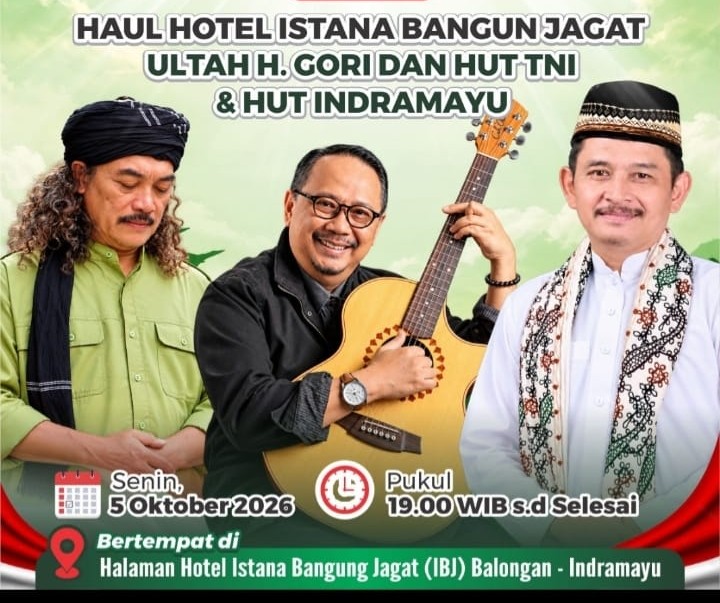
What meaning can we derive when H. Gori, Ebiet G. Ade, and Gus Nuril share the stage at the “Gebyar Nada & Dakwah” (Celebration of Melody and Da’wah) event? Organized by H. Gori Sanuri—an Indramayu entrepreneur—this event is set for Monday, October 5, 2026. It combines the anniversary commemoration (*Haul*) of his “Istana Bangun Jagat” Hotel with the celebration of his own birthday, the TNI (Indonesian National Armed Forces) anniversary, and the anniversary of Indramayu itself.
This is not a hedonistic, commercialized entertainment spectacle; rather, it is an “intimate” stage—a space for spiritual communion. It offers a reflection on the meaning of life’s journey, inviting us to pause just as social media increasingly “dictates” our inner lives and our spirits become imprisoned by “algorithms.”
By bringing Ebiet G. Ade and Gus Nuril together for this “Celebration of Melody and Da’wah,” H. Gori seems to compel us to be “naked and truly clean”—quoting the lyrics of Ebiet G. Ade’s hit song—while softly posing a question to the “swaying grass” at the end of a deep, weary sigh.
Ebiet G. Ade’s lyrics are not merely words set to a song within any specific genre; they are “poetry itself” that has been “set to music”—or as the “poet of gentle verse” Sapardi Djokodamono (who was also a literary critic) described it, “musicalized poetry.” During an appearance on the private television program “Mata Najwa,” Sapardi described Ebiet as a “poet”—not merely a “singer.”
It is within this context that the lyrics of Ebiet G. Ade—which I term lyrics of “nature’s pronouncements” (*sabda alam*) or “signs of the cosmos” (*ayat-ayat kauniyah*)—converge with H. Gori’s grand concept. This concept aligns with what Benedict Anderson termed “Imagined Communities”—a society envisioned and, in H. Gori’s case, “codified” within the vision of “Darussalam” (a Haven of Peace).
The construction of this “Darussalam” vision—as detailed in the book *Indonesia Darussalam Ala H. Gori Sanuri* by Dr. Masduki Duriyat—is not a project of “religious formalism.” Rather, it is an endeavor to embody values such as trustworthiness, justice, the common good, and responsibility within the framework of the Pancasila state and the 1945 Constitution.
Meanwhile, the presence on that same stage of KH Nur Arifin Husein—affectionately known as “Gus Nuril,” the leader of the Abdurrahman Wahid Soko Tunggal Islamic boarding school in Jakarta—represents, to my understanding, a “spring” or source that nurtures interfaith harmony and tranquility in the public sphere.
He embraces religion inclusively—not exclusively—transcending the doctrinal barriers that separate individuals in public life by grounding his approach in universal human values. Islam refers to this as *rahmatan lil ‘alamin*: a blessing for the entire universe, born of Divine Mercy. Thus, for me, the presence of these three figures on a single stage serves as a “symbol”—a means to create an “intimate” space, a realm of spiritual closeness defined by a unique genre of inner experience and a distinct mode of expression.
Each has walked their own destined path; they do not seek virality in the clamorous world of social media, yet they converge at a shared point of consciousness, aiming to guide us toward the pathways of a future civilization.
They appear together on stage, momentarily claiming the space. They are not here to present statistics, debate poverty figures, or clash over unemployment data.
Instead, they come to awaken our collective memory—inviting us to reflect, across eras and generations, on tragedies, social wounds, and the kind of loss that cannot be deciphered from mere numbers.
This is where nation-building transcends mere infrastructure projects; it requires a spiritual “subsidy”—something invisible in statistical tables yet crucial for the dignity and sustainability of our national “wellspring,” or what H. Gori calls *Darussalam* (Abode of Peace).
Let us, therefore, welcome Ebiet G. Ade and Gus Nuril—brought together through the initiative of H. Gori, an entrepreneur shaped by the spiritual atmosphere of Indramayu’s whispering winds and rice-paddy mud—not merely as performers to be watched.
This is a shared, “intimate” space for reflecting on the long journey through the boundless corridors of life.**
Indramayu, September 30, 2026
Wassalam.
—–