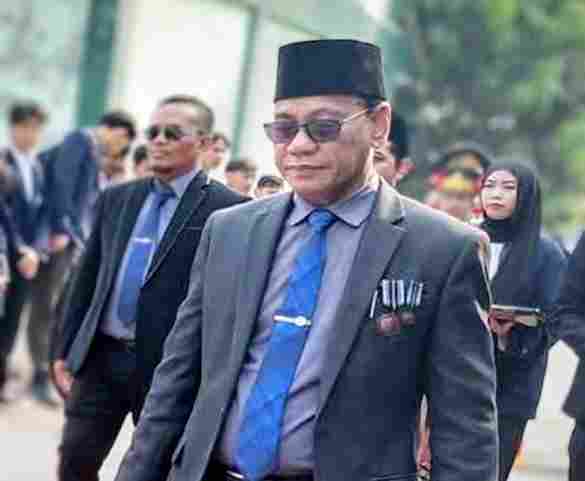
By:
*Masduki Duryat*
_(Rector of the Al-Amin Institute of Islamic Studies, Indramayu)_
There are times when a single word creates more of an uproar than a thousand programs. During the 28th anniversary celebration of the National Mandate Party (PAN) on September 18, 2026, President Prabowo Subianto remarked to the attendees that certain experts had criticized his policies, subsequently uttering the phrase, *”so smart that they become stupid.”* While the context was a speech delivered before “true friends,” the moment the speaker is the President of the Republic of Indonesia, those words cease to belong solely to an internal setting; they immediately become a public message. (Bloomberg Technoz)
The issue is not merely whether the President is permitted to respond to criticism. He certainly is. The President is both a citizen and a public official entitled to explain, refute, or even correct criticisms deemed erroneous. Likewise, experts, academics, the media, and the public possess the constitutional right to express their thoughts and opinions. The Constitutional Court has even emphasized the importance of preserving a space for criticism and preventing a “chilling effect” that might make the public afraid to express their views openly. (Constitutional Court of the Republic of Indonesia)
*The Issue Is Not Criticism, but the Dignity of Power*
This is where the ethical issue lies. The President does not speak merely as Prabowo; he speaks with the weight of the presidential institution.
When an academic criticizes government policy, the ideal response is to counter argument with argument, data with data, and methodology with methodology. If the criticism is flawed, refute it substantively. If the data is incorrect, present the correct data. If the analysis is biased, expose that bias.
For, as noted by communication observer Fajar Junaedi, public policy should be grounded in “evidence-based policy” rather than a battle of status between those in power and experts. He argues that the use of pejorative language by public officials risks setting a poor precedent for democratic discourse. (suara.com)
Thus, the issue at hand is not that the President took offense at criticism, but rather how a President handles disagreement.
*Is This a Legacy of Command Culture?*
Questions regarding Prabowo’s military background are intriguing but must be approached with caution. There are insufficient grounds to conclude that such remarks are necessarily a “hangover from the mindset of a Kopassus Commander.”
However, from a socio-political perspective, there are indeed differences in organizational culture worth reflecting upon. In a command-based organization, decisions must be executed with discipline and adherence to the chain of command. In a democracy, conversely, disagreement serves as a mechanism for correcting the exercise of power.
The President is not leading troops required to respond with “Ready!” He leads a republic whose constitution explicitly provides space for dissenting opinions.
Therefore, democracy requires leaders capable of distinguishing between loyalty and mere obedience. Loyalty to the state is not synonymous with always validating the government. In fact, the harshest criticism often stems from a deep love for the country.
*Here, Gontor Offers a Mirror*
Interestingly, coinciding with the controversy, during Gontor’s centennial celebration, KH Hasan Abdullah Sahal delivered a powerful message regarding criticism and correction. In the presence of President Prabowo, he emphasized openness to protest and criticism; indeed, the Gontor tradition has long stressed the courage to say “yes” when one must say yes, and “no” when one must say no. (Gontor)
Furthermore, KH Hasan’s phrase—”State the truth; do not merely justify reality”—which also appears in a composition he sang, *Akankah Dunia Rela* (Will the World Accept It?), holds extraordinary relevance for the relationship between religious scholars (*ulama*) and state leaders (*umara*). (Republika Online)
That statement essentially embodies an ethic of power: do not alter the truth simply to align it with a reality that happens to benefit us.
*Religious Scholars Are Not Rubber Stamps for Power*
This is where Gontor offers an important lesson. Islamic boarding schools (*pesantren*) should not stand alongside those in power merely to offer applause. Religious scholars (*ulama*) who are close to the authorities (*umara*) are not those who have lost the courage to speak the truth.
Gontor itself has asserted that *pesantren* are not institutions to be dictated to by officials, ministers, businesspeople, or those in power. *Pesantren* must stand firm on the mandates and values they hold dear.
Thus, the President needs not only those who say “ready,” but also those with the courage to say, “No, Mr. President, that is mistaken.”
Democracy thrives when those in power are not allergic to criticism, academics do not misuse their expertise, and religious scholars do not lose their moral courage.
For ultimately, a nation does not collapse from an excess of criticism; rather, it faces danger when those in power listen to too little of it.
And perhaps this is the profound message from Gontor: the duty of a religious scholar is not to validate the status quo simply because of their proximity to power but rather to speak the truth precisely when that truth is uncomfortable for those in power.**
Indramayu, September 20, 2026
——