DON’T WAIT UNTIL THE FOREST IS JUST A STORY
Indonesian Forest Day and an Alarm for Civilization)
By Ali Aminulloh
Trees fall without a sound. Hills lose their green. Springs slowly shrink. Rivers carry mud. The air feels hotter. Then when heavy rain falls, people are shocked to see water come carrying wood, soil, rocks, even sweeping away homes and lives.
We call it a disaster.
But perhaps some of these disasters are messages we have ignored for too long.
The forest is wounded. And when the forest is wounded, humanity is actually wounding its own future.
Every August 7, Indonesia commemorates Indonesian Forest Day. This commemoration is not just a celebration of the remaining green expanses. It should be a moment for reflection: how far have we protected the earth that is our home?
Indonesian Forest Day was born from the civil movement “Hutan Itu Indonesia”. The idea began in 2017 through a public petition, and was widely commemorated for the first time on August 7, 2020, involving organizations, communities, youth, academics, indigenous peoples, and environmental activists.
August 7 was chosen in the month of Indonesian Independence. That choice carries an important message: independence does not only mean freedom from human oppression of other humans. Independence must also give future generations the right to enjoy clean air, sufficient water, fertile soil, and forests that remain alive.
In 2026, the spirit of Indonesian Forest Day is summarized in the theme: “Restore the Forest, Restore Life.”
A simple sentence that carries a huge message.
Because what we are restoring is not just trees.
What we are restoring is life.
Our Forests Are Vast, But Still Wounded
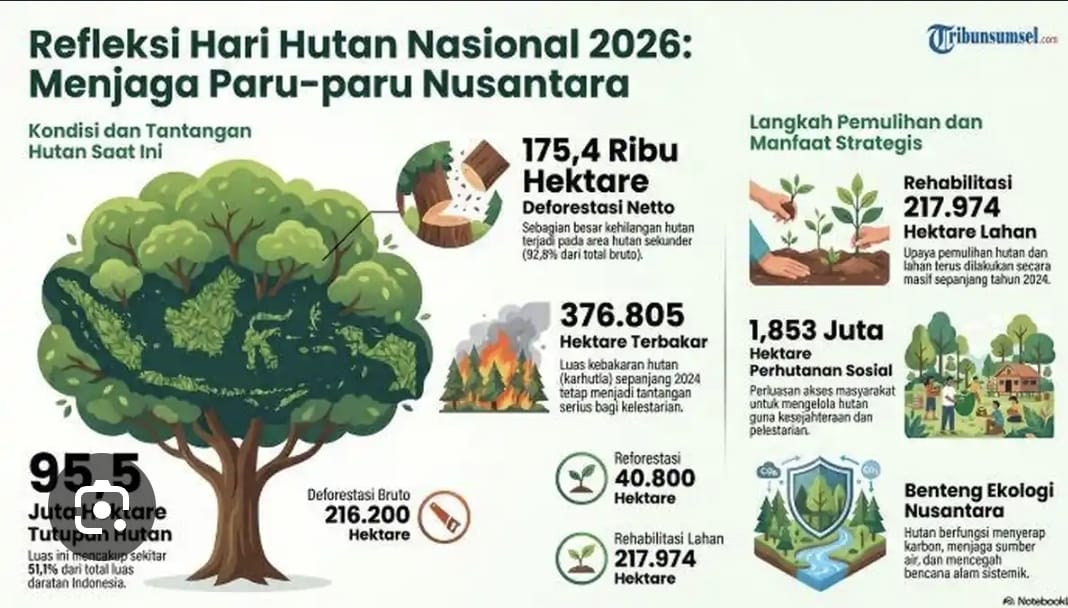
Indonesia is still one of the countries with the largest tropical forest areas in the world. Around 95.5 million hectares of Indonesian land remain forested.
That number is impressive.
But let’s not be too quick to feel safe.
Behind that green expanse, forest loss continues on a large scale. Government data shows net deforestation in 2024 reached around 175 thousand hectares. Meanwhile, some independent monitoring using different methods shows forest cover loss can reach hundreds of thousands of hectares in a single year.
Hundreds of thousands of hectares.
The number is easy to read on paper. But imagine the actual landscape.
Inside are millions of trees.
Bird nests.
Places for wildlife to breed.
Medicinal plants.
Water springs.
Soil that stores water.
Communities that depend on the forest for their livelihood.
Then one day that area is cleared.
Trees are gone.
Soil is exposed.
Water loses its place to rest.
And when rain comes, the earth no longer has the same ability to hold it.
When Forests Leave, Water Turns Wrathful
Forests are extraordinary natural dams.
Tree roots bind the soil.
Leaves slow the fall of rain.
Litter layers absorb water.
Forest soil stores water and releases it slowly into rivers.
When forests disappear, part of that natural mechanism disappears too.
Rainwater that should seep into the soil becomes surface runoff. Rivers receive huge volumes of water in a short time.
Then we see floods.
In hilly areas, soil without vegetation becomes more vulnerable to erosion and landslides.
More ironically, areas flooded in the rainy season can experience water shortages in the dry season.
Why?
Because water is no longer stored well by forests.
Water comes quickly.
Leaves quickly.
And humans are left facing floods during rain and drought during the dry season.
Don’t Always Blame the Rain
Whenever floods occur, rain is often the first to be blamed.
“The rain was too heavy.”
“The rain lasted too long.”
But rain has been falling on earth long before highways, mines, plantations, and modern cities were built.
The more important question is:
What happened to the land where the rain fell?
Is the forest still there?
Are the catchment areas still protected?
Do rivers still have room?
Are the hills still covered with trees?
Or has the land become concrete, mines, open areas, or monoculture landscapes?
Of course not all floods and landslides are caused by forest destruction. Extreme rain, climate change, soil characteristics, geology, drainage, and spatial planning all play a big role.
But forest destruction makes the landscape more vulnerable.
It becomes a risk multiplier.
Rain may come from the sky.
But disasters are often amplified by human decisions on the ground.
When Forests Disappear, the Air Gets Hotter
Trees are not just landscape decoration.
Forests absorb carbon dioxide, store carbon, maintain humidity, and help regulate the water cycle.
When trees are cut or burned, some carbon is released back into the atmosphere.
When forest cover decreases, the soil surface receives more direct sunlight.
Areas become hotter.
The air becomes drier.
The water cycle changes.
On a large scale, changes in forest cover can affect rainfall patterns and strengthen the impacts of climate change.
That’s why today’s public questions are so relevant:
Why is the air getting hotter?
Why are seasons becoming harder to predict?
Why does extreme rain feel more frequent?
Why do droughts last longer?
The answer is not just one.
But we cannot close our eyes to the fact that forest destruction causes the earth to lose one of its cooling and life-supporting systems.
Philosophical Awareness: Who Are We?
Amid these problems, the idea of Syaykh Al-Zaytun A.S. Panji Gumilang on the “Trilogy of Awareness” becomes relevant: philosophical awareness, ecological awareness, and social awareness.
First, philosophical awareness
It asks humans:
Why are we on earth?
Are we just beings who come to take?
Take wood. Take minerals. Take soil. Take water. Take as much as possible.
Then leave the damage to our grandchildren?
Or are we here to build life?
Philosophical awareness reminds us that humans are not absolute owners of the earth.
We are just one generation in the long journey of life.
There were generations before us.
And there will be generations after us.
Therefore, the earth must not be exhausted in one era.
Second, ecological awareness
It places humans not outside nature, but as part of nature.
Forests are not just economic objects.
Rivers are not just water channels.
Soil is not just a commodity.
All are parts of an interconnected life system.
If the forest is healthy, water is protected.
If water is protected, agriculture thrives.
If soil is fertile, food is available.
If air is clean, humans are healthy.
Conversely, if forests are damaged, humans will ultimately bear the consequences.
Therefore, protecting forests is not romanticism.
Planting trees is not a ceremony.
Restoring springs is not a small activity.
All are great work to sustain civilization.
And planting trees is not enough by just sticking in a seedling, taking a photo, then going home.
Seedlings must be cared for.
Ecosystems must be restored.
Natural forests that remain must be protected.
Because a forest that grows for hundreds of years cannot be replaced by planting trees for a few seasons.
Third, social awareness
Environmental damage almost never stops with the one who caused it.
When upstream forests are cleared, downstream communities may flood.
When springs are damaged, villagers lose water.
When peat burns, smoke is inhaled by millions.
When the environment is polluted, children bear the impact.
This means forest issues are social justice issues.
Some gain profits.
But often other communities pay the cost of the damage.
Therefore forest management must be based on responsibility, justice, and sustainability.
Indigenous and local communities who have guarded forests for generations must be involved and respected.
They must not just be spectators when decisions about the land they live on are made far away at a desk.
Forests Don’t Need Ceremonies
Indonesian Forest Day should spark real action.
Government must be firm against illegal logging, illegal mining, forest burning, and misuse of spatial planning.
Businesses must understand that economic profit cannot be built on ecological destruction.
Universities must produce knowledge that helps protect the earth.
Schools must instill ecological awareness from an early age.
Communities can start with small things: care for trees, protect water sources, don’t throw trash in rivers, reduce paper waste, support environmentally responsible products, and dare to report environmental destruction.
But above all, we need a change in mindset.
We must stop seeing forests only by the value of their timber.
See forests by how much life they protect.
Don’t Let Our Grandchildren Ask
Imagine decades from now.
A child opens a history book.
They see photos of Indonesia’s very dense tropical forests.
They see orangutans swinging in trees.
They see tigers, birds, clear rivers, and green mountains.
Then they ask:
“Was it true that Indonesia once had forests this vast?”
That simple question will be very painful if our generation fails to protect them.
Let us not bequeath them photos of forests, but not the forests themselves.
Let us not bequeath stories of springs, while the springs have dried up.
Let us not teach animal names through books because their habitats are gone.
Indonesian Forest Day, August 7, 2026, is therefore not just a day to remember forests.
It is a call to take a stand.
Build philosophical awareness so humans understand why they live.
Build ecological awareness so humans understand they are part of nature.
And build social awareness so humans understand that the earth does not belong to one person, one group, or one generation.
Forests may not be able to speak.
But floods, landslides, droughts, hot air, disappearing springs, and extinct wildlife are nature’s language that we must understand.
Don’t wait for that language to turn into a scream.
Don’t wait until Indonesia’s forests are just a story.
Indonesia, August 7, 2026
——-