H. PURNOMO, S.Sos. FLAPPING THE WINGS OF A SANTRI FROM THE LAND OF WIRALODRA, INDRAMAYU, RECIPIENT OF THE 2025 YOUNG FIGURE DRIVERS OF THE REGIONAL ECONOMY
By: H. Adlan Daie
Political and Socio-Religious Analyst
It’s interesting to read the profile of H. Purnomo, S.Sos., who, at a relatively young age, under 40, has already spread his wings relatively high in the world of entrepreneurship and business, spanning various sectors from construction to culinary.
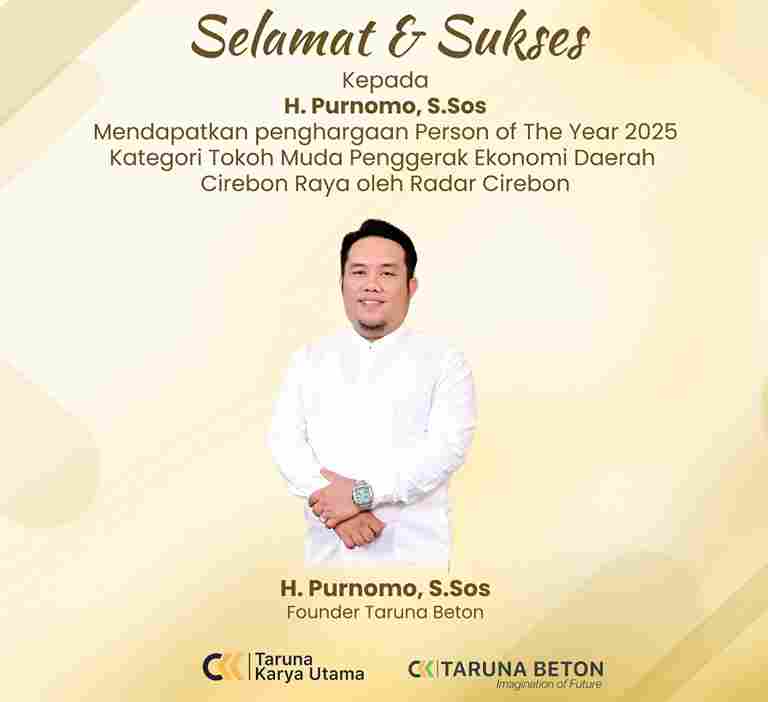
Today (Thursday, December 18, 2025), H. Purnomo was awarded the “Person of the Year 2025” award in the category of Young Figure Driving the Regional Economy of Greater Cirebon by “Radar Cirebon,” a media group with a large network in Indonesia. Congratulations!!!
This is a portrait of a santri (Islamic student) from the millennial generation (born between 1981 and 1996) who has successfully “spread his wings” in the business world, a “minority” profession rarely pursued by santri. He succeeded not only for himself but also in the “Radar Cirebon” media award category, being named “Regional Economic Driver.”
In Javanese political sociology literature, citing Clifford Geezt’s research, H. Purnomo is interesting to the author as an “exception” or “uniqueness” in Javanese political demographics. Born into a santri family, his parents gave him the name “Purnomo,” a name not commonly used in Clifford Geezt’s Javanese socio-political trilogy within the “santri” social group.
H. Purnomo was born in Indramayu on May 20, 1987, into a santri family. His choice of post-elementary schooling indicates that he grew up in a santri family, attending santri educational institutions at Mts NU Putera Buntet and MAN Buntet Cirebon. Buntet is one of the “historical” and “iconic” Islamic boarding schools in the treasury of Nahdlatul Ulama (NU) Islamic boarding schools on the island of Java.
Gus Dur wrote an article titled “Pa Iskandar and Pa Darmin” in Tempo magazine (November 4, 1980 edition) 45 years ago about the inclusiveness of the Lirboyo Islamic boarding school, an NU Islamic boarding school with a very strong pesantren tradition, reflecting the phenomenon where social diversity has merged into the “cultural elasticity” of NU Islamic boarding schools.
In this context, at least in the author’s social construction, H. Purnomo is one of those “cultural elasticity” who has merged, as Gus Dur’s analysis constructs in the article. There are no psychological barriers to interaction across social and political divides—where the 1955 and 1971 elections were very clear in their social divisions.
Apart from the sociological portrait above, what is interesting about H. Purnomo is that he is a student with a degree in the social sciences, but He successfully “spread his wings” in the business world, a profession that, once again, is very much a minority, rarely pursued by Islamic boarding school students.
The author certainly doesn’t understand the ins and outs of H. Purnomo’s journey from crawling, climbing, falling, and rising to his current position as the Owner and Founder of several companies that have become substitutes and driving forces for the regional economy.
His success in the business world at a young age, under 40, reminds me of an old, inspirational book entitled “The Ideological Letters of a Father,” written in 1922 by J. Rockefeller, an oil tycoon and the richest man in the world at that time.
J. Rockefeller wrote this letter to his son, who was about to graduate from a prestigious American university:
“You must believe that you yourself are your greatest asset, not your father’s wealth. You will stand firm on your own, by the strength of your own feet,” J. Rockefeller wrote to his son.
“In this world, nothing can beat perseverance. Education alone is not enough. The world is full of educated people who fail. Only perseverance will not disappoint. That is character,” he wrote further.
According to the author, this perseverance variable shaped H. Purnomo’s character, a built-in consistency that fostered competence and innovation within his strengths in adapting to the social and economic environment in his region, Indramayu.
In this context, he is compatible (competent and suitable) to serve as President Commissioner of PT. Pandita Jasa Prima, President Director of PT. Waskita Jaya Purnama, President Director of PT. Muara Jati, Owner & Founder of Taruna Beton, Owner of Taruna Coffie & Resto, etc.
Outside of his business activities, he continues to serve within the Nahdlatul Ulama (NU) community and actively pursues social engagement in various organizations, including Treasurer of GP Ansor Indramayu (2020-2024), Daily Chair of IMI Indramayu (2021-2023), Chair of LPNU West Java (2021-2026), and Advisory Board of HIPMI Indramayu (2022-2025).
In short, what H. Purnomo has achieved at a young age, as Imam Syafie calls “ladzidul ‘ais fin nashobi,” is “the sweat of perseverance will not betray the final result,” especially if he “anfa’ linnas” (anfa’ linnas), making a minimal contribution to his hometown, Indramayu.
The positive virus of entrepreneurship or the spirit is crucial to instill in the social ecosystem of Indramayu’s younger generation, particularly the young Nahdlatul Ulama (NU) generation. The award H. Purnomo received from “Radar Cirebon” in the category of Young Figures Driving the Regional Economy may serve as a driving inspiration.
This is crucial for Indramayu. The social problems of poverty and social fragility cannot be addressed by the Indramayu Regional Government’s capacity alone, except through the role of the business sector and the independent character of its citizens. This is where the award H. Purnomo received above becomes meaningful.
The “ultimate” question is, will H. Purnomo spread his wings even higher for the benefit and benefit of the wider public? Let’s wait and see where the universe will lead his wings in the future.**
Indramayu, December 18, 2025
Wassalam.
——-