From Roem-Roijen to the Middle East: History Teaches the World Peace
By Ali Aminulloh
A nation that desires longevity must have the courage to choose reason over anger.
History often positions war as a platform for courage. The boom of cannons, the march of troops, and heroism on the battlefield are often glorified as symbols of a nation’s fortitude. Yet, many nations have fallen not because they lost a single battle, but because they maintained hostility for too long. It was at this point in Indonesian history, May 7, 1949, that a lasting lesson emerged: that the greatest courage is sometimes not continuing the war, but rather daring to pave the way for peace.
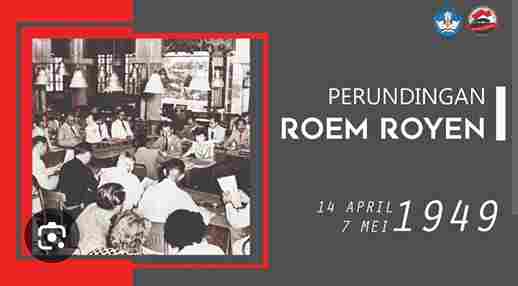
The Roem-Roijen Agreement was born not when the Republic of Indonesia was at the peak of its power, but rather when the young republic was on its brink. The Second Dutch Military Aggression had struck Yogyakarta, the republic’s leaders were captured, and the Dutch were trying to instill in the world the perception that Indonesia was finished. Yet, in this desperate situation, the nation’s leaders did not lose their clarity of thought. They chose diplomacy as an effort to save the future. The negotiations, which began in mid-April and reached an agreement on May 7, 1949, at the Hotel Des Indes in Jakarta, then served as the gateway to the Round Table Conference and the recognition of Indonesian sovereignty a few months later.
Herein lies the majesty of the event. The Republic was not showing weakness when it sat at the negotiating table, but rather, it was demonstrating maturity. The negotiators understood one simple yet fundamental point: a nation that wants to live long cannot make decisions based solely on momentary anger. There are times when weapons are necessary, but there are also times when common sense must prevail.
Diplomacy as a Quieter Form of Victory
Mohamad Roem and the republican leaders certainly understood that the people were angry. Dutch aggression had left deep wounds. Guerrilla resistance in various regions was still raging. Emotionally, continuing the war was the easiest option to accept, reflecting the spirit of the times.
But history requires more than emotional courage. It requires a keen eye for consequences.
If the war were prolonged, casualties would mount. Villages would be further destroyed. Food distribution would be paralyzed. The government would cease to function. Children would lose their schools. The nascent republic might have triumphed in the symbolism of resistance, but lost in the ability to survive.
Therefore, Roem-Roijen was a quieter form of victory: the victory of reason over turmoil, the victory of strategy over revenge, the victory of the future over immediate gratification.
This agreement essentially paved the way for an end to guerrilla warfare, a halt to Dutch military operations, the return of the Republican government to Yogyakarta, the release of the nation’s leaders, and the path to the Round Table Conference. It was not the end of the struggle, but a turning point that gave the struggle a more definite political direction.
Reading Roem-Roijen through the Trilogy of Awareness
If examined more deeply, the Roem-Roijen Agreement was not merely a diplomatic event. It was an event of awareness. It is in this context that the idea of the Trilogy of Awareness—philosophical awareness, ecological awareness, and social awareness—becomes highly relevant for rereading this historical moment.
Philosophical awareness: when leaders are not intoxicated by revenge
Philosophical awareness demands the ability to see a greater purpose than emotional outbursts. The republic’s leaders did not view war as the sole measure of patriotism. They realized that independence was not simply about avenging wounds, but about ensuring the nation’s survival and future.
They chose to think beyond the immediate past: how the republic could gain international legitimacy, how the government could recover, and how the struggle could avoid becoming mired in endless conflict. This is the political maturity often hard to find in modern nations today.
Ecological awareness: war always destroys more than meets the eye
War doesn’t just kill people. It destroys the land where food grows, destroys the homes where families live, disrupts the schools where generations are formed, and leaves trauma that lingers long after the gunfire has ceased.
The republic’s leaders understood that the homeland should not be used as an arena for destruction for too long. Independence must mean the continuation of life. In other words, diplomacy is a way to save the nation’s living space from wider destruction.
Social awareness: the people must not become sacrifices for elite egos
Long wars are always paid for by the common people. Farmers lose their rice fields, traders lose their markets, mothers lose their husbands, and children lose their sense of security. The state must not use the people as fuel to maintain symbols of political courage.
Roem Roijen is important because behind his diplomatic language lies a single humanitarian goal: restoring the pulse of society.
When the Modern World Fails to Learn
Ironically, the great lesson Indonesia once practiced in 1949 has not yet been fully learned by the modern world. The ongoing tensions between Iran, Israel, and the United States demonstrate that technology may advance, but wisdom does not necessarily follow suit.
Revenge rhetoric, missile threats, displays of military force, and the struggle for geopolitical dominance continue to fill the global public sphere. Each feels they are safeguarding honor. Each feels they are upholding security. But what is most evident are civilian casualties, the destruction of living spaces, global economic uncertainty, and the deepening of intergenerational hatred.
Faced with situations like this, the modern world is actually demonstrating a failure of consciousness:
– philosophical failure because it prefers reaction to dialogue;
– ecological failure because it allows the earth to become a blasting field;
– social failure because civilians are once again the price to pay.
Humans of this century can send missiles soaring through the sky, but they still often fail to break through the impasse of their own minds.
Lessons Indonesia Should Not Ignore
Indonesia must not forget its historical legacy. This nation has proven that dialogue can produce more lasting victories than emotional victories on the battlefield. From Roem-Roijen, there are at least four important lessons for Indonesia today.
First, differences must not be allowed to turn into permanent hostility. In politics, religion, and social life, the ability to sit together is far more crucial than the ability to defeat each other.
Second, development must protect the earth and the social order. Economic progress that destroys living space will only shift conflict from the battlefield to the everyday lives of the people.
Third, the people must remain at the center of all policies. Elite prestige, group competition, and conflicting interests must not displace the people’s basic needs for security, welfare, and education.
Fourth, Indonesia must have the courage to strengthen its identity as a global mediator. We have a strong diplomatic history. We have won not only with weapons, but with sanity.
Awareness is a Prerequisite for the Survival of Civilization
The Roem-Roijen Agreement ultimately conveyed a very simple message: this nation survived because it still had leaders who were willing to think clearly amidst the tensions.
They did not worship revenge.
They did not glorify endless war.
They chose a path that may have been unpopular at the time, but proved to be a safeguard for the future.
Today, as the Middle East rekindles and the world is filled with the language of threats, Indonesia should re-open the pages of May 7, 1949. From there, we learn that war can indeed force people to submit, but only awareness can keep civilization intact.
Because history has proven time and again: nations that are late to awaken are usually destroyed sooner.**
Indonesia, May 7, 2026
——