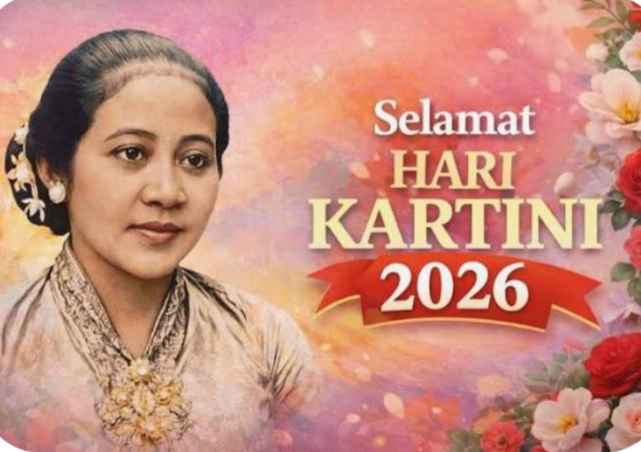
Kartini and True Independence: From Seclusion to Freedom of Spirit, Thought, and Knowledge
By: Ali Aminulloh
Every year we celebrate Kartini, but secretly, we also forget her. We wear kebaya, but abandon our courage. We repeat her name, but don’t continue her thoughts. Ironically, the more often it’s commemorated, the thinner its meaning becomes. So the question is simple but poignant: are we truly celebrating Kartini, or merely celebrating comfort without change?
Amidst the country’s sweeping theme: “Empowered Women, Protected Children Towards a Golden Indonesia 2045” by the Ministry of Women’s Empowerment and Child Protection of the Republic of Indonesia, the name of Raden Ajeng Kartini is once again echoed. But Kartini is not merely a symbol to be plastered on billboards or sewn into celebratory uniforms. She is an unsolved anxiety. She is a question we have yet to fully answer: are women truly empowered, or merely appear empowered?
Kartini was born in Jepara in 1879, into a world that limited women before they even knew themselves. She was confined at a young age, separated from the outside world, and directed toward a predetermined destiny. But precisely in those limitations, she discovered the most radical freedom: thinking. She read, wrote, and challenged. Not by shouting, but with awareness. From a confined space, she gave birth to ideas that transcended her time.
What Kartini did was not merely a woman’s struggle. She was building humanity. When read today, the spirit of her struggle aligns with the Trilogy of Awareness initiated by Shaykh Al Zaytun: a perspective that not only liberates women but also humanizes them.
First, philosophical awareness. Kartini did not live in blind obedience. She questioned, doubted, and sought meaning. Why shouldn’t women be allowed to go to school? Why should life be determined by others? These questions were simple, but therein lay her courage. Today, when access to education is widely available, our challenge is no longer prohibition, but negligence. Many can learn, but few truly think. Kartini taught that true freedom lies not in the space for movement, but in the depth of consciousness.
Second, ecological awareness. Kartini did not want education to be merely intellectual decoration. She wanted knowledge that was alive, that touched reality, and that improved lives. School for women was not just about “being able,” but about “being meaningful.” In today’s context, as women are beginning to appear in strategic spaces: in laboratories, in policymaking, and in the digital world, the same question remains relevant: does our knowledge only elevate ourselves, or does it also elevate the lives around us?
Third, social awareness. Kartini never fought alone. She always thought of other women, her community, and her nation. She wrote not to be remembered, but to inspire action. This is the essence of true empowerment: it doesn’t stop at the individual, but expands to create impact. In the spirit of “Empowered Women, Protected Children,” this awareness is key. Because empowered women are not only independent, but also capable of protecting, educating, and strengthening the next generation.
However, today’s world presents a different mirror. In various parts of the world, women are transcending boundaries once considered impossible. In Iran, for example, we see women becoming nuclear scientists, pilots, and even drone controllers. They work in spaces once synonymous with men. They are not simply present, but leading, controlling, and creating. They prove that as awareness grows, social boundaries become fragile.
It is at this point that the idea of empowerment finds a more profound depth. It is not merely access, not merely opportunity, but true freedom. A freedom that Shaykh Al Zaytun formulated in three main axes: freedom of spirit, freedom of thought, and freedom of knowledge.
Freedom of spirit is when women no longer live in fear, oppression, or simply go with the flow. They know themselves, value their dignity, and stand with complete inner conviction. Kartini demonstrated this from the beginning: in the midst of seclusion, she never gave up spiritually. Her body may be restricted, but her soul remains free.
Freedom of thought is the courage to think for oneself, to question, and not to submit to the rigidity of restrictive traditions. This is what makes Kartini different. She not only accepts the world, but also interprets it. He not only lives within the system, but also dares to criticize it. Today, freedom of thought is increasingly important amidst the flood of information, because not everything that’s popular is true, and not everything that’s common is true.
Independence on knowledge is the pinnacle. It’s not just about possessing knowledge, but mastering it, developing it, and utilizing it use it for the greater good. From her seclusion, Kartini dreamed of a school. From her limitations, she gave birth to the idea of education. And today, that dream has been realized in millions of women who study, work, and lead.
If the trilogy of awareness teaches us to be conscious of life, then these three freedoms teach us to live that awareness fully.
Then we return to ourselves. Indonesia is heading towards a period known as Indonesia Emas (Golden Indonesia) in 2045. But gold is not born from celebration, but from formation. And that formation is impossible without truly empowered women, women who are free in spirit, sharp in thought, and broad in knowledge.
Kartini once said that she wanted the impossible. Perhaps today, the impossible seems simple: women who think freely, learn with purpose, and act for others. But that is precisely the challenge, because the simple is often overlooked.
So Kartini Day is not about remembering the past. It is a mirror for today and a compass for the future. Because the light Kartini once fought for has never truly been extinguished. It only waits to be rekindled in a free spirit, in bold thinking, and in life-giving knowledge.
And from there, Indonesian women will not only join us on the road to Golden Indonesia 2045, but also become the light that guides it.**
Indonesia, April 21, 2026
——-