Pedestrian Day: Why Must Okeke Teach This Nation How to Walk?
(Reflection on Walking Day)
By Ali Aminulloh
We live in a fertile tropical country, yet our bodies are parched by movement. Highways are filled with machines, sidewalks are narrowed by neglect, and feet, humanity’s most ancient means of transportation, are neglected. Paradoxically, we proudly call ourselves a great nation, yet forget the small steps that nourish civilization. If walking is a right, why does it feel like a luxury?
Trilogy of Consciousness: From Mind to Earth, from Earth to Others
Amidst the honking of horns and the fatigue of the city, an idea invites us to pause and take a step. The Trilogy of Consciousness, initiated by Shaykh Al Zaytun, connects three important nodes: philosophical awareness (what, why, how, and why we live), ecological awareness (how we care for the earth), and social awareness (how we treat others). Walking, simple yet radical, is the meeting point of all three: it trains reason, nourishes nature, and ennobles humanity.
Al Zaytun: When Steps Become the Curriculum of Life
At Al Zaytun, the vision of education doesn’t stop in the classroom. It’s actually in motion. The OKeKe (Foot Fitness Exercise) program targets a minimum of 10,000 steps per day, exemplified directly by the Sheikh and his fellow exponents. Here, health isn’t a slogan; it’s a daily discipline.
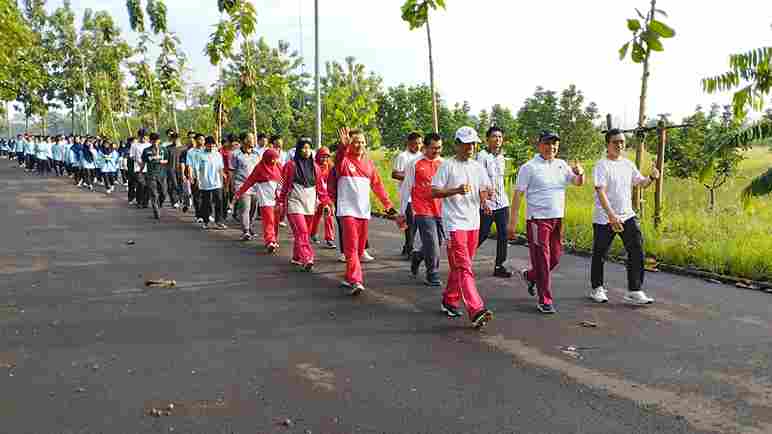
Every Sunday, the campus transforms into a breathing public space. Car-Free Day streams through the streets: from the Great Hall, along Rahmatan Lil ‘Alamin, and back to the Great Hall. Students, teachers, mentors, guardians, and lecturers all share the rhythm of their steps. This is the education of tolerance in action: healthy bodies, clear minds, and human relationships.
A Country That’s Lazy to Move, a City That Forgets Pedestrians
Outside campus walls, Indonesia is often labeled a country that’s lazy to move. Cities are growing rapidly, but pedestrian space is lagging behind. Sidewalks are unfriendly, crosswalks are minimal, and safety is often sacrificed. We build for wheels, not feet. The consequences are not just physical exhaustion, but also social fragility, and the distance between people grows wider.
January 22nd: Remembering Trampled Rights
National Pedestrian Day, commemorated every January 22nd, was born out of grief. The Tugu Tani tragedy (2012), which claimed the lives of 12 pedestrians, forced us to reflect: who is being protected by the roads? This commemoration is not a ceremony, but rather a call to protect pedestrian rights, provide safe facilities, and reduce accidents.
The way to celebrate is clear and urgent:
– Raise pedestrian safety awareness
– Create safe and comfortable pedestrian facilities
– Reduce road accidents
– Respect pedestrians as equal road users
Walking as an Ethic of Civilization
Walking is the quietest yet most impactful ethic. It reduces emissions (ecological), hones self-discipline (philosophical), and opens up a space for conversation (social). What was practiced at Al Zaytun demonstrates: when steps are restored, humans are humanized.
Epilogue: Dare to Step, the State Protects.
Maybe we don’t need a major revolution. Simply restoring the most basic right: to walk. From safe sidewalks to exemplary campuses, from machine-free Sundays to healthier Mondays. Because a civilized civilization always begins with one small thing: feet that dare to step, and a nation willing to protect them.**
Indonesia, January 22, 2026
——–