
From Zakaria’s Prayer to Contemporary Curriculum: Surah Maryam and the Educational Revolution that Awakens Consciousness
By: Ali Aminulloh
The Mihrab as the Center of Civilization, the Mosque as a Curriculum Laboratory, and Education as a Path to Enlightening Humanity
Why did an educational revolution emerge from the prayer of an elderly prophet, rather than from conference rooms crowded with quality jargon and numerical achievements? While modern education is busy formulating indicators of success, Surah Maryam, verses 11–17, presents a compelling paradox: profound change begins in the mihrab, a quiet space where human consciousness is reorganized. It was there that Zakaria, peace be upon him, not merely prayed, but planned the future of civilization.
These verses in the Qur’an are not merely stories of biological miracles. They are profound pedagogical narratives. Zakaria’s prayer is not merely a request for offspring, but a prophetic educational vision: to produce a generation of basyaran sawiyyan: young people who grow in balance, wholeness, and maturity in consciousness. The generation capable of “bringing the dead back to life” is not buried bodies, but frozen hearts, dull consciences, and paralyzed social awareness. At this point, education is redefined: not merely the transfer of knowledge, but the revitalization of humanity.
The mihrab, in this interpretation of education, is not merely a symbol of personal piety. It is a conceptual space where visions are formulated and directions are set. The mosque appears as the center of civilization: where revelation, reason, and reality converge. Zakaria began there because he understood: if the source of education is not clear, the results will lack vitality. Education deprived of divine guidance will produce intelligent but empty individuals, skilled but morally fragile.
The pattern Zakaria established was a complete prophetic one: revelation as the source of values, consciousness as the goal, and humanity as the outcome. This is the foundation for the birth of the perfect human being, a human being who is not divided between reason and faith, between knowledge and ethics, between progress and humanity. Thus, Surah Maryam 11–17 is not simply a text to be read, but an educational roadmap relevant across time.
This idea finds its articulation in the contemporary educational endeavors developed within the Al Zaytun community. Through the LSTEAMS curriculum framework, education is constructed as an interconnected system rooted in values. Law is placed as the foundation, with the awareness that the highest law is divine teaching. From there, all disciplines, from science, technology, engineering, art, mathematics, and spirituality, are derived and integrated. Knowledge does not stand neutrally without values; it is directed to enliven humanity and preserve life.
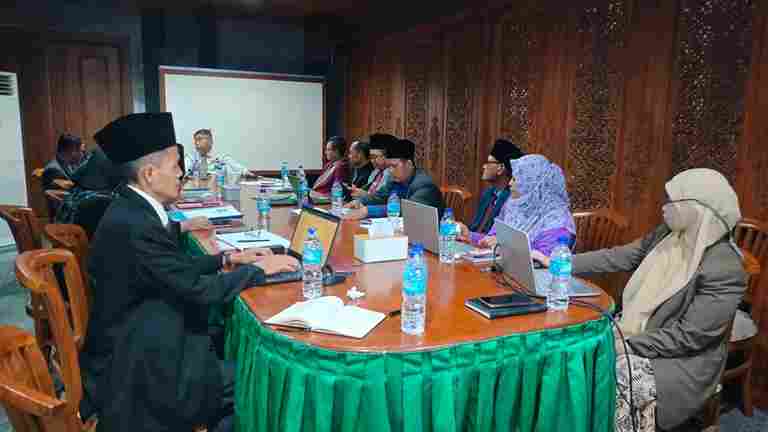
The implementation of this vision does not stop at the conceptual level. To revitalize the curriculum as a path to awareness, the Al Zaytun Curriculum Team, under the direct guidance of Sheikh Al Zaytun, holds regular “Kamisan” discussions. Held in the Special Room of the Rahmatan Lil Alamin Mosque, this forum restores the mosque to its fundamental function as a laboratory of civilization. The discussion is attended by exponents, the Teachers’ Council, the principal, the Dormitory Control Council, and KOSMAS. This orchestration of collective consciousness unites experience, knowledge, and moral responsibility.
In this space, the curriculum is discussed not as an administrative document, but as a humanitarian project. In one of the closing sessions of the Thursday Prayer, Sheikh Al Zaytun directly linked the implementation of education to the profound message of Surah Maryam, verses 11–17. Education, he emphasized, must foster a trilogy of awareness: philosophical awareness that leads humans to question the meaning of life and the purpose of learning; ecological awareness that positions humans as guardians of life and the balance of nature; and social awareness that fosters empathy, justice, and a commitment to humanity. This trilogy is the heart of holistic education.
This is where the novum gradum of education takes shape. A new leap that is not merely adaptive to the demands of the times, but faithful to the source of life-giving values. Education is no longer understood as a labor-producing machine, but rather as a process of developing human beings who are self-aware, universally aware, and aware of others.
Surah Maryam teaches a fundamental lesson: civilization is not built from noise, but from clarity. From the mihrab of the Rahmatat Lil Alamin Mosque during the Thursday Prayer discussion, a common thread emerged: education must bring life to humanity. When revelation is made the source, the mosque the center of formulation, and consciousness the goal, then a generation of “sabiyyan sawiyya” is born: a generation with intelligent minds, a vibrant conscience, and a strong sense of social responsibility. It is there that education rediscovers its soul, and the future finds hope.**
Indonesia, January 22, 2026
—–


