From Educational Equality to Equitable Economic Growth
By: Dr. Ali Aminulloh, M.Pd.I., ME
Mahad Al-Zaytun reaffirmed its role in promoting the advancement of national education. Through ongoing student training, this boarding school demonstrates a real commitment to contributing to Indonesia’s future. Education, for Al-Zaytun, is not merely a teaching and learning process, but an investment in civilization that determines the nation’s future direction.
The student training carried the overarching theme of “Revolutionary Transformation of Boarding School Education Towards a Modern Indonesia in the 21st Century and 100 Years of Indonesian Independence.” This theme arose from the awareness that Indonesia is facing significant challenges, ranging from disparities in educational quality to the demands of global competitiveness. Boarding school education is considered strategically positioned to shape a generation that excels not only academically but also matures in character and values.
Education and Economics: Two Inseparable Sides
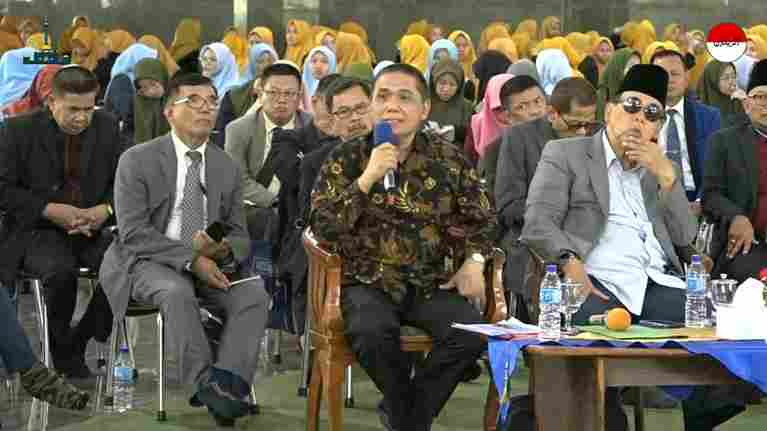
In its 30th session, held on Sunday, December 28, 2025, Mahad Al-Zaytun presented Prof. The speaker was Dr. Buyung Sarita, Professor of Economics and Business at Halu Oleo University in Kendari, Southeast Sulawesi. In his presentation, Prof. Buyung emphasized that education and economic growth are two sides of the same coin.
With the title “Equality in Education and Economic Growth,” Prof. Buyung explained that educational inequality will lead to economic inequality. Regions lagging behind in education will struggle to catch up, while regions with advanced education will continue to accelerate. Therefore, equitable distribution and quality of education are key to ensuring economic growth is enjoyed fairly by all levels of society.
Boarding School Education and the Formation of National Character
According to Prof. Buyung, boarding school education has a significant advantage because the learning process takes place holistically. Students learn not only in the classroom but also through daily life, instilling discipline, responsibility, and a work ethic. These values are the main capital in developing superior human resources.
He believes that this educational model is relevant for preparing the generation of Indonesia Emas 2045, a generation that is not only intelligent but also possesses integrity and is ready to face global challenges.
Learning from Developed Countries: Education as a Primary Investment
Prof. Buyung also touched on the experiences of various developed countries that have successfully driven economic growth through serious investment in the education sector. Equitable education has been proven to produce a productive workforce, strengthen the middle class, and create social and economic stability.
Indonesia, he argued, has a significant opportunity to achieve high economic growth if it has the courage to make education a top priority for national development, not merely a supplementary sector.
Ethical Values and a Just Economy
Interestingly, Prof. Buyung linked this discussion to the Islamicity Economic Index, which shows that countries with high levels of prosperity often implement the values of honesty, justice, and good governance. These values align with Islamic moral and ethical principles.
The message is clear: equitable economic growth is impossible without a strong foundation of values and ethics. Education plays a central role in instilling these values from an early age.
L-STEAMS: Managing Education and Finance Sustainably
In the context of education management, Prof. Buyung introduced the L-STEAMS approach (Law, Science, Technology, Engineering, Art, Mathematics, and Spirituality). This approach is used to build a comprehensive and sustainable education system, including financial management.
He believes that education finance should not be understood solely as a budgetary matter. It must be managed transparently, data-driven, utilizing technology, designed with a well-organized system, and grounded in creativity and accurate calculations. Most importantly, the entire process must be grounded in honesty and trustworthiness.
Through this approach, education finance not only supports the institution’s operations but also serves as a means of character development for students.
Education as a Path to Social Justice
The teacher training at Mahad Al-Zaytun affirms that education is the starting point for major change. Educational equality paves the way for equitable and sustainable economic growth. From these boarding school spaces, the hope of fostering an intelligent, character-based, and just generation of Indonesians continues to grow, leading to a Golden Indonesia 2045.**
Indonesia, December 29, 2025
——-