LK.Ara, Gayo Literary Master of the ‘Voices of the Mountain Children’
JAKARTA – LK.Ara’s poetry anthology, “Didong and the Guel Dance from Gayo Aceh,” is not an academic reference, but a philosophical work written in poetic form.
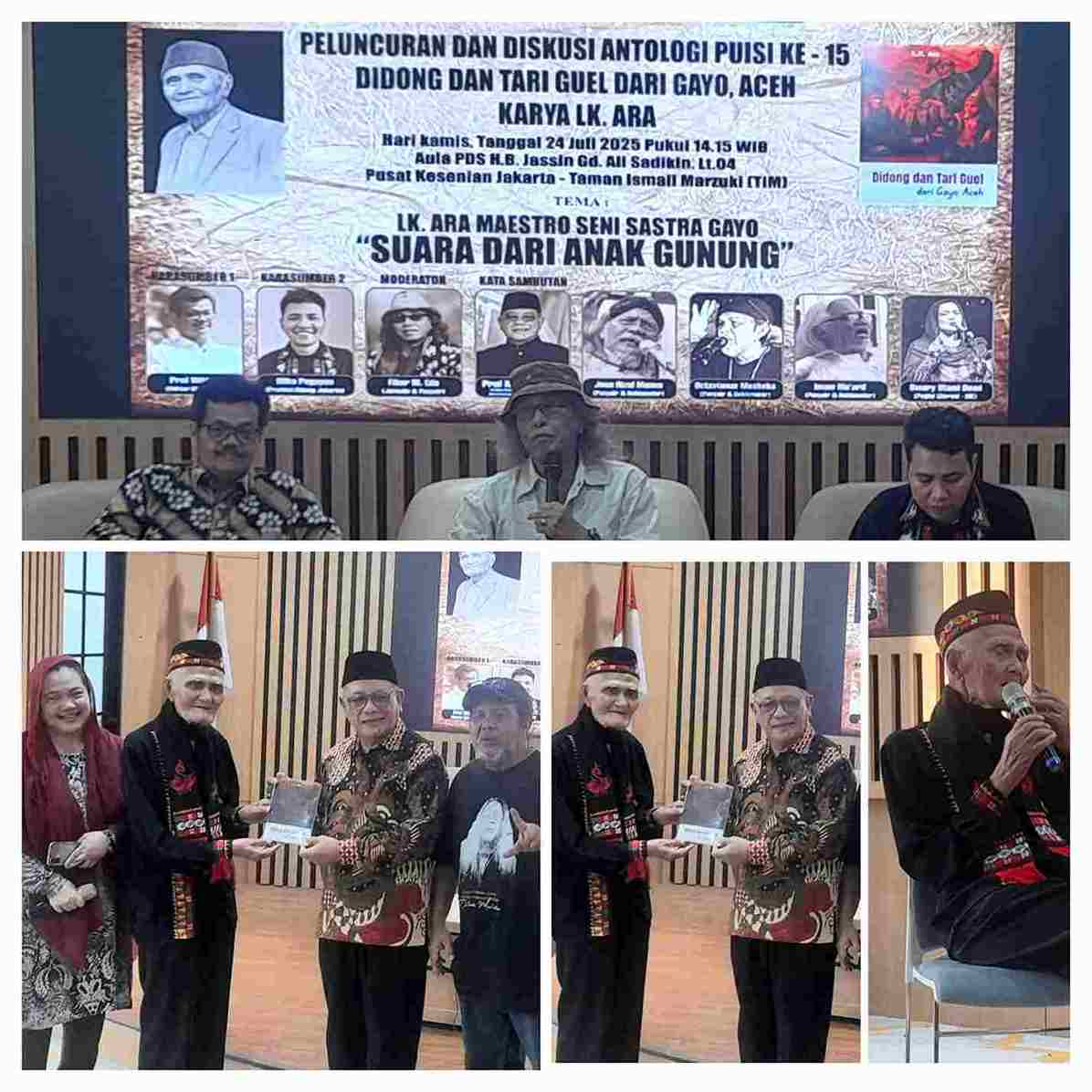
“As I said at the beginning of the discussion, why did the scholars of the past also express their feelings through poetry? Apparently, this is the secret, because the highest language exists in poetry,” said moderator Fikar W. Eda (Journalist and Poet), along with resource persons Prof. Dr. Wildan, M.Pd. (Rector of ISBI Aceh), and Miko Pegayon (Didong Practitioner Jakarta), with MC Swary Utami Dewi.
He made this statement at the closing ceremony for the launch and discussion of the 15th poetry anthology, “Didong and the Guel Dance from Gayo Aceh” by LK.Ara, with the theme “LK.Ara, Maestro of Gayo Literary Art” (Voices from the Children of the Mountains) at the HB. Jassin Literary Documentation Center (PDS) Hall, 4th Floor of the Panjang Ali Sadikin Building, at the Jakarta Arts Center (PKJ) Taman Ismail Marzuki (TIM) in Jakarta, Thursday afternoon (July 24, 2025).
“As Prof. Wildan said earlier, all the sentences in the poems in this book are full of metaphors that we can enjoy from the heart,” said Fikar W. Eda, adding that this book is a limited edition (50 copies), and hopefully, the print run will continue to grow and expand.
Meanwhile, Moctavianus Masheka, Bung Octa, Chairman of the Indonesian Literary Inspiration Park (TISI), the event’s organizer, stated that LK.Ara is a poet spanning three eras (the Old Order, the New Order, and the Reformation).
This Gayo poet has long lived in Jakarta, but in his old age returned to his hometown of Gayo, Aceh.
LK.Ara deserves to be considered a maestro of Gayo literary art, remaining a prolific writer at the age of 88.
“From the discussion, it was clear that the substance, ‘spirit,’ or philosophy of Gayoism is present in LK.Ara’s poetry. Studying his poems means studying metaphors from the Gayo region. This is very interesting,” said Bung Octa, who is also a poet and writer.
He added that TISI is a “home” for writers—especially from outside the region—to promote their works at literary book launches and discussions.
“TiSi has previously hosted the launch and discussion of poetry anthologies by Syarifuddin Arifin, a poet from Padang, West Sumatra, Ewith Bahar, a poet from Jakarta, and Endut Akudiat, a poet from Padang, West Sumatra. This is the fourth time TISi is hosting a discussion and launch of a poetry anthology by LK.Ara,” he explained.
Lighting a Nearly Extinguished Flame
In his opening remarks at the launch of the 396-page book “Didong and the Guel Dance from Gayo Aceh,” published by Yayasan Mata Air Jernih, with the first edition scheduled for July 2025, author LK.Ara stated that he wrote this book not only to commemorate, but also to rekindle a nearly extinguished flame.
“In it, readers will find history, cultural interpretations, and portraits of the masters who have dedicated their lives to preserving the sounds and movements of the Gayo highlands,” he said.
What’s special about this book is that it also serves as part of the journey of the Didong and Guel Dance maestros who performed on the national stage at the “Panggung Para Maestro” event at the Jakarta National Museum on July 11-12, 2025.
“This rare moment, when the voices of the Gayo village echo in the heart of the capital, bears witness to the fact that tradition is not a burden, but a glory. I dedicate this book to young people who question their roots, to dancers and poets who want to trace their roots, and to anyone who believes that traditional arts are not a monetary inheritance, but a compass for returning home. Hopefully, this book will be a clear introduction to understanding that culture is not just what we inherit, but what we maintain and keep alive,” he said.
LK. Ara was born in Takengon, Aceh, on November 12, 1937. He served as the cultural editor of the daily Mimbar Umum (Medan), an employee of the State Secretariat, and finally worked at Balai Pustaka until his retirement (1963-1985). He introduced the traditional Gayo poet To’et, performing in major cities across Indonesia. In 2019, LK. Ara, whose work has been published in 63 books—in 1969, he published his first poetry anthology—received the Didong Gayo Traditional Arts Maestro Cultural Award from the Indonesian government.
Prof. Dr. Wildan, M.Pd. (Rector of ISBI Aceh) on the occasion stated that LK. Ara had stitched together the fragments of history, meaning, and values into a cohesive work that would be useful for the younger generation, artists, and academics.
More than that, this book is a form of resistance against oblivion.
“Traditional art doesn’t live behind museums or large stages, but rather within the breath of humans who still faithfully call out the names of their ancestors,” he said.
He further mentioned this book by LK Ara—a poet, cultural figure, and son of the Gayo people—who has He dedicated his life to keeping the flame of tradition from fading—not just documentation, but the long-standing breath of an artistic civilization that has long stood strong in the highlands.
“In it, we find love for our hometown, in the ancient poetry that pulsates in the body of Didong, and in the sacred dance of the Guel Dance, which symbolizes glory. As the Rector of the Indonesian Institute of Arts and Culture (ISBI) Aceh, I consider this book to be very important as teaching material, a scientific reference, and as a space for cultural appreciation,” he concluded.
The event also included poetry readings from the book “Didong and the Guel Dance from Gayo, Aceh” by LK. Ara. Among the attendees were Prof. Rahmat Salam, Chair of the Aceh Leuser Antara Province Organizing Committee (KP3ALA), who performed a poem titled “ALA: Suara Yang Tak Boleh Padam” (A Voice That Cannot Be Extinguished).
Rahmat Salam admitted to receiving the poem from LK. Ara via WhatsApp shortly after performing his tahajjud prayer.
“I read it over and over again; I cried reading it,” Rahmat Salam recounted.
Then, there were poetry readings by entomusicologists Endo Suanda, Moctavianus Masheka, Swary Utami Dewi, Jose Rizal Manua, and many more.
The event was also attended by a number of artists, poets, writers, and cultural figures, including Nanang R Supriyatin, Pulo Lasman Simanjuntak, Putra Gara, Giyanto Subagio, and Wig SM. (***)
Contributor: Lasman Simanjuntak
—