Down-to-Earth Spirituality
By Abdul Karim_
“Man’s world is imperfectly programmed by his own constitution. It is an open world… it must be fashioned by man’s own activity.”
— Peter L. Berger, The Sacred Canopy
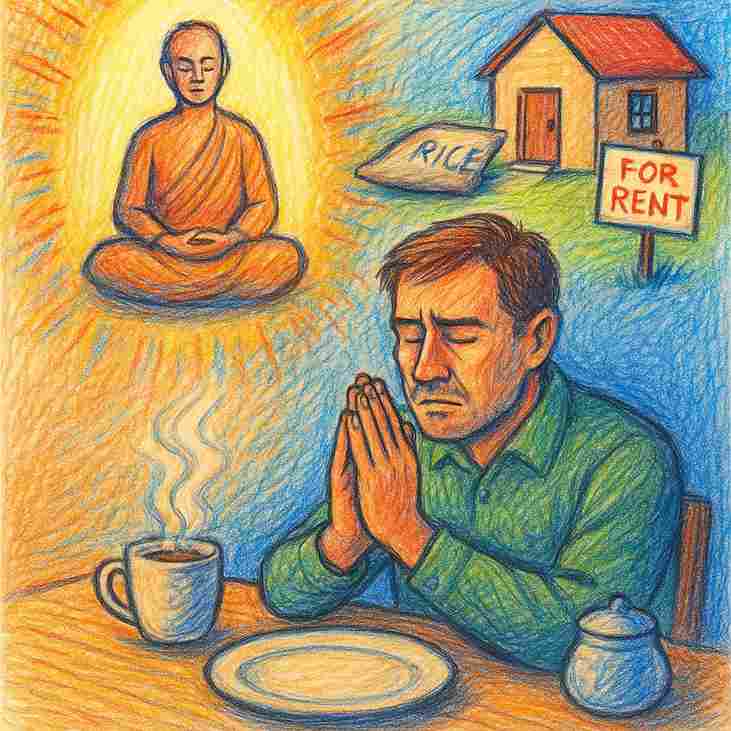
In honest and naked spiritual contemplation, we often fall into the illusion that the further we deny worldly reality, the higher we climb the spiritual ladder. Jacob Ereste, in his writing, “Spiritual Practice Must Not Ignore Financial or Material Matters,” clearly and bitterly criticizes one of humanity’s long-standing ills: being too engrossed in spiritual abstractions, ignoring that the earth still turns, bills still come, and stomachs can still get hungry.
He highlights an irony: that spiritual practice, which should be liberating, sometimes traps us in escapism. In their eagerness to reach an “advanced level,” humans have overlooked a simple but essential “elementary achievement”: how to find peace in an empty kitchen, not through denial, but with the full awareness that poverty is not mystical, and hunger is not a test to be approached with fatalism. Ereste presents a panorama full of irony, where fasting is considered proof of spirituality, when in fact it may simply mask the reality that there is no food.
Spirituality, according to Ereste, develops in layers: from elementary to intermediate, then advanced, to the unofficial title of grandmaster. However, this level, he emphasized, is not like formal education or martial arts certification. It is wild, fluid, and cannot be measured with human meters. But isn’t that precisely the problem? When spirituality lacks a mechanism for self-criticism, it is vulnerable to the tyranny of oppressive silence: a person can feel “high” spiritually while turning their back on social reality. In the words of Peter L. Berger, “religion is a human product, yet it acts back upon its producers.” This means that spirituality is a social construct, but it also influences social consciousness itself.
Berger, in The Sacred Canopy, shows that humans construct the world through externalization, objectification, and then re-internalization. Therefore, if someone lives in a spiritual world that ignores materiality, that world is what they will internalize. They no longer see poverty as a structure, but as divine will. They no longer understand hunger as a failure of the food system or economic justice, but as part of an inner practice. In such conditions, spirituality is no longer a tool for liberation, but a tool for taming.
What Berger describes as world-maintenance—the effort to maintain the stability of the social world through legitimacy and symbols—can be seen in the spiritual practices described by Ereste. When spirituality is deemed sufficient to soothe the mind amidst the scarcity of rice, the unjust world is no longer challenged. It is forgiven. Even further, it is deified. Inequality becomes part of the spiritual narrative. Injustice is polished into a lesson in patience.
This is what, in the eyes of R.H. Tawney’s work explores one of the historical tragedies of the relationship between religion and capitalism. In Religion and the Rise of Capitalism, Tawney explores how religious moral teachings began to erode as economics took center stage. Yet, at the same time, groups emerged that sought to revive individual piety without addressing the social and economic roots of suffering. Tawney notes that precisely in such phases, religion often degenerates into a private sphere, devoid of social responsibility.
Jacob Ereste is not condemning spiritual practice. He is instead calling for it to re-ground itself. He views inner peace as a noble achievement, but reminds us that healthy spirituality should not negate unpaid cigarettes, unmade coffee, or unpaid rent. Peace does not mean a numbness of mind toward reality. For if spiritual practice makes one indifferent to the hunger of one’s children or the suffering of one’s neighbors, then it is not depth that is achieved, but rather a cult of alienation.
When one believes that “all will be well as long as the earth turns,” as Ereste wrote, this can be comforting. But it can also be a denial. Peter Berger argues that in the process of secularization, religion can lose its “plausibility structure” when it no longer addresses the realities of life. When religion or spirituality only provides inner peace without social engagement, it loses its legitimacy. People may continue to pray, but they lose their reason to listen.
Tawney clearly states that economic and social issues are not merely secular matters. He writes that market practices, ownership, and wealth accumulation “must justify themselves at the be “The art of religion.” In other words, true spirituality is not one that distances itself from the world, but one that judges it, questions inequality, rejects exploitation, and addresses the oppressed with compassion, not just consolation.
Jacob Ereste is showing the face of a spirituality that has begun to forget that this world exists. He reminds us that one may be devout in the practice of dhikr, but one must not forget that one’s neighbor might not have eaten rice for three days. He writes in simple, even humorous language, yet he conceals deep social wounds. Behind the narrative of someone who remains fresh even without coffee lies a call: be aware, don’t silence suffering with mystification.
In a world where many people mistakenly interpret serenity as spiritual achievement, Ereste’s writing is a slap in the face. He reminds us that true spirituality is not about freezing in the face of hardship, but about continuing to walk, continuing to stir coffee, continuing to search for rice, while continuing to pray. Not to forget, but to remember more deeply.
For the spiritual is not one who runs away from the world, but who is fully present, with all the wounds and love that he or she has. Hug.**
Banten, July 11, 2025.
—
Bibliography:
Berger, Peter L. The Sacred Canopy: Elements of a Sociological Theory of Religion. Open Road Media, 2011.
Tawney, R.H. Religion and the Rise of Capitalism. Pelican Books, 1948.
Ereste, Jacob. “Spiritual Practice Must Not Ignore Financial or Material Matters.”
—